
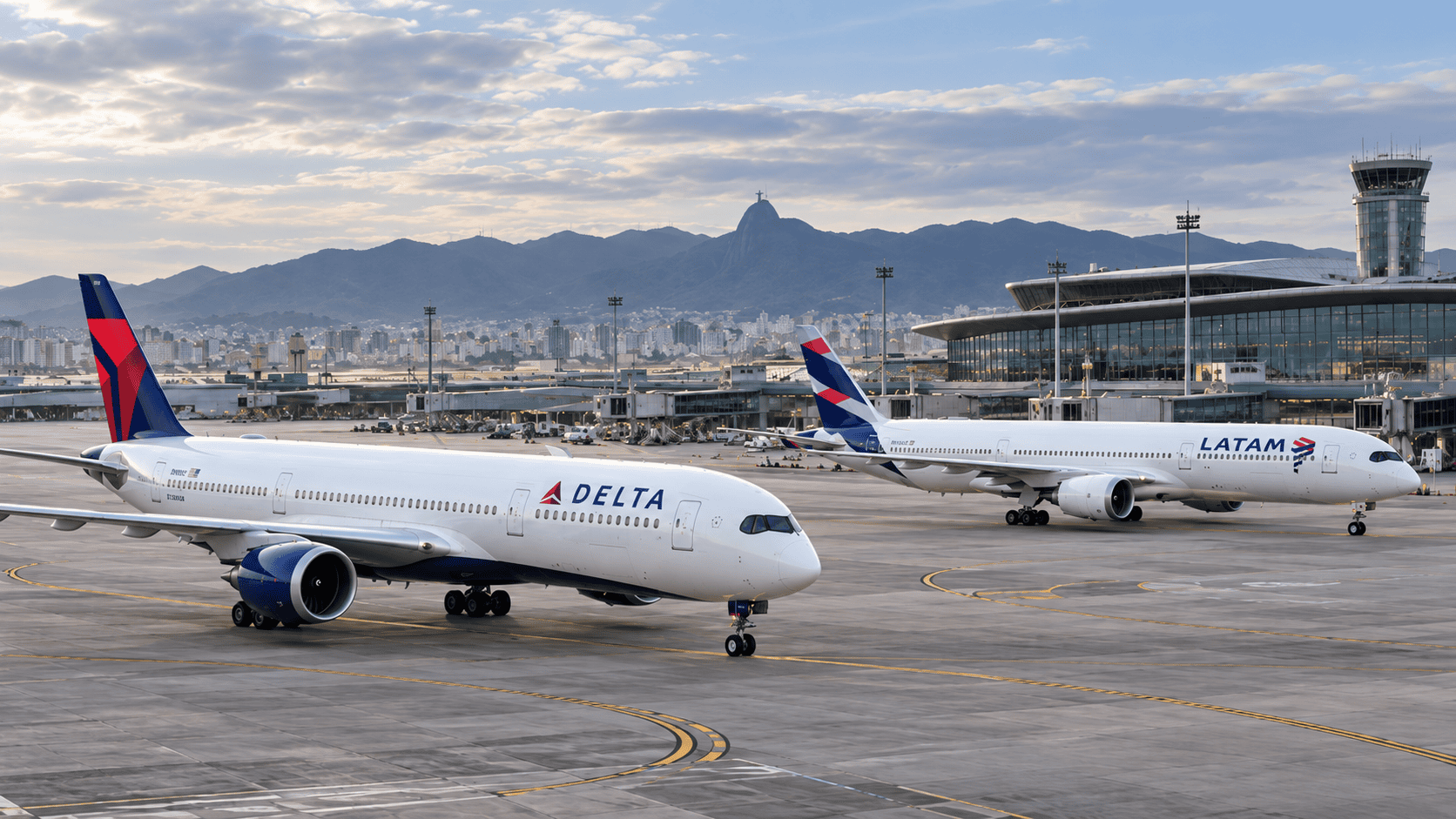
Four years after launching their Joint Venture, Delta Air Lines and LATAM Airlines have carried 17.4 million passengers across their combined network. With capacity now 31% above 2023 levels, the partnership is increasingly shaping north–south air connectivity across the Americas.
Delta Air Lines and LATAM Airlines are marking four years of their Joint Venture with a network that now spans 28 routes between North and South America. Between October 2022 and July 2026, the two airlines operated 83,000 flights, offered 20.8 million seats and carried 17.4 million passengers across the markets covered by the agreement.
The scale reached by the partnership is significant, but the more revealing figure is its recent growth. Combined capacity in 2026 is approximately 31% higher than in 2023, pointing to an increasingly extensive network between Delta’s North American footprint and LATAM’s presence across South America.
28 routes build a broader north–south network
The Joint Venture currently covers the United States and Canada in North America and Argentina, Brazil, Chile, Colombia, Ecuador, Paraguay, Peru and Uruguay in South America.
Its 28-route network includes connections such as São Paulo–Los Angeles, Bogotá–Orlando, Guayaquil–New York, Buenos Aires–Miami, Atlanta–Cartagena, Rio de Janeiro–New York/JFK and Lima–Salt Lake City.
These routes illustrate an important part of the partnership’s development. Connectivity is not limited to traditional gateways between the United States and South America. The addition of markets such as Cartagena, Orlando and Salt Lake City expands the range of entry and connection points available on both sides of the network.
That matters because the two airlines bring different geographical strengths to the agreement. LATAM provides access to a broad South American network, while Delta connects those flows with its operations across the United States and Canada.
The result is a system in which the value of an individual international route extends beyond its origin and destination, as connecting traffic can continue through the respective domestic and regional networks.
Ecuador leads capacity growth
Growth, however, has not been evenly distributed across the markets covered by the agreement.
Ecuador recorded the strongest increase, with combined capacity up 64% in 2026 compared with 2023. Brazil followed with growth of nearly 33%, while Peru increased by 25%. Colombia and Chile each recorded growth of approximately 10% over the same period.
The differences are noteworthy. They show that the overall 31% increase is being driven by very different market dynamics rather than a uniform expansion across the continent.
Brazil remains particularly important given the size of its aviation market and the role of São Paulo as one of LATAM’s main international gateways. Ecuador, meanwhile, stands out for the pace at which capacity has expanded within the partnership.
Argentina provides a more recent example of that expansion strategy.
The country joined the Joint Venture in 2025, extending the agreement into another major South American market. Combined capacity involving Argentina is already nearly 47% higher in 2026 than in 2025, according to the airlines.
Integration increasingly extends beyond the flight itself
The partnership has also developed beyond route planning and seat capacity.
Members of Delta SkyMiles and LATAM Pass can earn miles or points when travelling with either airline and access reciprocal benefits depending on their status. Eligible passengers can also receive priority check-in and boarding, seat selection and baggage benefits.
Operational integration is visible at several major gateways. Delta and LATAM use shared terminals at airports including São Paulo/Guarulhos, Santiago and New York/JFK, while digital baggage tracking has also been integrated into the passenger journey.
For a partnership built around connecting two large regional networks, these elements are more than additional passenger benefits. Easier transfers, baggage visibility and aligned airport processes become increasingly important as the proportion of passengers connecting between the two carriers grows.
Ramiro Alfonsin, Chief Commercial Officer of LATAM Airlines Group, described the underlying logic of the partnership:
“The Joint Venture has enabled us to offer customers access to more destinations and stronger connectivity by bringing together two highly complementary networks.”
LATAM says the share of passengers who would recommend travelling with the two airlines has increased by 50% since the partnership began.
Cooperation moves into aircraft maintenance
The relationship between the two groups is also expanding outside the passenger business.
In April 2026, Delta TechOps and LATAM Airlines Brasil announced an agreement covering maintenance and repair services for Airbus A320-family components.
Under the arrangement, selected repair work is supported by LATAM’s maintenance, repair and overhaul facility in São Carlos, Brazil, while Delta TechOps serves as the commercial interface for the initial portfolio of services. The cooperation is intended to support Delta aircraft as well as third-party airline customers.
The MRO agreement is separate from the Joint Venture, but it shows how the relationship between Delta and LATAM is developing beyond network coordination into technical and industrial activities.
From partnership to network architecture
Four years into the Joint Venture, the most important development is therefore not simply the number of passengers carried.
The combination of 28 routes, 20.8 million seats and a 31% increase in capacity since 2023 shows how Delta and LATAM are progressively linking their respective networks into a larger north–south connectivity system.
Markets are developing at different speeds, and further expansion will depend on demand, route economics and the ability of both airlines to feed traffic through their respective hubs.
But the scale already reached by the agreement suggests that the Delta–LATAM partnership is becoming an increasingly significant component of air connectivity between North and South America.
FAQ
When did the Delta–LATAM Joint Venture begin?
The Joint Venture was launched in October 2022 to deepen cooperation between Delta Air Lines and LATAM Airlines on routes between North and South America.
How many passengers have Delta and LATAM carried through the partnership?
Between October 2022 and July 2026, the airlines carried 17.4 million passengers across the countries covered by the Joint Venture.
How many routes are included in the Delta–LATAM Joint Venture?
The combined network currently includes 28 routes connecting cities across North and South America.
How much has Delta–LATAM capacity increased?
Combined capacity in 2026 is approximately 31% higher than in 2023.
Which market has recorded the strongest capacity growth?
Among the markets detailed by Delta and LATAM, Ecuador recorded the strongest increase, with combined capacity rising 64% in 2026 compared with 2023.