
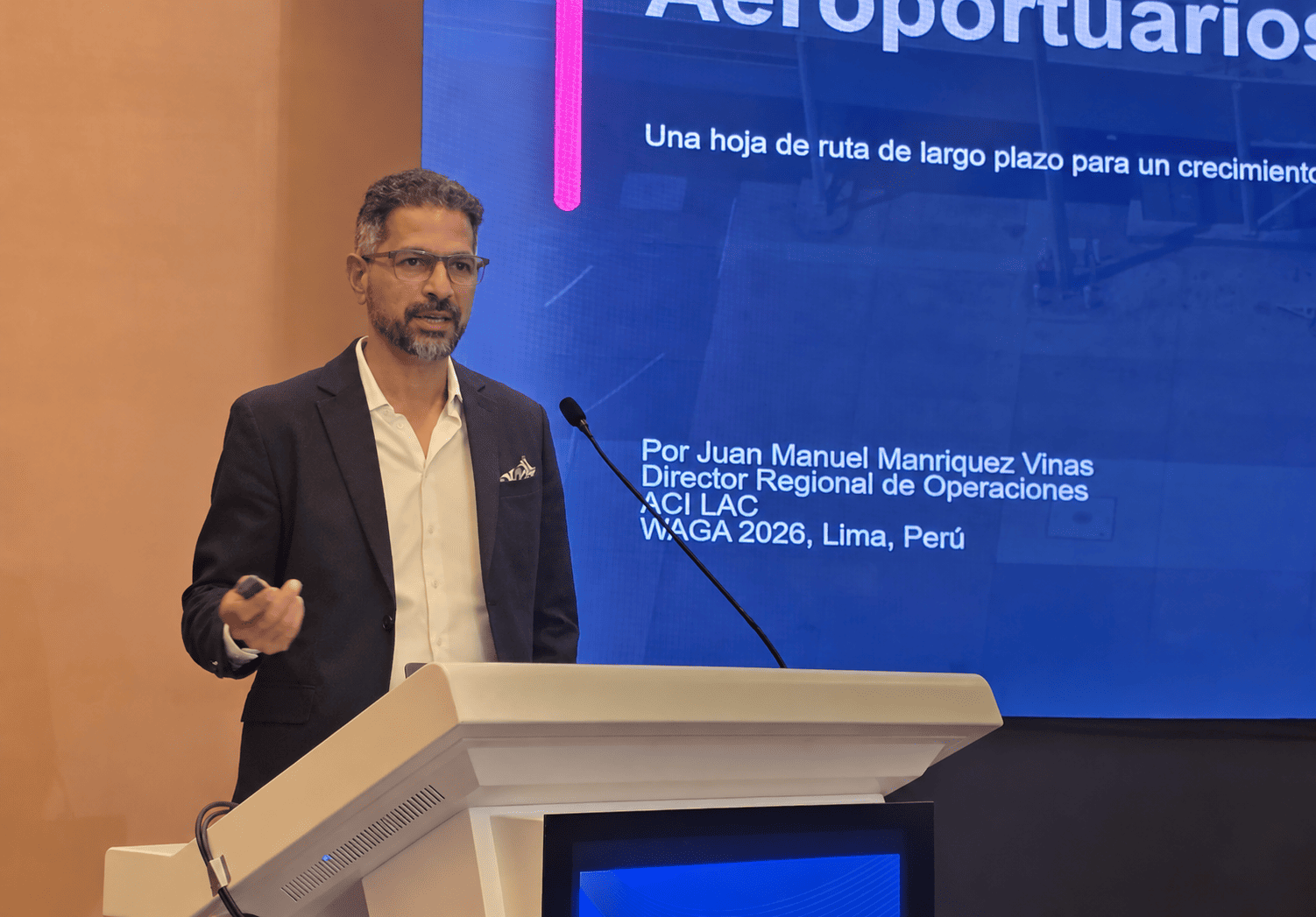
Speaking during a media workshop held in Lima ahead of the main WAGA 2026 conference sessions, Juan Manuel Manríquez, Regional Director of Airport Operations at ACI-LAC, outlined how airport master plans must coordinate future demand with airside capacity, land use, investment priorities and operational constraints.
Master plans provide a long-term roadmap
For Juan Manuel Manríquez, airport master planning starts with a simple question: what will an airport need to become as demand evolves?
During his presentation in Lima, Manríquez described the master plan as a framework that sets out an airport’s long-term development in phases. Traffic forecasts and operational requirements provide the starting point, but they must then be translated into a future configuration, infrastructure requirements and investment priorities.
The plan itself does not guarantee that every project will ultimately be built. Instead, it provides the logic and sequence needed to guide development as conditions change.
That distinction matters because airport decisions can have consequences extending decades into the future.
Planning amid uncertain forecasts and fixed constraints
One of the central challenges highlighted by Manríquez is that long-term decisions have to be made while many of the variables behind them remain uncertain.
Passenger behaviour can change, airline networks and fleet strategies evolve, and traffic forecasts can shift as external conditions develop. Airports, meanwhile, face constraints that are much harder to move, including available land, airspace, safety requirements and environmental conditions.
The planning challenge is therefore not simply to forecast more passengers and build more infrastructure. Airports must determine how much capacity is actually required, when it will be needed and which constraints could prevent that capacity from being used efficiently.
Juan Manuel Manríquez pointed to peak-hour activity as one of the practical inputs used to dimension infrastructure. Forecast demand has to be compared with the actual capacity of runways and other airport systems before development decisions are made.
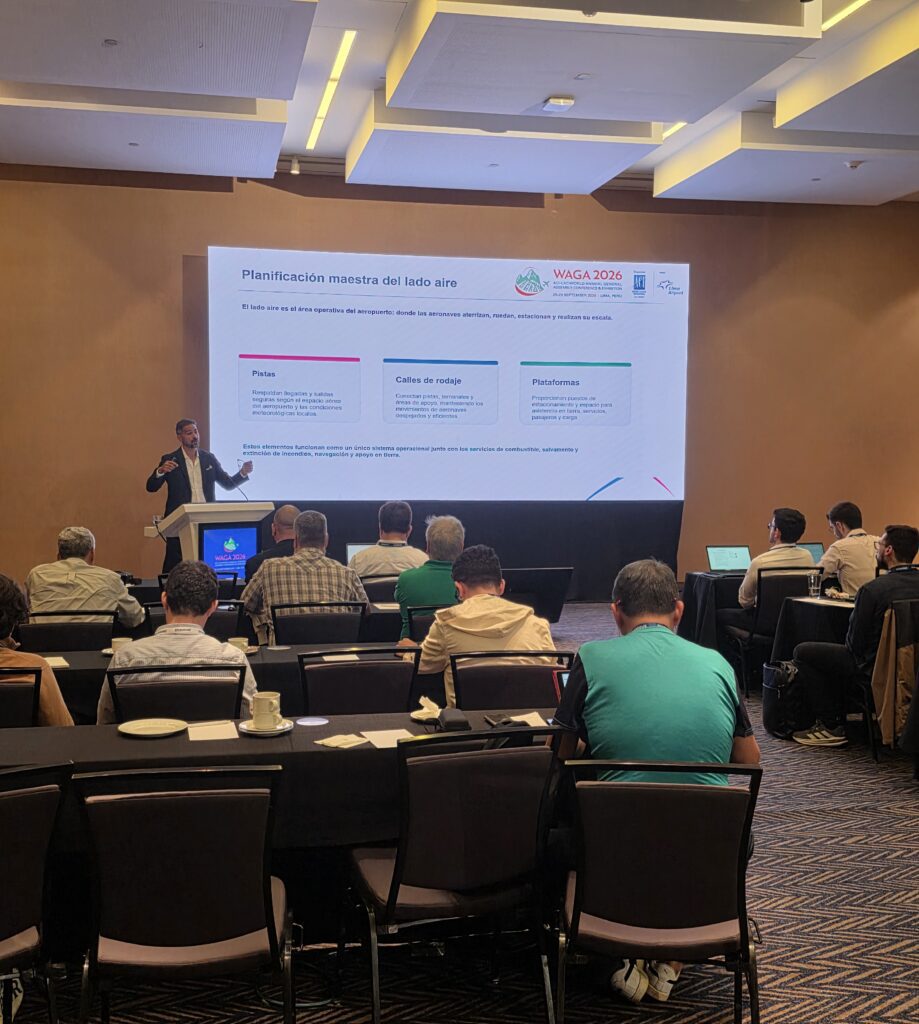
Airside capacity has to work as one system
The airside was a major focus of the presentation.
Runways support arrivals and departures, taxiways connect aircraft movements across the airport, and aprons provide the space required for parking, ground handling, passengers and cargo. But Juan Manríquez stressed that these elements cannot be planned independently.
A runway may theoretically be able to handle more aircraft movements, but that additional capacity creates little value if the apron cannot accommodate the same volume. The same applies to taxiways and other operational systems.
Airport master planning is therefore intended to harmonise these different components so that the airside works as one operating system rather than as a collection of separate infrastructure projects.
The same principle applies beyond the airport boundary. Manríquez noted that new infrastructure can remain underused if the surrounding airspace does not have the capacity to support the additional aircraft movements expected from it.
Land must be protected before expansion is needed
Master planning also has a land-use function.
An airport may identify the need for a second runway or another major facility decades before construction becomes necessary. If the surrounding land is not protected, urban development or incompatible buildings can eventually remove that option.
Juan Manuel Manríquez used this long horizon to illustrate why airport planning cannot begin only when capacity is already exhausted. Land required for future infrastructure may need to be safeguarded 20 or 30 years in advance, along with the areas affected by operational and safety requirements.
This also makes phasing critical. Airports must decide what needs investment immediately, what can wait until the medium term and which options should remain available for future technologies or changes in demand.
At the same time, construction has to take place without stopping existing airport operations. Increasing runway or taxiway capacity while aircraft continue to move safely through the airport is itself part of the planning challenge.
Investment must follow real demand
The presentation repeatedly linked infrastructure decisions to demand and financing.
Juan Manuel Manríquez cautioned against developing capacity in isolation from the wider system that will support it. Large airport projects require significant capital, meaning that the infrastructure being proposed must correspond to a credible operational need and a realistic financing framework.
That approach also extends to climate resilience. Climate change adaptation can form part of a master plan, but investment decisions should be based on an assessment of the actual risks facing the airport rather than on generic assumptions.
In practical terms, airport master planning becomes an exercise in prioritising, monitoring and preserving options as demand, technology and external conditions evolve.
For airports in Latin America and the Caribbean, the message from Lima was clear: long-term growth depends not only on building more infrastructure, but on ensuring that every part of the airport system is prepared to grow together.
FAQ
What is an airport master plan?
It is a long-term framework that links traffic forecasts and operational requirements with future airport configuration, infrastructure and phased investment priorities.
Why is airspace important to airport master planning?
New runways or terminal capacity may be underused if the surrounding airspace cannot accommodate the additional aircraft movements they are designed to generate.
Why do airports protect land decades in advance?
Land needed for future runways or facilities can be lost to incompatible development if it is not safeguarded before expansion becomes necessary.
How does climate resilience fit into a master plan?
Climate adaptation can be incorporated into long-term airport planning, with investment decisions tied to assessed risks and operational needs.