
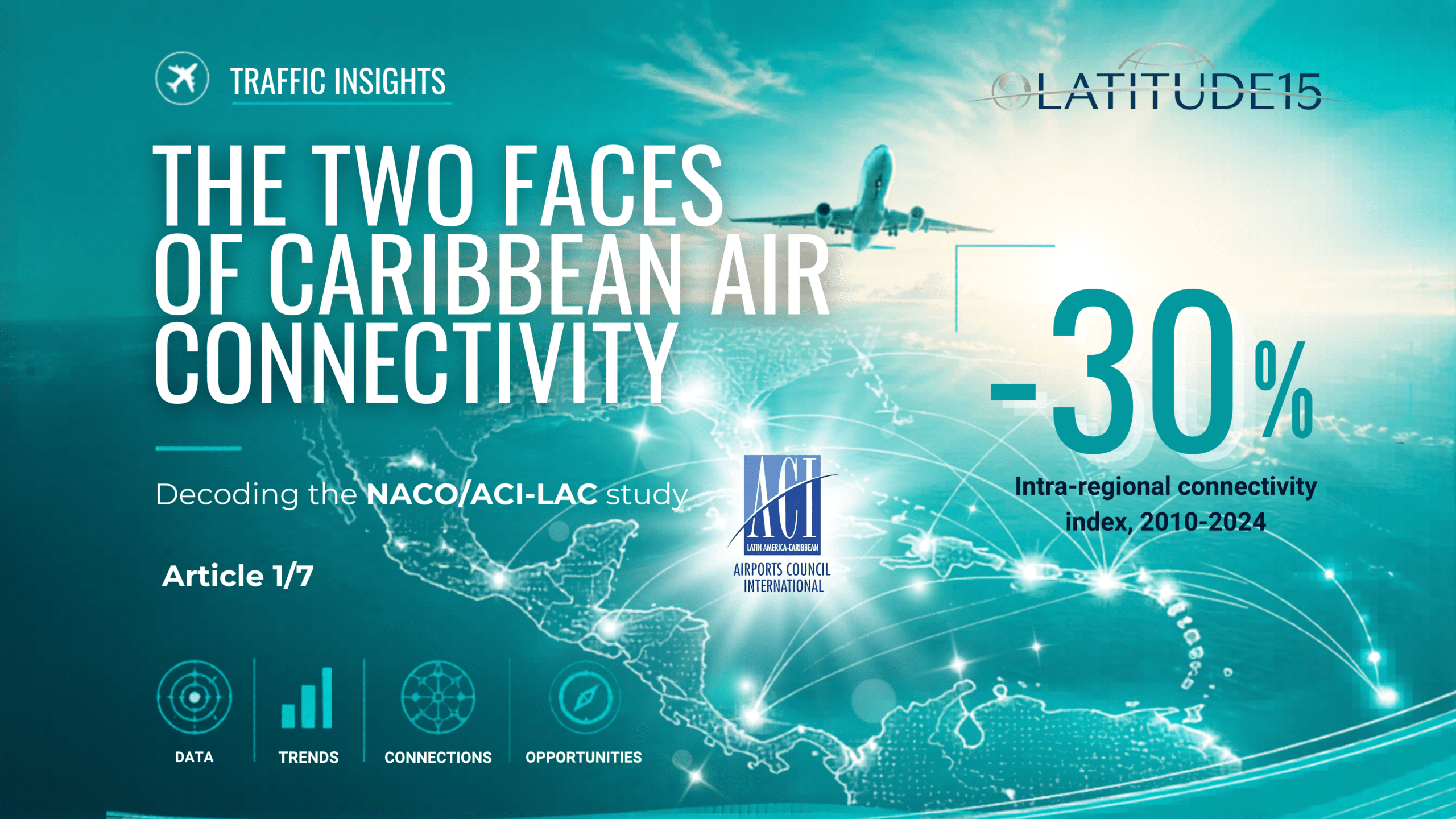
Between 2010 and 2024, extra-Caribbean air capacity nearly doubled, while intra-Caribbean capacity fell by close to 50%. An independent study commissioned by ACI-LAC to NACO and released in March 2026 reveals that the Caribbean is now one of the only regions in the world to have lost ground on intra-regional connectivity. A strategic paradox, decoded.
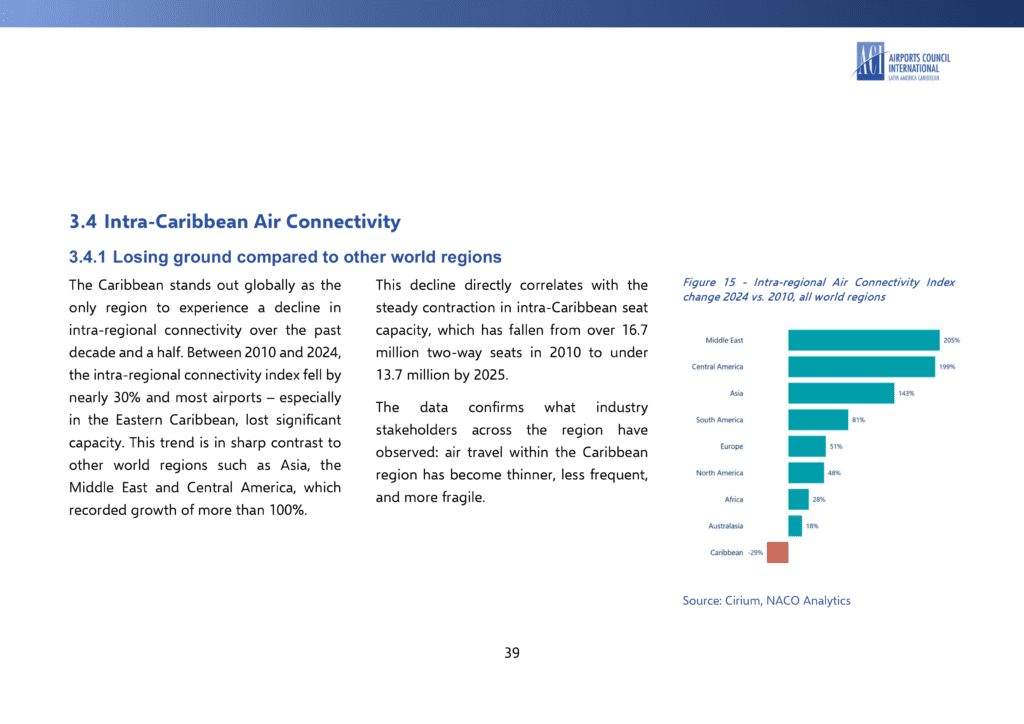
The figure is striking. According to The State of Air Connectivity in the Caribbean: A Renewed Vision for Progress, the independent study commissioned by Airports Council International – Latin America and the Caribbean (ACI-LAC) to Dutch consultancy NACO and published in March 2026, the region’s intra-regional connectivity index dropped by nearly 30% between 2010 and 2024. Over the same period, Asia-Pacific and the Middle East recorded growth of more than 100%. The Caribbean is not merely lagging: it is the only region in the world moving backwards.
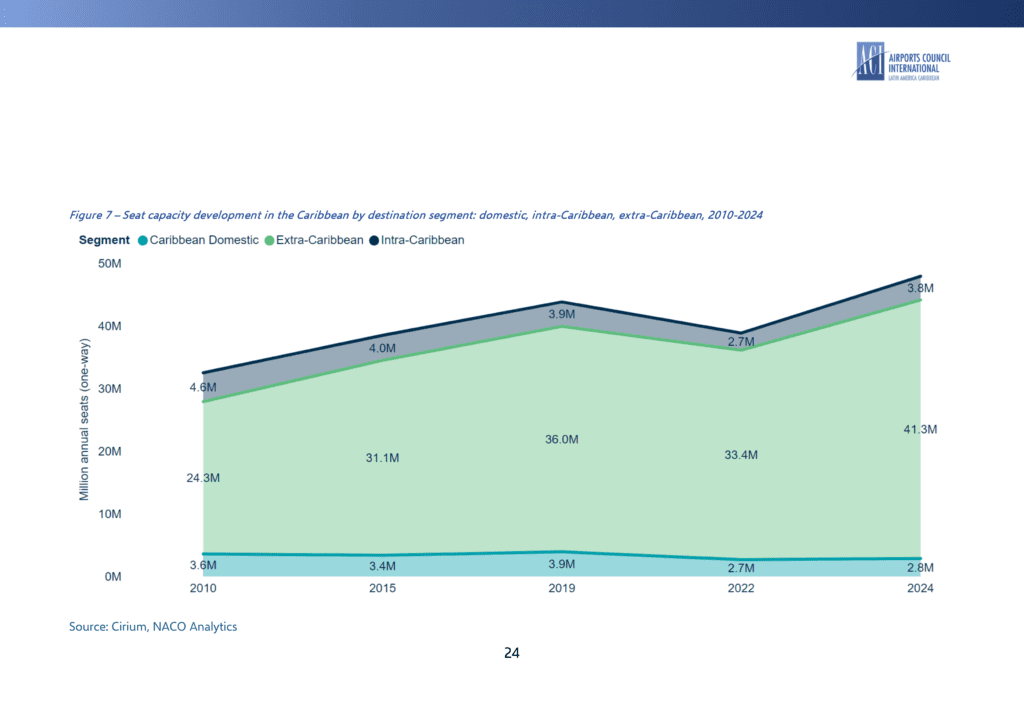
This regression conceals an apparently contradictory reality: the region’s overall global connectivity is expanding strongly. Between 2010 and 2024, the compound annual growth rate of Caribbean air capacity stood at +2.8%, driven almost entirely by the extra-Caribbean segment (+3.9% per year). In 2025, Caribbean airports collectively offered direct service to nearly 150 international destinations across 36 countries. Total capacity reached 82.6 million two-way seats, up from 48.6 million in 2010. The region has never been better connected to the rest of the world.
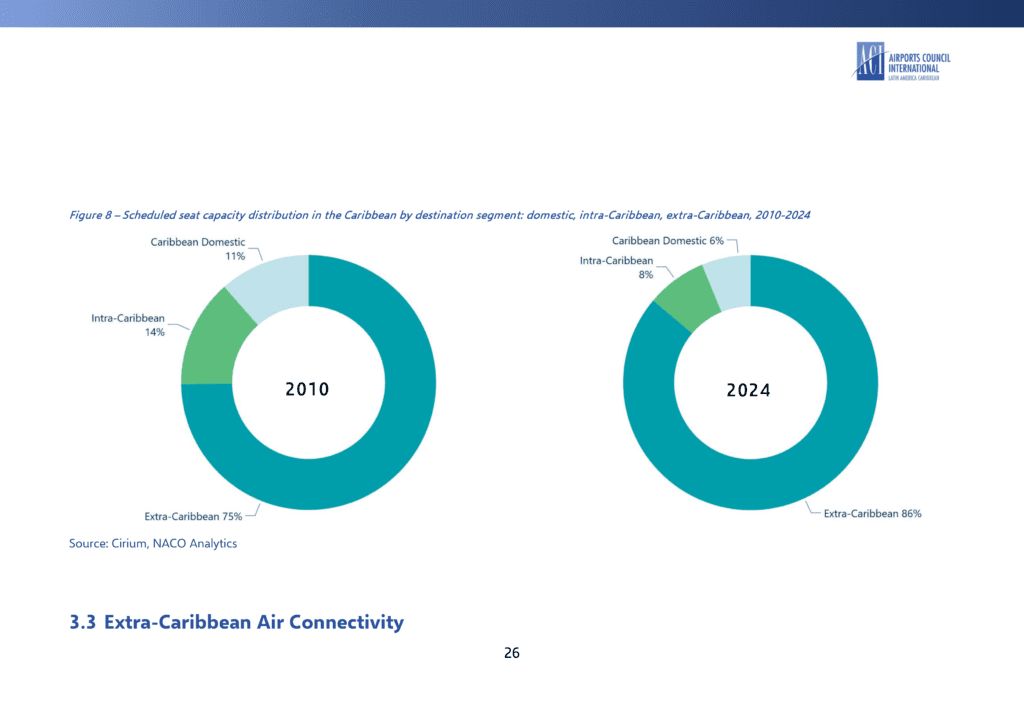
Yet this spectacular outward opening has been accompanied by a quiet internal collapse. The share of intra-Caribbean capacity in the regional total fell from 14% in 2010 to 8% in 2024. Combined with the domestic segment, it now represents less than 15% of total seat capacity, compared with 25% fifteen years earlier. In absolute terms, the number of intra-Caribbean city pairs served at least twice weekly dropped from 64 to 41 between 2005 and 2025, while extra-Caribbean pairs rose from 62 to 92. The direction of the shift is unambiguous.
NACO frames the central question in clear terms: the expansion of global connectivity has not translated into accessible, reliable, or affordable mobility on intra-regional routes. Put differently, the Caribbean has become an excellent receptacle for inbound international tourism, but a poor circulation space for its own residents and businesses. The economic benefits of aviation, measured by the Air Transport Action Group at up to 8.7% of total employment and 12.8% of GDP in small island states, remain captured by only one face of connectivity.
An asymmetry rooted in investment choices
Why this gap? The study offers a documented answer drawn from interviews with more than twenty senior Caribbean airport executives. North America accounts for over 50% of the region’s international visitors and was, in 2025, the largest extra-regional source market for 8 of the top 10 Caribbean countries by air capacity. Airport resources, political attention and commercial efforts naturally concentrate on this lucrative market, which directly supports local jobs and tax revenue. Intra-Caribbean connectivity, as one interviewed executive summed it up, is treated as a “nice to have” rather than a strategic commercial priority.
This logic plays out in the head-to-head competition between Caribbean tourism hubs for the same North American flow. According to NACO’s analysis, Montego Bay and Aruba share roughly 85% of their extra-Caribbean route network. Punta Cana and Montego Bay share 83%. Nassau and Bridgetown 85%. The region’s airports compete on the same routes to New York, Miami, Toronto or Atlanta, rather than connecting to one another. The structural outcome is a dense, competitive extra-regional network and a thin, fragmented intra-regional one.
A fragility hidden behind aggregate figures
The asymmetry does not affect all territories equally. Economic gravity centres (Dominican Republic, Puerto Rico, Jamaica) and high-end leisure destinations (Bahamas, Aruba, Curaçao) concentrate the bulk of extra-regional connectivity, with seven or more weekly frequencies to their main markets. Conversely, smaller states such as Grenada, the British Virgin Islands or Saint Kitts and Nevis show very limited direct extra-regional connectivity, due to thinner catchment areas and more niche tourism offerings.
For these less connected markets, dependence on non-Caribbean hubs (Miami, Panama City) creates a structural vulnerability. A significant share of intra-regional traffic is in fact routed through Miami or Panama for lack of sufficient direct regional links. According to OAG data analysed by NACO, among the 14% of intra-Caribbean travellers who transit through a connection, roughly 35% do so via Miami and 6% via Panama. The region effectively outsources part of its own mobility.
What the study announces, and what comes next
NACO does not stop at diagnosis. The study calls for a paradigm shift in how the intra-Caribbean connectivity agenda is approached. Without targeted policy interventions to restore and strengthen intra-regional links, the consultancy writes, Caribbean air connectivity will remain durably asymmetric: robust for inbound international tourism, inadequate for the mobility of Caribbean people and businesses. The report puts forward five levers for progress, including a targeted bilateral approach rather than ambitious regional harmonisation, pragmatic regulatory convergence, and regional connectivity incentive schemes inspired by European, Australian and North American models.
The six remaining articles in this series will explore, one by one, the drivers of this widening gap: the degraded quality of existing links, the mismatch between travel costs and local income levels, the fragmentation of the airline market, airport competition for inbound traffic, the paradox of a liberalisation that exists only on paper, and finally the concrete levers for a renewed vision. The diagnosis is on the table. The conversation can begin.
Source : NACO (Netherlands Airport Consultants), The State of Air Connectivity in the Caribbean: A Renewed Vision for Progress, independent study commissioned by ACI-LAC, March 2026, 128 pages.