
As debates around overtourism continue to intensify across several global destinations, the cruise industry is increasingly facing questions about its social impact, its visibility within local economies and the way its presence is perceived by residents.
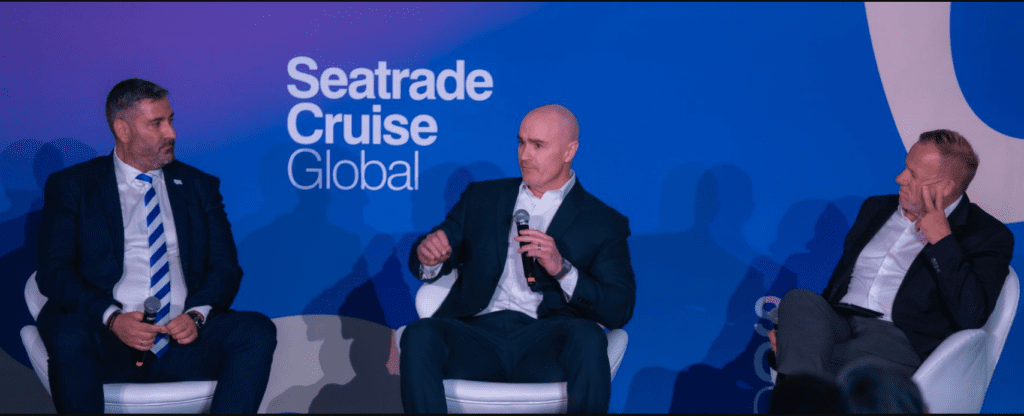
At Seatrade Cruise Global, the session “Welcome Ashore: Supporting Local Voices at the Heart of Cruise Tourism,” held on April 13 at the Sunset Vista Salon, explored how some destinations and local business owners are attempting to reshape that conversation.
Rather than focusing on infrastructure, passenger volumes or commercial performance, the discussion centered on something more intangible but increasingly strategic: narrative. Through the Welcome Ashore initiative, speakers from Alaska, Greece and the Bahamas argued that the voices of local communities benefiting from cruise tourism have often remained absent from public debate — and that this imbalance may be contributing to growing misconceptions around the sector.
From statistics to storytelling
A recurring theme throughout the session was the idea that economic figures alone are no longer sufficient to defend the role of cruise tourism within destinations.
According to several panelists, while the industry regularly highlights passenger numbers, spending and employment figures, these metrics often fail to capture how cruise activity supports everyday life within local communities.
Ian Dempster, founder of Sitka Nuts and Welcome Ashore Ambassador for Alaska, explained how this realization shaped the response to local initiatives seeking to restrict cruise tourism in Sitka. Rather than relying exclusively on statistics, community advocates shifted toward personal storytelling.
As Ian Dempster noted, “you don’t see the impact on the community unless we get out there and tell the stories.”
Those stories extended beyond tourism businesses themselves, highlighting how seasonal cruise revenues helped support school maintenance, community centers and nonprofit organizations in the region.
The discussion suggests that local storytelling is increasingly being viewed as a strategic communication tool — one aimed at humanizing the economic impact of cruise tourism.
Reframing cruise tourism at the community level
The Welcome Ashore initiative itself reflects a broader effort to reposition the industry’s relationship with local communities.
Presented as a “community-first movement,” the platform seeks to amplify the voices of residents, entrepreneurs and local stakeholders who directly depend on cruise tourism.
For Anastasios Konstantaros, Ambassador Greece and CEO at Rhodes Tourism Promotion Organization, this requires integrating a wide range of local actors into destination management discussions — from tour guides and bus drivers to restaurant owners and hoteliers.
His comments also reflected the growing complexity of balancing tourism growth with local quality of life, particularly in highly seasonal destinations such as Rhodes.
“It’s easy to get as many tourists as possible, but it’s hard to manage them afterwards,” he observed, warning that negative perceptions around overtourism often emerge from poor visitor management rather than tourism itself.
This perspective points to a broader challenge facing many cruise destinations: maintaining local support while continuing to grow tourism activity.
Local economies and the visibility challenge
Another major theme was the visibility — or invisibility — of cruise tourism’s contribution to local economies.
In Nassau, where tourism volumes are particularly high, Pepin Argamasilla, Managing Partner at John Watling’s Distillery, described how local businesses increasingly see themselves as part of a larger destination ecosystem rather than isolated attractions.
Rather than trying to retain visitors within a single venue, he emphasized the importance of encouraging exploration across the wider community.
“We all have one brand and it’s called the Bahamas,” he explained, highlighting the need to distribute visitors across cultural institutions, restaurants and independent businesses.
This approach suggests that destination competitiveness may increasingly depend on collaboration between local actors rather than competition for passenger spending.
At the same time, several speakers acknowledged that many of these local dynamics remain poorly understood outside destination communities themselves.
Cruise tourism and social acceptance
Beyond economic arguments, the session also revealed a growing awareness within the industry that cruise tourism’s future may depend heavily on social acceptance.
References to Barcelona, visitor congestion and negative media narratives underscored how quickly public perception can influence political and regulatory discussions around cruise activity.
In response, Welcome Ashore appears to position local ambassadors as a counterbalance to those narratives, encouraging residents and business owners to publicly articulate the benefits they associate with cruise tourism.
For Dempster, this requires visible and active participation from communities themselves. “Sometimes all it takes is one person to start a movement,” he said, describing the initiative as an opportunity for local voices to organize collectively around shared interests.
Yet the discussion also indirectly highlights a more delicate reality: the stronger the debate around overtourism becomes, the more important it may be for destinations to demonstrate that tourism growth remains aligned with local priorities and quality of life.
Reading the road ahead
The discussions around Welcome Ashore suggest that the cruise industry is entering a new phase in how it communicates its role within destinations.
While economic impact remains central, the conversation increasingly appears to be shifting toward visibility, perception and community legitimacy. In this context, local storytelling is emerging not simply as a marketing tool, but as part of a broader effort to strengthen social acceptance around cruise tourism.
For destinations, cruise operators and local businesses alike, this evolution may indicate that the future of cruise development will depend not only on attracting visitors, but also on ensuring that local communities continue to see value in welcoming them ashore.