
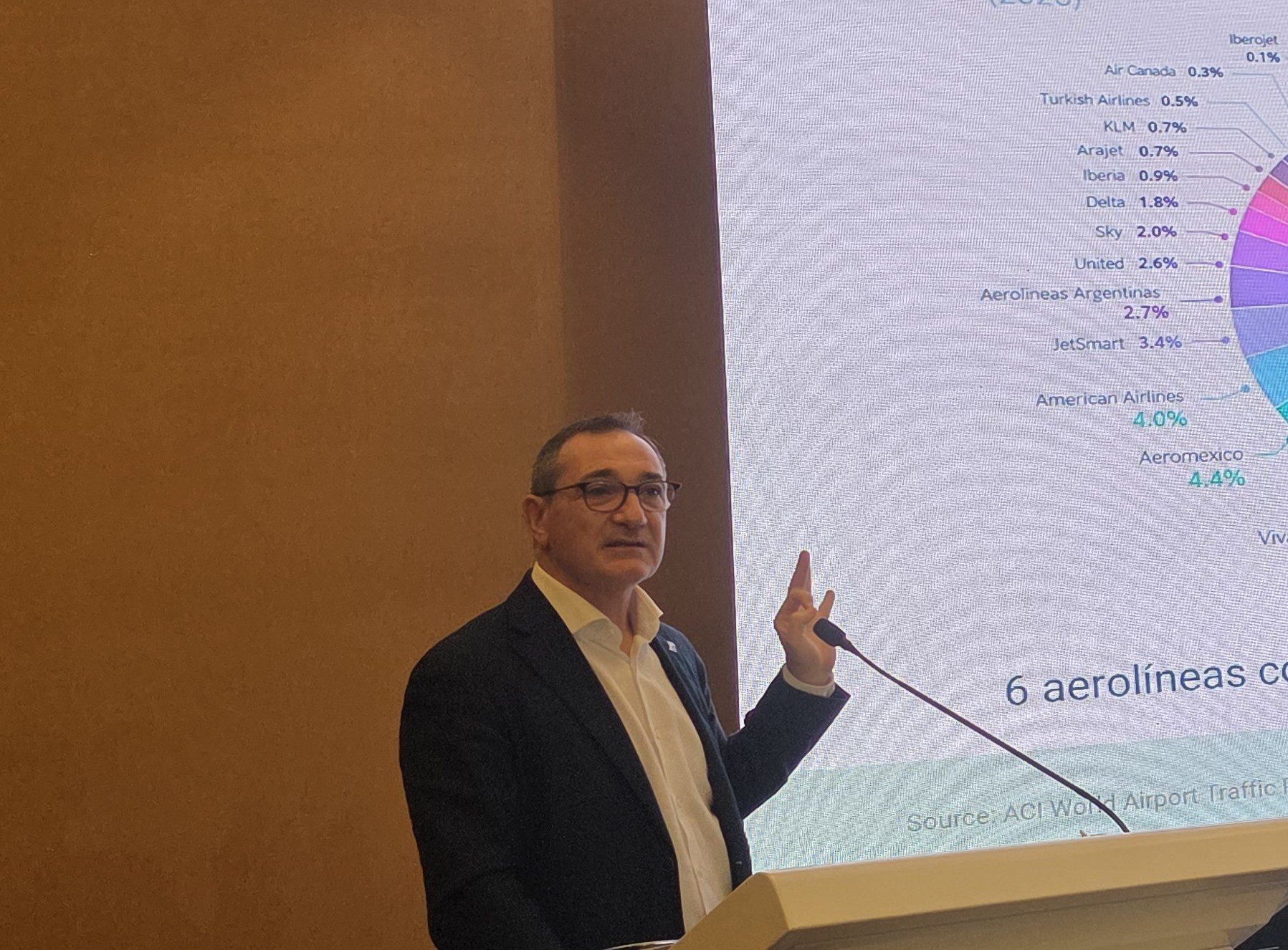
Latin America and the Caribbean recovered passenger traffic rapidly after the pandemic, but the breadth of the region’s air network has not followed the same trajectory. At WAGA 2026 in Lima, ACI-LAC Director General Rafael Echevarne highlighted a persistent connectivity gap and renewed calls for greater liberalisation of air transport markets.
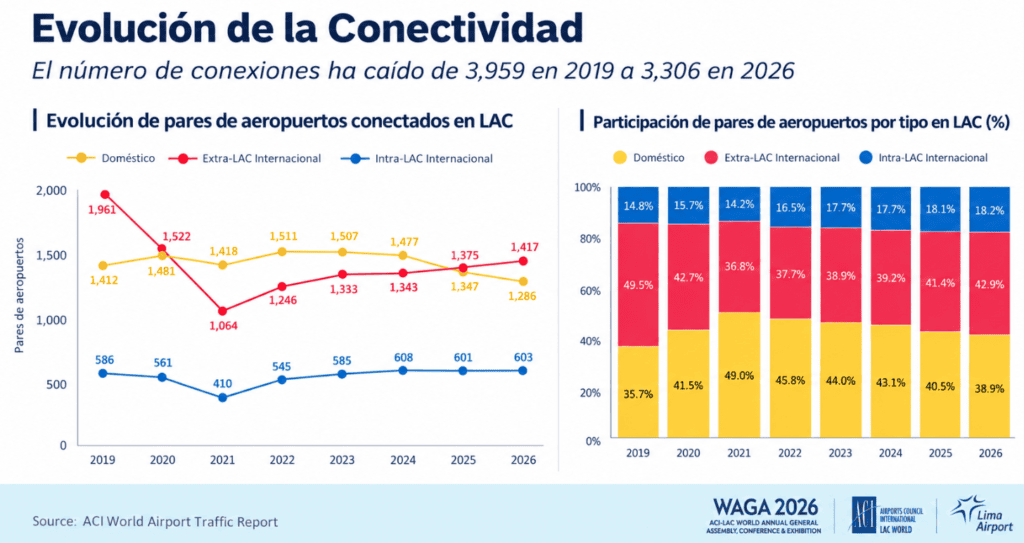
The number of airport pairs serving Latin America and the Caribbean fell from 3,959 in 2019 to 3,306 in 2026, according to figures presented by Rafael Echevarne during a media session in Lima on September 27.
That represents around 653 fewer connections, or a decline of approximately 16.5% compared with the pre-pandemic network.
For Dr. Rafael Echevarne, the figures expose an important distinction between traffic recovery and connectivity recovery. The connectivity issue forms part of the broader growth challenges facing LAC airports, alongside airport economics and long-term infrastructure needs.
“We are below the levels we had in 2019.”
He noted that while Latin America recovered quickly in terms of total passenger volumes, the region has nevertheless lost connectivity.
The decline is uneven across the network
The contraction has not affected all types of connectivity in the same way.
According to the data presented in Lima, domestic airport pairs declined from 1,412 in 2019 to 1,286 in 2026, a reduction of around 8.9%.
The largest drop came from international connections between LAC and markets outside the region, which fell from 1,959 to 1,417 airport pairs, a decline of approximately 27.7%.
By contrast, intra-LAC international connectivity increased slightly, from 588 airport pairs in 2019 to 603 in 2026.
That distinction matters. The data do not show an absolute collapse in connections between LAC countries compared with 2019. Instead, they show that intra-regional international links remain a relatively small component of the overall network.
In 2026, they account for about 18.2% of airport pairs, compared with 38.9% for domestic connections and 42.9% for international links outside LAC.
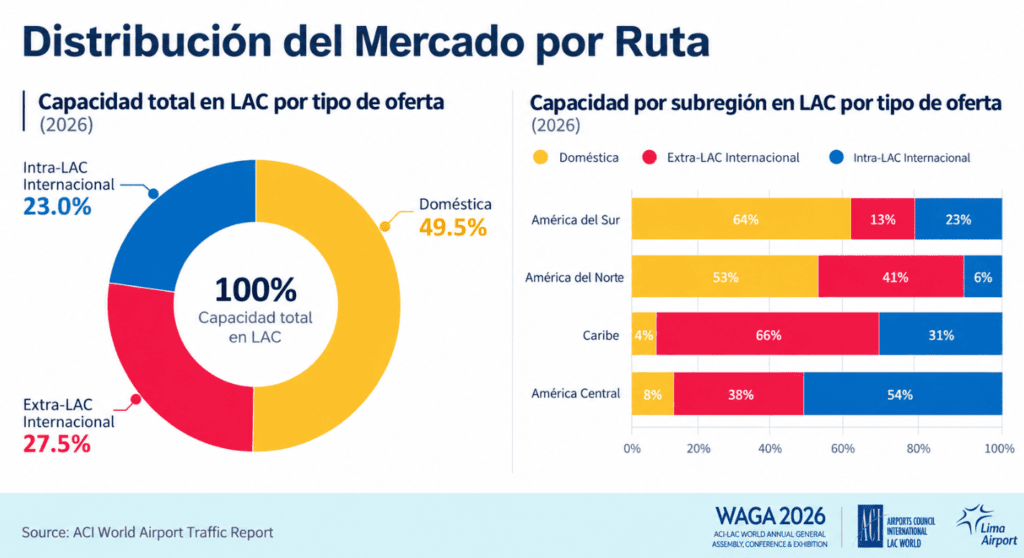
Dr. Echevarne also pointed to the imbalance between external and intra-regional connectivity, noting that the region currently has more capacity linking it with markets such as the United States and Canada than between Latin American countries themselves.
ACI-LAC puts regulation at the center of the debate
For ACI-LAC, improving connectivity is not solely an airport infrastructure issue.
Rafael Echevarne argued that regulatory frameworks continue to limit how easily airlines can establish new routes across national borders.
He contrasted the region with Europe, where liberalisation allows airlines to operate much more freely between countries without having to recreate separate operating structures for every national market.
In Latin America and the Caribbean, he said, additional permissions and country-specific requirements can slow expansion and reduce the flexibility airlines have to enter new markets.
ACI-LAC is therefore advocating policies of market opening, deregulation and liberalisation as a way to create a more dynamic air transport environment.
Dr. Echevarne reiterated the position at the official WAGA press conference on September 28, describing liberalisation and deregulation as the most effective route, in ACI-LAC’s view, to stimulate air traffic across the region.
Connectivity as an economic and territorial issue
The argument extends beyond airline competition.
Latin America and the Caribbean include territories separated by the Andes, the Amazon, large deserts and extensive island networks, making aviation particularly important where surface transport alternatives are limited.
For Rafael Echevarne, this gives connectivity a broader economic and social role.
“Aviation is not a luxury here in our region.”
He described air transport as fundamental to economic and social development and to the ability of cities and destinations to connect with wider markets.
The figures presented at WAGA therefore underline a broader challenge: passenger volumes can recover without restoring the full diversity of the air network. For ACI-LAC, closing that gap will require not only airport capacity and airline demand, but also a regulatory environment that makes new routes easier to establish.
FAQ
Has LAC air connectivity returned to 2019 levels?
No. The figures presented by Echevarne show 3,306 airport pairs in 2026, compared with 3,959 in 2019.
Which segment has recorded the largest decline?
International connectivity between LAC and markets outside the region, falling from 1,959 to 1,417 airport pairs.
Has intra-LAC international connectivity declined since 2019?
No. The figures presented show a slight increase from 588 to 603 airport pairs, although intra-LAC links still represent the smallest of the three connectivity segments.
What does ACI-LAC propose to improve regional connectivity?
The organisation is advocating greater air transport liberalisation, deregulation and market opening to make it easier for airlines to launch and operate routes across the region.
Editor’s note: This article is Part 2 of 7 in LATITUDE15’s WAGA 2026 series examining the key issues highlighted by ACI-LAC Director General Rafael Echevarne in Lima.