
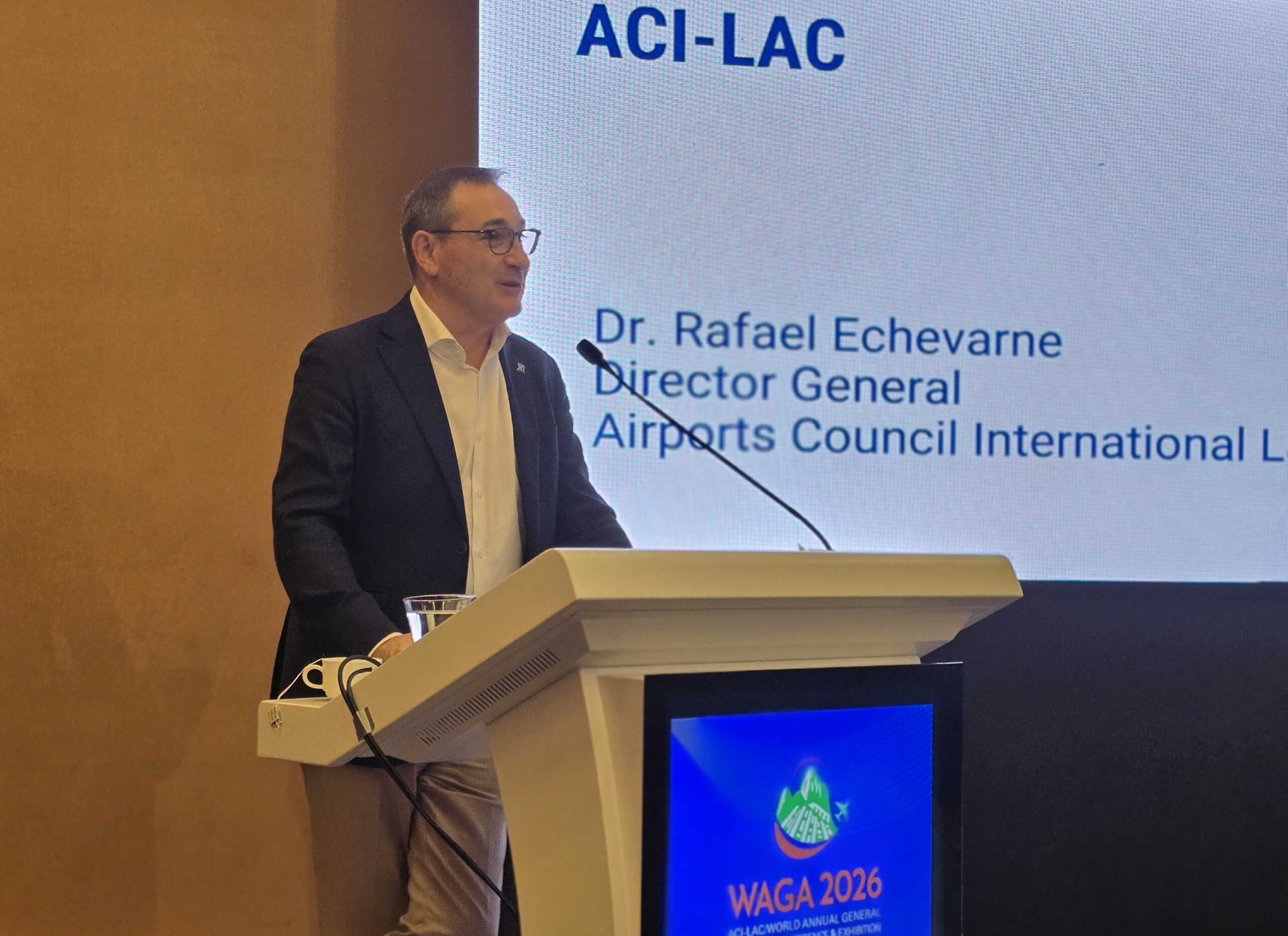
Speaking in Lima on September 27, ahead of WAGA 2026’s main conference programme, ACI-LAC Director General Rafael Echevarne presented a broad assessment of the airport industry across Latin America and the Caribbean. The region handled 797 million passengers in 2025, but connectivity remains below 2019 levels while airport economics and long-term infrastructure requirements continue to shape its growth outlook.
Rafael Echevarne’s presentation combined traffic, connectivity, investment and airport economics data to illustrate both the scale of the Latin American and Caribbean market and the constraints facing its future development.
ACI-LAC represents around 360 airports managed by some 90 operators across 45 countries, while the wider ACI network includes more than 2,200 airports worldwide. During the media workshop, Rafael Echevarne positioned aviation as particularly important in a region where geography limits alternative forms of transport.
“Aviation is not a luxury here in our region. It is a fundamental part of the economic and social development of our countries,” Rafael Echevarne said, in remarks translated from Spanish.
A 797-million-passenger market with room to grow
Latin America and the Caribbean handled 797 million passengers in 2025, accounting for around 8% of global passenger traffic, according to figures presented by Rafael Echevarne. Global airport traffic stood at approximately 9.4 billion passengers, with ACI expecting volumes to roughly double by 2045.
Brazil was the region’s largest market in 2025 with approximately 235 million passengers, followed by Mexico with 191 million and Colombia with 100 million.
The presentation also highlighted the region’s remaining growth potential. Total passengers per capita stood at 1.11 in Brazil, 1.25 in Peru and 1.45 in Mexico, compared with 5.69 in the United States and 6.51 in Spain.
For ACI-LAC, generating additional traffic therefore depends not only on demand, but also on whether markets can develop stronger and more flexible air links.

Connectivity remains below 2019 levels
The number of connected airport pairs across LAC fell from 3,959 in 2019 to 3,306 in 2026.
The decline, however, is not uniform. Extra-LAC international airport pairs fell from 1,959 to 1,417, while domestic pairs declined from 1,412 to 1,286. By contrast, intra-LAC international connections increased slightly from 588 to 603.
Rafael Echevarne linked the connectivity challenge partly to the regulatory structure of the regional market. He contrasted Latin America and the Caribbean with Europe’s more liberalised environment, arguing that separate national authorisation processes can slow airlines seeking to establish new services across borders. ACI-LAC is advocating greater openness, deregulation and liberalisation to support route development.
Airport economics remain a constraint
ACI data presented in Lima also pointed to differences between LAC airports and their global peers.
Total airport revenue in LAC stood at approximately US$19.30 per passenger in 2024, compared with US$20.71 across the rest of the world. LAC airports also remain more dependent on aeronautical revenues, while non-aeronautical activities represented 25.5% of revenues, compared with 36.8% globally.
The position is particularly difficult for smaller facilities. Thirty percent of LAC airports recorded financial losses in 2024, and 82% of those loss-making airports handled fewer than one million passengers.
The figures underline the challenge facing regional airports that provide connectivity and territorial access while operating with relatively limited traffic and commercial revenue bases.
Infrastructure becomes the next test
Long-term capacity will require substantial investment.
The presentation put LAC airport capital expenditure requirements at approximately US$93.5 billion between 2021 and 2040, including US$82.6 billion for the 2026-2040 period.
ACI’s figures also connect infrastructure constraints directly with wider economic outcomes. By 2040, every one million passengers unable to travel because of insufficient airport capacity could translate into approximately 9,500 fewer jobs and US$254 million less regional GDP.
For Rafael Echevarne, the figures presented in Lima point to a broader equation for Latin America and the Caribbean: passenger demand exists, but unlocking the region’s aviation potential will also require connectivity policies, financially sustainable airports and infrastructure capable of accommodating future growth.
FAQ
How many passengers did Latin America and the Caribbean handle in 2025?
ACI-LAC figures presented by Rafael Echevarne put regional traffic at 797 million passengers, around 8% of global traffic.
How has LAC airport connectivity changed since 2019?
Connected airport pairs declined from 3,959 in 2019 to 3,306 in 2026, although intra-LAC international pairs slightly increased over the period.
How many LAC airports were loss-making in 2024?
According to the presentation, 30% recorded financial losses, with 82% of those airports handling fewer than one million passengers.
How much airport investment does LAC require?
The figures presented at the workshop indicated approximately US$93.5 billion in airport CAPEX requirements between 2021 and 2040.