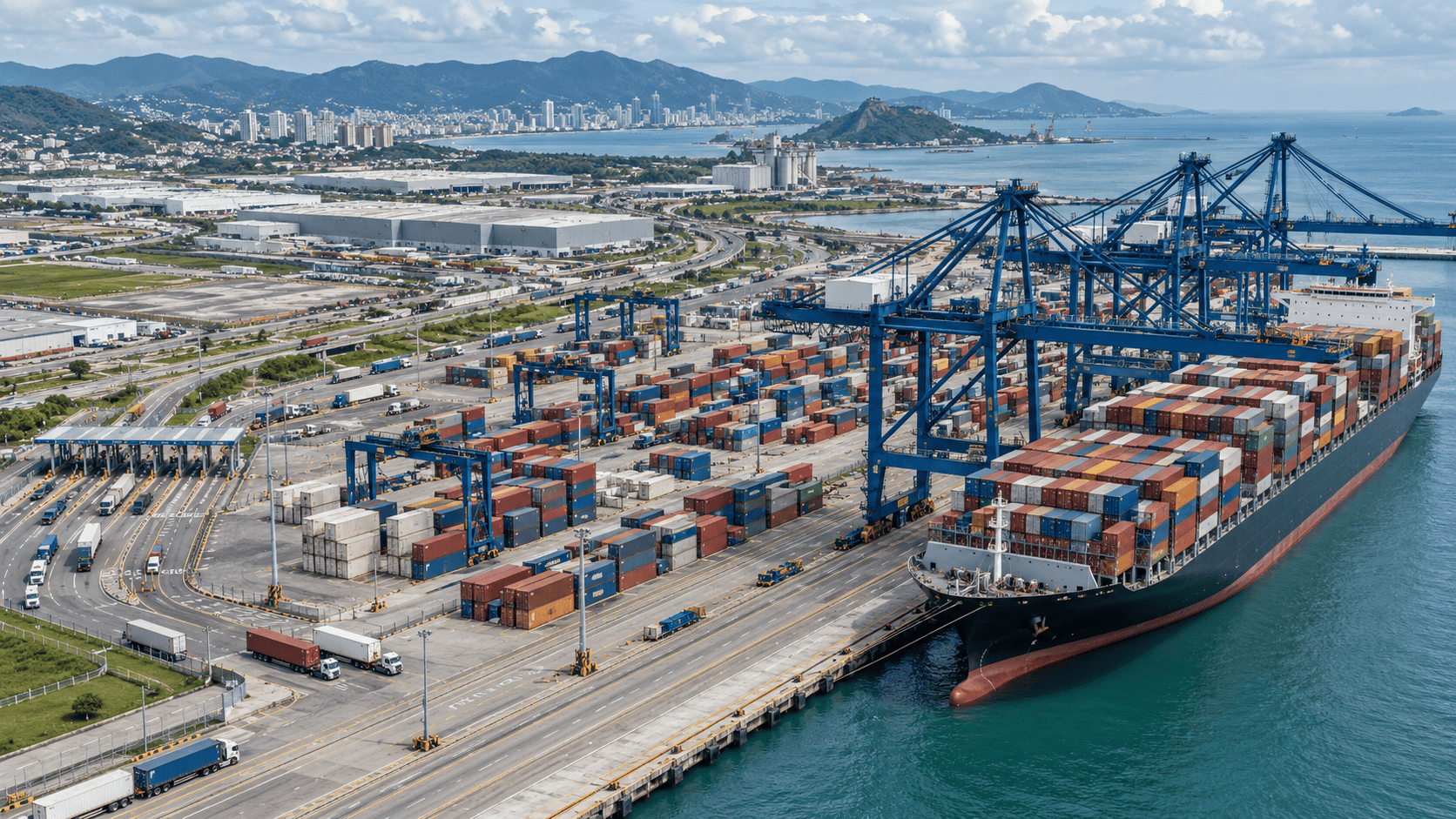
The landlord model remains the dominant framework for port concessions across much of Latin America and the Caribbean. But an OAS-CIP comparative study of ten markets argues that attracting private investment is no longer enough: future concessions will increasingly need measurable performance, stronger public oversight, sustainability commitments and closer integration with national logistics chains.
Port concessions have played a central role in bringing private capital and operating expertise into Latin American and Caribbean ports. Yet the next stage of port reform may depend less on transferring operations to private companies and more on how governments manage what happens after a concession is awarded.
A comparative study commissioned by the Inter-American Committee on Ports (CIP) of the Organization of American States (OAS) examined concession systems in ten countries: Barbados, Brazil, Chile, Colombia, El Salvador, Guyana, Jamaica, Mexico, Panama and Peru. Published in 2025, the report compares legal frameworks, concession mechanisms, tariffs, sustainability practices and institutional capabilities, before proposing a new governance approach called the Smart Public Port Partnership, or SP3.
Its findings remain particularly relevant in 2026 as port authorities across the region face simultaneous pressure to expand capacity, digitalize operations, decarbonize infrastructure and connect terminals more effectively with inland logistics networks.
One model, ten different port systems
The study finds that the landlord model, in which the public sector generally retains ownership of port infrastructure while private operators run terminals, is the predominant structure among the countries examined.
But the similarities largely end there.
Brazil and Mexico have developed diversified frameworks combining concessions, leases, public-private partnerships and private-use terminals. Chile, Colombia and Panama operate more consolidated landlord systems supported by public bidding and specialized oversight. Jamaica and Peru also rely substantially on private participation, but with different contractual and regulatory structures.
Barbados remains an important contrast, with port operations concentrated under a state-owned operator and no conventional concession regime, while Guyana retains a largely state-managed structure with potential for greater use of PPP mechanisms.
The result is a regional port landscape in which the same broad management label can conceal very different levels of regulatory capacity, private-sector involvement and public oversight.
That distinction matters because the performance of a concession depends not only on the operator, but also on the ability of the granting authority to set targets, monitor results and coordinate the terminal with the wider transport system.
Investment is only part of the equation
Peru illustrates what concessions can achieve in terms of infrastructure mobilization.
By the end of April 2026, concessioned ports supervised by Ositrán had accumulated US$2.376 billion in executed investment, equivalent to 57% of the reference investment commitments contained in their contracts. Those investments have helped deliver more than four kilometres of new quay infrastructure as well as new ship-to-shore cranes, yard equipment and cargo-handling systems.
In 2025, Peru’s concessioned terminals handled more than 65 million tonnes of cargo and over 3.8 million TEU, according to government data.
Those figures demonstrate the ability of concessions to mobilize capital and expand capacity. But the OAS-CIP study raises a second question: how should governments measure whether that investment is producing the broader logistics and public-interest outcomes expected from the concession?
Measuring what happens after the concession is awarded
The report argues that evaluation should extend well beyond whether a concessionaire has fulfilled its investment commitments.
It proposes monitoring indicators including vessel turnaround time, crane productivity, cargo dwell time, investment executed versus committed, post-concession cargo growth, employment impacts, environmental performance and contractual compliance. Transparency of tenders and public access to contracts are also included as governance indicators.
This changes the way a port concession is assessed.
A new berth or additional crane capacity may expand theoretical throughput, but that does not automatically mean ships spend less time in port, cargo clears faster or logistics costs decline.
This performance-based approach also aligns with the World Bank’s 2025 Port Reform Toolkit, whose latest edition places greater emphasis on performance measurement, governance, private participation, economic regulation, sustainability and digital transformation. The World Bank describes the role of port authorities as evolving from traditional landlords toward more active port developers and coordinators of wider stakeholder interests.
A port cannot stop at the terminal gate
One of the strongest conclusions of the OAS-CIP study concerns what happens outside the port itself.
The report identifies weak coordination between port, transport, trade and urban authorities, insufficient alignment between concessions and national logistics plans, limited multimodal infrastructure and fragmented regulatory frameworks as recurring regional challenges.
That means a terminal can receive substantial private investment while bottlenecks remain on access roads, rail connections, customs processes or nearby logistics zones.
For future concessions, the study therefore recommends closer alignment with national logistics plans and port master plans, stronger last-mile and multimodal connections, and interoperable digital systems linking ports with customs authorities and logistics operators.
This issue is increasingly important as concession periods can extend across decades. Infrastructure designed today must operate within trade corridors and supply chains that may change significantly over the life of the contract.
SP3 proposes a more active role for the State
The study’s most distinctive proposal is the Smart Public Port Partnership.
SP3 does not call for a return to fully state-operated ports. Nor does it eliminate private concessions. Instead, it proposes changing the relationship between the State and the concessionaire.
Under the model, the public sector would act as a more active strategic partner, with greater access to operating data and performance indicators, stronger technical participation and clearer alignment between port concessions and national logistics policies. The proposal also emphasizes public disclosure of contracts, amendments and performance results.
Importantly, SP3 is a proposal developed within the OAS-CIP study, not a regional concession regime already adopted by Latin American and Caribbean governments.
Its significance lies instead in the governance question it raises: whether the traditional landlord arrangement provides public authorities with enough tools to manage increasingly complex port ecosystems.
Sustainability and digitalization are becoming concession issues
The same evolution is visible beyond contractual governance.
The OAS-CIP study proposes different levels of sustainability requirements depending on port maturity, ranging from basic environmental monitoring to carbon measurement, electrification and, for more advanced ports, shore power, electric or hybrid equipment and real-time environmental monitoring.
Regional priorities have continued moving in that direction. In May 2026, the CIP and the International Association of Ports and Harbors brought port stakeholders together in Montevideo around energy transition and decarbonization, data collaboration and digitalization, and risk and resilience.
The CIP’s Bridgetown Action Plan 2026–2029 also identifies logistics and competitiveness, sustainable port management, and public policy and regulation among its priority areas.
The challenge for port concessions is therefore changing. Attracting a private terminal operator remains important, but the contract increasingly needs to account for what connects that terminal to the rest of the economy.
For Latin America and the Caribbean, the next phase of port reform may consequently be less about choosing between public and private management and more about building measurable, transparent and integrated partnerships between the two.
FAQ
What is the landlord port model?
Under the landlord model, the public sector generally retains ownership of the port land and basic infrastructure, while private companies operate terminals or provide cargo-handling services under concessions or leases.
Which countries were examined in the OAS-CIP study?
The study covers Barbados, Brazil, Chile, Colombia, El Salvador, Guyana, Jamaica, Mexico, Panama and Peru.
What is the Smart Public Port Partnership model?
SP3 is a governance model proposed in the OAS-CIP study. It combines private participation with greater public-sector technical involvement, contractual transparency, measurable performance indicators and alignment with wider logistics policies.
Has SP3 already been adopted across Latin America and the Caribbean?
No. The study presents SP3 as a proposed model for future concession design and management, rather than an already adopted regional regulatory framework.