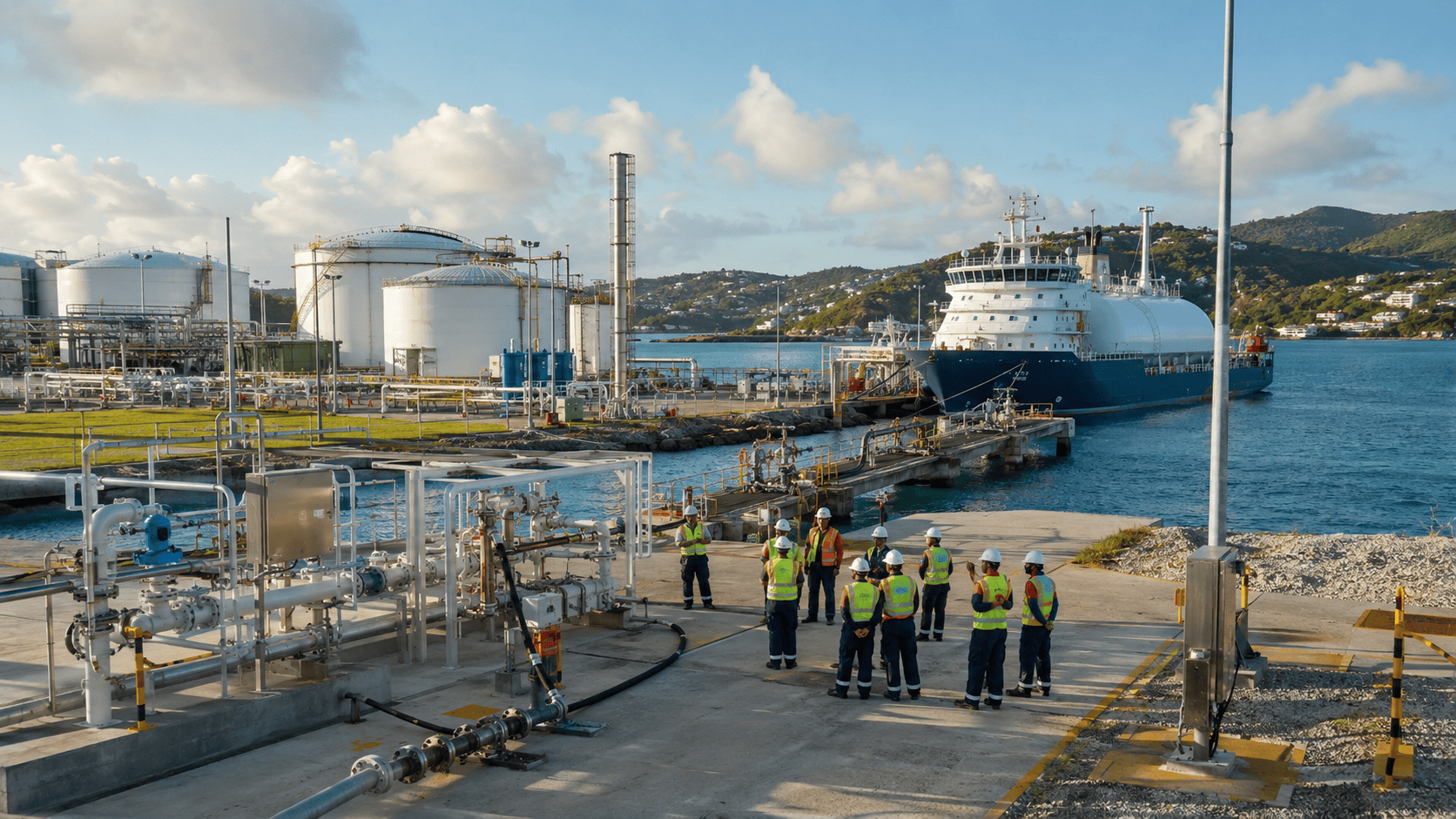
A port can build an ammonia bunkering facility. A shipping company can order a methanol-fuelled vessel. Neither investment delivers much value without people who know how to operate the technology safely.
That human dimension is becoming increasingly important as shipping moves toward lower- and zero-emission fuels.
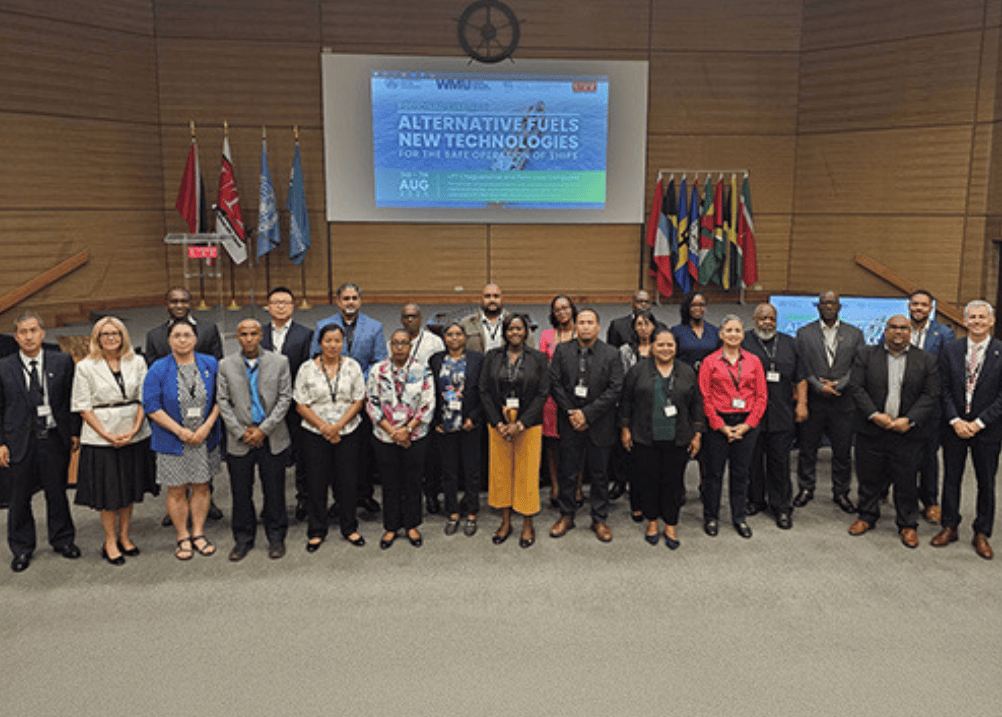
From 3 to 7 August 2026, 24 participants from eight Caribbean States gathered in Port of Spain for an IMO-supported programme focused on alternative fuels and new maritime technologies. The sessions covered methanol, ammonia and hydrogen, alongside bunkering procedures, protective equipment, emergency response and teaching methods designed to help participants pass those skills on.
The event highlighted a challenge that could become as important as fuel availability itself: maritime decarbonisation requires not only new infrastructure, but a workforce capable of operating it.
New fuels require new skills
Conventional marine fuels come with decades of operating experience, established procedures and mature training systems.
Alternative fuels change that equation.
Methanol introduces specific requirements linked to toxicity, fire safety and fuel transfer. Ammonia demands particular attention because of its highly toxic nature, making leak detection, protective equipment, exclusion zones and emergency procedures critical. Hydrogen brings another risk profile, including high flammability and different storage and handling requirements.
The result is that alternative-fuel training cannot simply be treated as one generic qualification.Different fuels require different competencies, and the people involved extend well beyond crews aboard ships.
Bunker operators, terminal personnel, pilots, harbour masters, maintenance technicians, inspectors, firefighters and port emergency teams may all need new skills as alternative-fuel infrastructure enters service.
A green-fuel port therefore requires two infrastructures to develop in parallel: the physical systems used to store and transfer fuel, and the human infrastructure required to operate around them safely.
The competency framework is being built now
International standards are beginning to catch up with the technology.
In 2025, the International Maritime Organization issued generic interim training guidelines for seafarers working on ships using alternative fuels and new technologies.
The framework became more specific in 2026.
At its February session, the IMO’s Sub-Committee on Human Element, Training and Watchkeeping finalised draft training guidelines for ships using methyl or ethyl alcohol and ships using ammonia as fuel. The Maritime Safety Committee subsequently approved those guidelines in May 2026.
Work continues on competencies related to hydrogen, LPG, battery-powered ships and fuel-cell technologies, while the wider STCW Convention and Code remain under review.
The implication for maritime academies is significant.
Training requirements are no longer a distant issue waiting for a future generation of vessels. The competency framework is being developed while alternative-fuel technologies are already entering commercial fleets.
At the same time, the broader regulatory pathway remains unsettled. The IMO’s Net-Zero Framework has not yet completed its formal adoption process, adding uncertainty over how quickly zero- and near-zero-emission fuels will scale across the fleet.
Training providers are therefore being asked to prepare for technologies whose long-term market shares are still evolving.
The bottleneck may be the trainers themselves
The potential scale of the challenge is considerable.
Under a rapid-transition scenario developed by the Maritime Just Transition Task Force, as many as 450,000 seafarers could require additional training by 2030, rising to around 800,000 by the mid-2030s.
Those figures are scenario-based rather than firm forecasts, but they illustrate how quickly training demand could grow if alternative fuels scale rapidly.
The problem is not simply finding enough seafarers to enrol in new courses. It is also creating enough instructors, institutions and practical training environments to teach them.
The IMO has already begun addressing that issue through its Train-the-Trainer Programme on Alternative Fuels for Sustainable Shipping, designed to build local teaching capacity rather than relying only on centralised international courses.
The August 2026 Caribbean programme followed that logic. Participants came from Antigua and Barbuda, The Bahamas, Barbados, Belize, Dominica, Jamaica, Suriname and Trinidad and Tobago, with exercises designed not only to build technical knowledge but to help participants transfer that knowledge to others.
That changes the workforce question.
The real challenge is not merely training individuals. It is building a system capable of producing new competencies at scale.
Trinidad offers a glimpse of a regional model
Trinidad and Tobago is particularly relevant because several parts of that system already exist in one place.
The Port of Spain programme was hosted through the Maritime Technology Cooperation Centre Caribbean at the University of Trinidad and Tobago. MTCC Caribbean itself has a regional mandate covering 16 Caribbean countries, giving it a platform for sharing knowledge beyond one national market.
Participants also visited the Yara TRINGEN complex at Point Lisas, where ammonia production, storage and associated port infrastructure provide a real industrial environment for examining protective equipment, leak response and emergency procedures.
Methanol adds another practical dimension.
Proman, which has experience with methanol as a marine fuel, contributed industry knowledge to the programme, while UTT cadets have already had opportunities to gain exposure aboard methanol-fuelled vessels.
That combination matters.
Alternative-fuel training will increasingly require more than classroom instruction. It will need access to real equipment, operational environments, instructors with practical experience and partnerships between maritime schools and industry.
Trinidad and Tobago therefore offers a useful example of how industrial capability and maritime education can reinforce one another.
For the wider Caribbean, it also raises a strategic possibility: specialised green-shipping training could become a regional maritime service in its own right.
The investment dilemma: train before the market arrives?
Building that capability will require choices.
Training institutions may need new simulators, specialist equipment, updated curricula and instructors familiar with technologies that are still evolving.
Waiting until every standard and fuel pathway is settled carries one risk: the region may face a skills shortage just as alternative-fuel vessels and bunkering infrastructure begin to scale.
Investing too early carries another: training providers may have to update courses, equipment and certification as international requirements evolve.
The answer may therefore lie in flexible regional capacity rather than duplicating every capability in every territory. Shared centres of expertise could serve multiple ports, administrations and shipping companies, spreading the cost of specialist instructors, simulators and practical facilities across a wider market.
If developed successfully, those centres could eventually serve professionals from Latin America and beyond.That would turn a compliance and safety requirement into something more strategic: a specialised maritime knowledge industry.
The Caribbean’s green shipping transition will not be built solely with new engines, tanks, pipelines and bunkering systems.It will also depend on whether the region can create enough people — and enough institutions — capable of operating them.
For Caribbean shipping, human infrastructure may prove to be both the next bottleneck and one of the next opportunities.