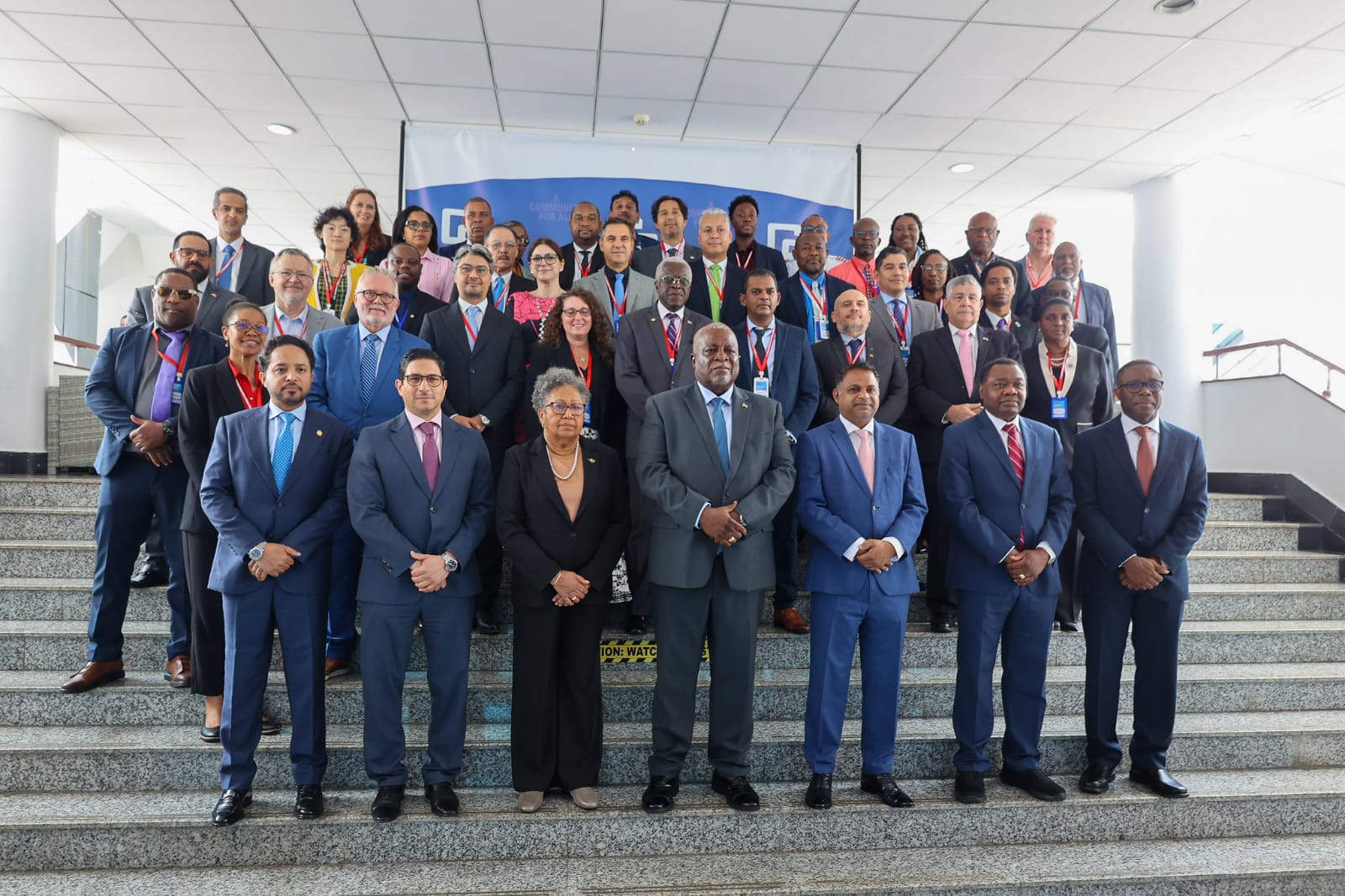
Front row: Hon. Brigadier (Retd) Mark Phillips, Prime Minister of Guyana – 4th, left; Hon Deodat Indar, Minister of Public Utilities and Aviation, Guyana – 3rd, right; Dr Carla Barnett, Secretary-General, CARICOM – 3rd, left; with officials from the International Civil Aviation Organization, directors of civil aviation across the Region and other partners.
Caribbean governments are looking to deepen regional cooperation on aviation safety as national regulators face growing technical, financial and workforce constraints. A draft CASSOS roadmap to 2035 puts shared expertise, regulatory harmonisation and sustainable oversight at the centre of that effort.
More than 70 representatives from governments, civil aviation authorities, regional institutions, international organisations and the aviation industry met in Georgetown, Guyana, on October 1, 2026, for the Caribbean High-Level Symposium on Aviation Safety.
Convened by the CARICOM Secretariat in collaboration with the International Civil Aviation Organization (ICAO) and hosted by the Government of Guyana and the Guyana Civil Aviation Authority, the meeting focused on how Caribbean states can strengthen aviation safety oversight through greater regional cooperation.
A shared response to limited national capacity
The challenge facing the region is particularly acute for smaller administrations. Civil aviation authorities must keep pace with international standards, technological change and increasingly complex regulatory requirements while operating with limited pools of specialised personnel and financial resources.
CARICOM Secretary-General Dr Carla Barnett argued that these constraints make cooperation increasingly important.
“Regional cooperation is indispensable.”
The Caribbean Aviation Safety and Security Oversight System (CASSOS) sits at the centre of that approach. By pooling expertise and supporting common regulatory practices, the regional body is intended to help Member States maintain levels of technical capacity and safety oversight that may be difficult to sustain individually.
For Caribbean aviation, the issue extends beyond regulatory compliance. Aviation underpins tourism, trade, investment, emergency response and movement between territories, making effective safety oversight part of the wider economic infrastructure of the region.
CASSOS roadmap looks toward 2035
A key part of the Georgetown discussions was the Draft CASSOS Roadmap and Action Matrix to 2035.
The roadmap is designed to address several long-term priorities, including the sustainability of national civil aviation authorities, regulatory harmonisation, technical capacity, financing, implementation timelines and mechanisms for monitoring progress.
That shifts the discussion from individual regulatory challenges toward a more coordinated model in which states can share expertise and build stronger common oversight capacity.
The symposium also brought together international partners including ICAO, the European Union Aviation Safety Agency (EASA), the U.S. Federal Aviation Administration (FAA), Transport Canada and the United Kingdom, alongside regional authorities and industry representatives.
The involvement of those organisations also reflects the need for Caribbean regulatory systems to remain aligned with wider international aviation standards while developing solutions suited to the region’s smaller and fragmented markets.
Safety oversight and regional connectivity are converging
The safety agenda is increasingly linked to CARICOM’s broader push for a more integrated regional air transport market.
The CARICOM Multilateral Air Services Agreement (MASA) provides the framework for a single market for air transport services within the Community. Haiti acceded to the agreement in September 2026, becoming the 13th CARICOM Member State to join.
For CARICOM, greater market integration and stronger safety oversight therefore need to progress together.
Barnett told the Georgetown meeting that stronger connectivity must rest on regulatory confidence and operational reliability, adding that aviation safety is fundamental to the functioning of an integrated regional market.
That connection matters for airlines as well as regulators. A more integrated market can create opportunities for additional services and more efficient regional connectivity, but it also increases the importance of consistent certification, oversight and regulatory standards between participating states.
From regional commitment to implementation
The next challenge will be turning the Georgetown discussions into operational capacity.
CARICOM had said ahead of the symposium that participants were expected to consider a Georgetown Declaration on Aviation Safety and a roadmap of priority actions. The organisation’s post-event communication, however, has focused primarily on the regional cooperation agenda and the work surrounding the CASSOS roadmap rather than explicitly confirming final adoption of the declaration.
The practical test will therefore be whether states can translate regional commitments into sustainable funding, shared technical resources, harmonised regulation and measurable improvements in oversight through 2035.
For a Caribbean aviation market seeking stronger connectivity, the ability to pool scarce regulatory expertise may become just as important as adding new routes.
FAQ
What is CASSOS?
The Caribbean Aviation Safety and Security Oversight System is CARICOM’s regional mechanism for supporting Member States in aviation safety and security oversight, including technical cooperation and regulatory harmonisation.
What was discussed at the Georgetown aviation safety symposium?
Discussions included the sustainability of civil aviation authorities, regulatory harmonisation, technical capacity, financing and the Draft CASSOS Roadmap and Action Matrix to 2035.
Why is regional cooperation important for Caribbean aviation safety?
Smaller aviation administrations face limited financial and specialist human resources while still having to meet international safety obligations. Sharing expertise can help strengthen national oversight capacity.
How does aviation safety relate to the CARICOM MASA?
The MASA aims to support a single regional market for air transport services. CARICOM argues that expanded connectivity must be supported by strong and reliable safety oversight across participating states.