Caribbean governments are seeking to expand intra-regional food trade, but weak and costly maritime connections continue to limit the movement of agricultural and fisheries products between territories. Discussions at Caribbean Week of Agriculture 2026 in Jamaica have again put shipping, port efficiency and cold-chain logistics at the centre of the regional food security agenda.
Maritime connectivity returns to the regional agenda
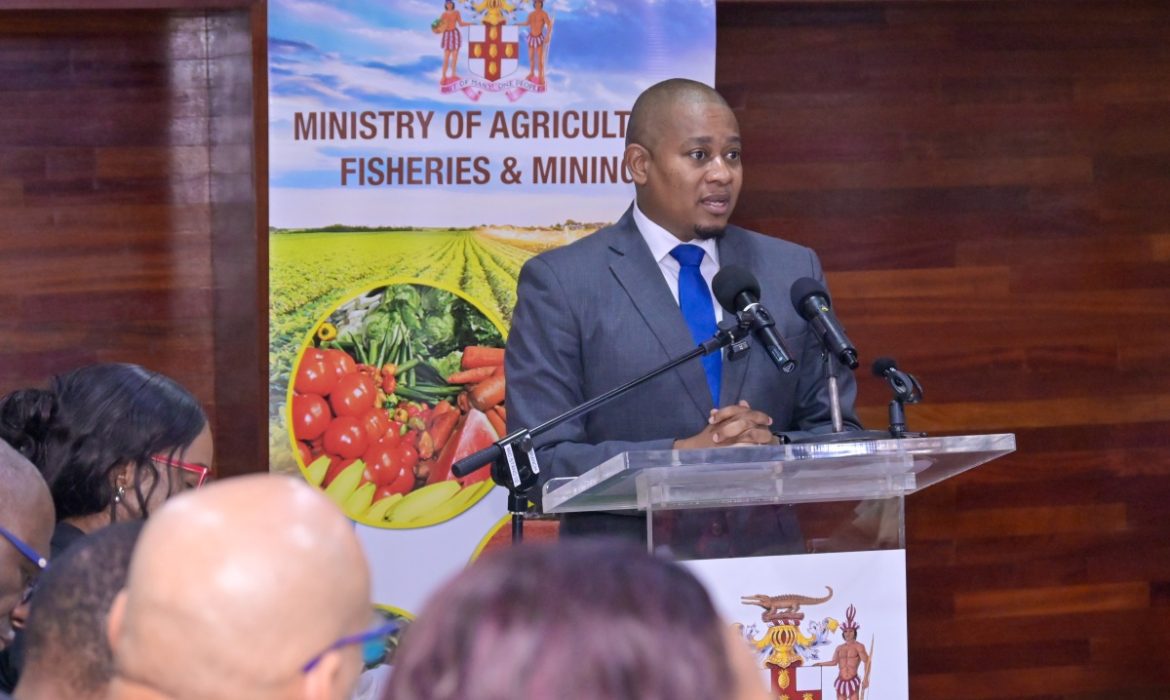
Floyd Green, Jamaica’s Minister of Agriculture, Fisheries and Mining, called for urgent action on regional maritime connectivity on October 2, 2026, in Trelawny, Jamaica, ahead of the 127th Special Meeting of CARICOM’s Council for Trade and Economic Development (COTED) on Agriculture.
Floyd Green argued that increasing agricultural production alone will not strengthen Caribbean food security if producers cannot efficiently reach neighbouring markets.
“We still have to treat with the matter of maritime logistics.”
The minister said stronger connections are needed to move products across the region, identifying maritime logistics alongside regulatory harmonisation and labour availability as issues still requiring regional action.
The intervention came at the end of the 20th Caribbean Week of Agriculture (CWA), held in Jamaica from September 27 to October 2, where policymakers, agricultural organisations, development institutions and industry representatives examined how regional food systems could become more resilient and integrated.
Moving food remains as important as producing it
The transport problem had already surfaced at the opening of CWA 2026.
Floyd Green warned that high transport costs and difficulties moving agricultural commodities between Caribbean countries remain major obstacles to greater regional food trade. He pointed specifically to shipping, logistics and sanitary requirements as constraints that can delay or restrict the movement of produce.
For an island region, that creates a structural challenge. Increasing production in one market does not necessarily translate into greater regional availability when affordable and reliable connections to other territories are limited.
The issue is particularly relevant for agricultural and fisheries products, where smaller shipment volumes, perishability, handling requirements and temperature control can make conventional cargo arrangements difficult or uneconomic.
As CARICOM seeks to reduce dependence on imported food and increase trade between Member States, the maritime system therefore becomes part of the food-security equation rather than simply a transport issue.
CWA puts maritime logistics under scrutiny
Maritime connectivity was not a secondary subject at the 2026 event.
On September 29, CWA hosted a dedicated session on “Strengthening Maritime Logistics for Food Security and Agricultural Trade in the Caribbean.”
Participants included the Food and Agriculture Organization, Inter-American Institute for Cooperation on Agriculture, Caribbean Regional Fisheries Mechanism, University of the West Indies, Caribbean Export, Caribbean Development Bank, Port Managers Association of the Caribbean and the CARICOM Secretariat, among other organisations. The session specifically considered how air and sea freight could better support agricultural and fisheries trade.
That breadth of participation highlights the complexity of the problem. Improving maritime trade involves not only vessels, but also ports, cargo consolidation, storage, customs and documentation procedures, food-safety requirements and reliable cold-chain infrastructure.
Smaller cargo and cold-chain solutions enter the equation
Regional financing programmes are beginning to address some of those operational gaps.
The Caribbean Development Bank (CDB) and European Union’s Regional Food Security Programme includes support for projects aimed at improving agri-food logistics, port efficiency and maritime transport for intra-regional trade. Its priorities include cold-chain infrastructure, route and load optimisation, port handling and storage, and the modernisation of existing maritime services.
A current initiative in Dominica illustrates what that could mean in practice.
CDB is procuring consultancy services to assess the technical and economic viability of refurbishing a schooner for the transport of less-than-container-load (LCL) agricultural cargo. The assignment also covers the design of a modular cold-chain solution and, subject to a positive assessment, preparation and supervision of refurbishment works. The procurement deadline is October 14, 2026.
For Caribbean markets, LCL solutions could be particularly relevant because individual producers or territories may not consistently generate enough cargo to fill conventional containers. Consolidating smaller consignments while maintaining appropriate storage conditions could help create more flexible links between regional markets.
The Dominica project remains at the assessment stage and does not yet represent a new operational regional shipping service.
From regional commitments to operating connections
The 127th Special COTED concluded with CARICOM officials calling for decisions made during CWA to move from discussion to implementation. Ministers addressed food imports, food safety, agricultural inputs, animal and soil health, the blue and green economy and other regional priorities, while emphasising that farmers, fishers and consumers should ultimately see tangible benefits.
For maritime stakeholders, the challenge is increasingly clear.
The Caribbean has repeatedly identified transport as an obstacle to deeper regional trade. The next test will be whether that recognition translates into reliable shipping capacity, efficient ports, viable small-cargo services and cold-chain infrastructure capable of connecting producers with markets across the region.
Without those operating links, increasing Caribbean food production may solve only half of the regional trade equation.