
For decades, the international air networks of the English-speaking Caribbean have been shaped primarily by North America, Europe and intra-Caribbean travel. Latin America, despite its geographic proximity, has played a more limited role, with much of the continent traditionally reached through connecting hubs rather than an extensive network of nonstop services.
Jamaica is now testing a different model.
Latin American visitor arrivals to Jamaica reached 58,797 in 2025, up from 35,252 in 2024 and 31,152 in 2023 — an increase of almost 88% in two years. Tourism earnings from the market more than doubled over the same period, rising from more than US$55 million in 2023 to US$116 million in 2025.
The volumes remain modest compared with Jamaica’s core source markets. But the combination of rising demand and new direct capacity suggests that selected Latin American corridors are becoming increasingly relevant to Caribbean airport networks.
Jamaica is building direct links into South America
The shift has developed progressively.
LATAM restored Lima–Montego Bay in December 2024, reconnecting Jamaica directly with Peru while also giving passengers access to LATAM’s wider network through Lima. By July 2025, Copa Airlines and LATAM were together providing more than 10,000 seats per month into Jamaica from Latin America, which Jamaican authorities described as a historic high for connectivity from the region.
Colombia then added another layer.
Wingo introduced Bogotá–Montego Bay and followed on June 23, 2026 with Medellín–Montego Bay. The Medellín service operates three times weekly and provides 31,992 seats annually. Its inaugural flight carried 121 passengers. Wingo presents the route as both an inbound tourism link and a new direct option for Jamaicans travelling to Medellín.
Sangster International Airport’s current network lists both Bogotá and Medellín with Wingo, alongside its other Latin American links.
What makes this progression significant is that the routes represent different connectivity models: Panama as an established continental hub, Lima as both an origin market and South American gateway, and Bogotá and Medellín as Colombian markets increasingly able to support direct service.
Panama is not being replaced
The emergence of more nonstop South American services does not mean the traditional Panama model is becoming obsolete.
Copa continues to connect both Kingston and Montego Bay with Panama City, from where passengers can access its broader network across the Americas. Grand Cayman also maintains its own nonstop Panama link with Cayman Airways, operating twice weekly, with additional frequencies added during summer 2026 to support leisure, business and onward Latin American travel.
The wider market data reinforce Panama’s continuing importance. In August 2026, Copa offered nearly 1.97 million seats across its network, up 16.7% year on year. Panama’s overall airline capacity increased 11.5%, while Panama City Tocumen recorded 12.3% growth.
Hub economics remain particularly valuable for Caribbean markets because they allow airlines to combine passengers from cities that may not individually generate enough demand for their own nonstop service.
The new routes therefore add a second layer rather than replace the first: hub connectivity remains strong while selected point-to-point markets begin to emerge.
Demand and capacity are beginning to reinforce each other
Jamaica has identified Argentina, Brazil, Chile, Colombia, Mexico and Peru as priority Latin American source markets. Its tourism authorities said in February 2026 that scheduled services from Panama City, Lima and Bogotá were performing at or above target load factors, although detailed airline load-factor figures were not disclosed.
Colombia is particularly interesting because Wingo introduces a low-cost proposition alongside the established hub and full-service models.
That fits a broader shift in Latin American aviation. Low-cost carriers represented 38% of regional capacity in August 2026 and increased seats by 3.8% year on year, faster than mainline carriers.
For Jamaica, the opportunity is also not limited to inbound tourism. Wingo explicitly positions Medellín as a destination accessible to Jamaican travellers for cultural and business purposes.
That does not demonstrate balanced traffic in both directions. It does, however, show that the commercial proposition is broader than simply flying Latin American holidaymakers to Montego Bay.
What does this change for Caribbean airports?
For airports, the most immediate implication is diversification.
Latin America does not need to replace North America or Europe to become strategically valuable. Additional traffic can broaden airline portfolios, passenger profiles and geographic exposure while creating new opportunities for terminal spending and route development.
But Jamaica’s recent expansion should not be interpreted as evidence of a region-wide boom.
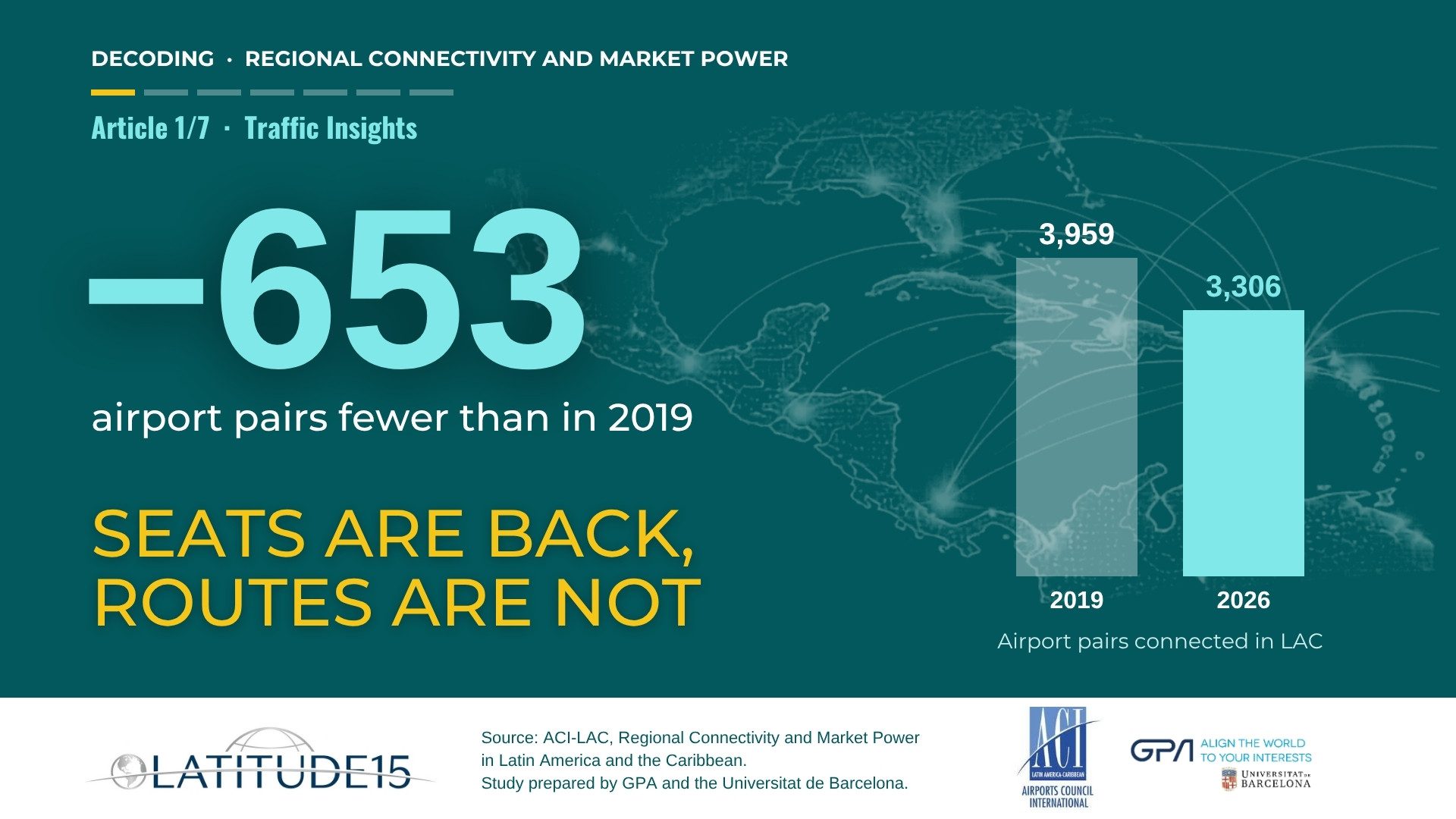
OAG data for August 2026 show overall Latin American airline capacity up 2% year on year to 52.4 million seats, while international capacity declined 2.9%. Capacity between Latin America and the Caribbean was down 4.7%, equivalent to roughly 206,700 fewer seats than in August 2025.
That makes Jamaica’s development more selective — and arguably more instructive.
It suggests that growth may be concentrating in specific corridors where tourism demand, airline strategy, pricing and hub connectivity align, rather than spreading evenly across the Caribbean.
Bogotá, Lima and Panama City are particularly significant in this context. In August 2026 they ranked among Latin America’s ten largest airports by capacity, with Bogotá at 2.48 million seats, Lima at 1.50 million and Panama City at 1.20 million.
Connecting Caribbean destinations to such airports provides access not only to local demand, but potentially to much larger continental networks.
Where could the next opportunities emerge?
Several English-speaking Caribbean markets still have limited nonstop access to mainland Latin America. But proximity alone does not make a route viable.
The stronger opportunities are likely to be markets where passengers are already travelling indirectly through Panama, Miami or other hubs, creating an existing base of demand that airlines can measure before committing aircraft to a nonstop service.
That is why the Jamaican case matters beyond Jamaica.
It shows how a Caribbean airport can combine an established hub relationship with increasingly targeted direct routes rather than choosing between the two models.
Latin America is unlikely to replace North America or Europe as the English-speaking Caribbean’s principal international market. Nor does it need to.
Its strategic value lies in diversification — and in identifying the individual corridors where demand has become deep enough to support sustainable direct connectivity.
The question is no longer simply whether Latin American demand exists. It is where that demand has become large enough to justify the next nonstop route.