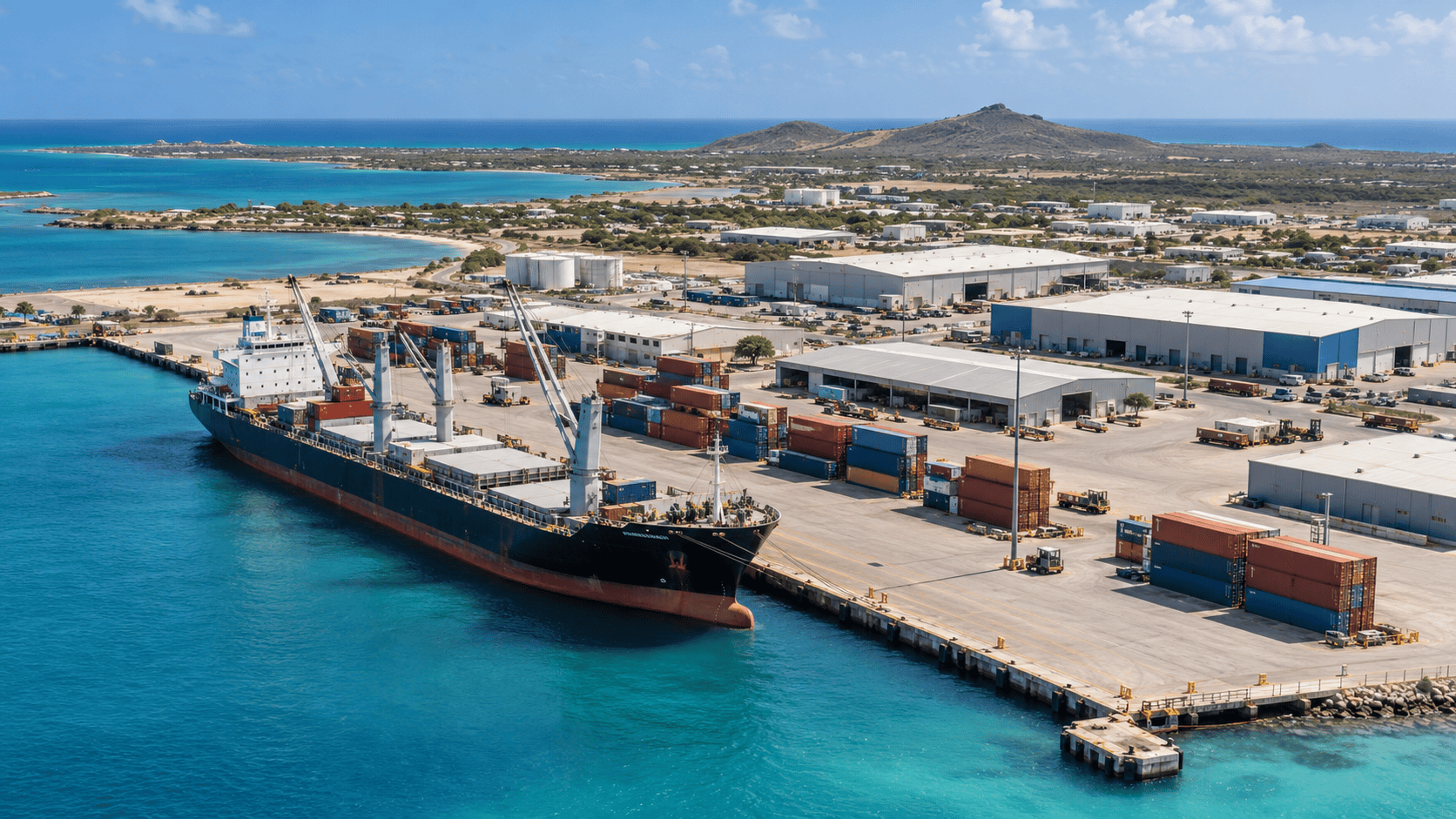

In Saint Martin, the development of Galisbay Port is about more than expanding capacity. It reflects a broader ambition: strengthening the port’s role in a Caribbean maritime landscape increasingly structured around major port hubs and regional distribution networks.
For the French side of the island, the challenge is to reinforce its logistical autonomy while acknowledging a unique reality: Saint Martin and Sint Maarten share the same island but are governed by two separate administrations and operate distinct port systems, closely interconnected through trade and cargo flows.
Rebalancing cargo flows in favour of the French side
The development of Galisbay is primarily intended to enable the French side to receive a larger share of the goods bound for its market directly. Approximately 75% of the island’s commercial traffic currently enters through Sint Maarten’s port infrastructure, leaving Galisbay with considerable scope to expand and secure its own supply chains.
For Albéric Ellis, Managing Director of the Établissement portuaire de Saint-Martin, strengthening the port is a matter of sovereignty and supply security. The French side needs its own facility capable of ensuring that essential goods can continue to enter the territory.
The aim, however, is neither to replicate the capacity available on the Dutch side nor to create direct competition between the two ports. The island’s two economies and logistics systems are too interdependent to be considered in isolation. Any change in port activity on one side inevitably affects the other.
The objective is instead to achieve a more balanced distribution of flows by enabling the French side to handle more cargo and respond more effectively to the territory’s needs, while maintaining complementarity across the island.
Additional capacity could also improve operational continuity. Albéric Ellis points to periods of heavy swell that disrupt access to the French port, forcing some vessels to wait offshore or divert to facilities on the Dutch side. Developing Galisbay should therefore strengthen the island’s ability to maintain cargo flows when one of its port facilities is temporarily constrained.
A Caribbean structured around major gateways
Galisbay’s development must also be viewed in the context of broader changes in regional maritime transport.
The increasing size of vessels and the consolidation of shipping services are reinforcing the role of major ports capable of handling substantial volumes. Cargo is then redistributed from these hubs to individual island markets.
Within this system, each port must develop a function suited to its market, infrastructure and territorial needs. Investment requirements, available cargo volumes and the specific characteristics of each destination make differentiated port roles essential.
For Galisbay, the opportunity lies in strengthening its position as the gateway to the French side while expanding its connections with a Caribbean maritime system in which a share of regional cargo passes through major hubs before being transported to the islands.
Expanding capacity without disrupting operations
Estimated at approximately €135 million, the Galisbay development project is expected to take the port to a new level of operational capacity.
The project aims to increase annual throughput progressively from around 20,000 TEUs today to between 50,000 and 60,000 TEUs. This expansion would give the French side greater capacity to receive goods bound for its market directly.
The transformation will nevertheless have to be carried out while the port remains operational. Existing infrastructure will continue to handle traffic throughout the construction period, followed by the phased commissioning of the new facilities.
This requirement is critical for an island territory that depends on maritime transport for its supplies. Galisbay cannot suspend operations while the port is being upgraded: the project must preserve existing cargo flows while preparing for future capacity growth.
Its success will therefore depend on more than the construction of new infrastructure. It will also require the port to manage the transition between existing and future facilities, attract additional cargo volumes and strengthen its relationships with shipping operators.
A cruise strategy tailored to Galisbay
The development strategy for Galisbay also extends to the cruise sector. In this segment, the French side has an opportunity to build an offering suited to its infrastructure and the specific characteristics of the territory.
Galisbay already receives ships at anchor, with passengers transferred by tender to the town centre. Some embarkation and disembarkation operations also take place at weekends, while demand is emerging for these activities to be extended to weekdays.
These operations point to a targeted market position aligned with the port’s capacity and supported by its proximity to the town centre. The stated objective is to increase annual cruise traffic from the current 15,000–20,000 passengers to approximately 50,000.
Beyond the number of calls, the challenge will be to identify the types of operations and vessels best suited to Galisbay’s infrastructure. This development will also need to generate tangible benefits for businesses on the French side.
Protecting the environment means protecting the economy
For an island destination, the quality of the marine and coastal environment is inseparable from economic attractiveness. Preserving it means protecting the very resource on which the territory depends. The project’s long-term environmental measures reflect this principle.
The experience of Hurricane Irma also demonstrated that a port must be designed with resilience in mind: it needs to remain operational and support the territory’s rapid recovery following a major climatic event.
A strategic role aligned with the territory’s realities
Galisbay’s future depends on establishing a port role that reflects the territory’s needs: strengthening the logistical autonomy of the French side, developing capacity suited to the Saint Martin market and consolidating connections with Caribbean maritime networks.
In a region composed of interdependent island markets, port performance is not measured solely by cargo volumes. It also depends on supply continuity, efficient connections and complementarity between regional infrastructure.
By expanding its capacity and developing a role that complements the Caribbean’s major port hubs, Galisbay intends to consolidate its position as the gateway to the French side and contribute more directly to the organisation of maritime flows across the region.