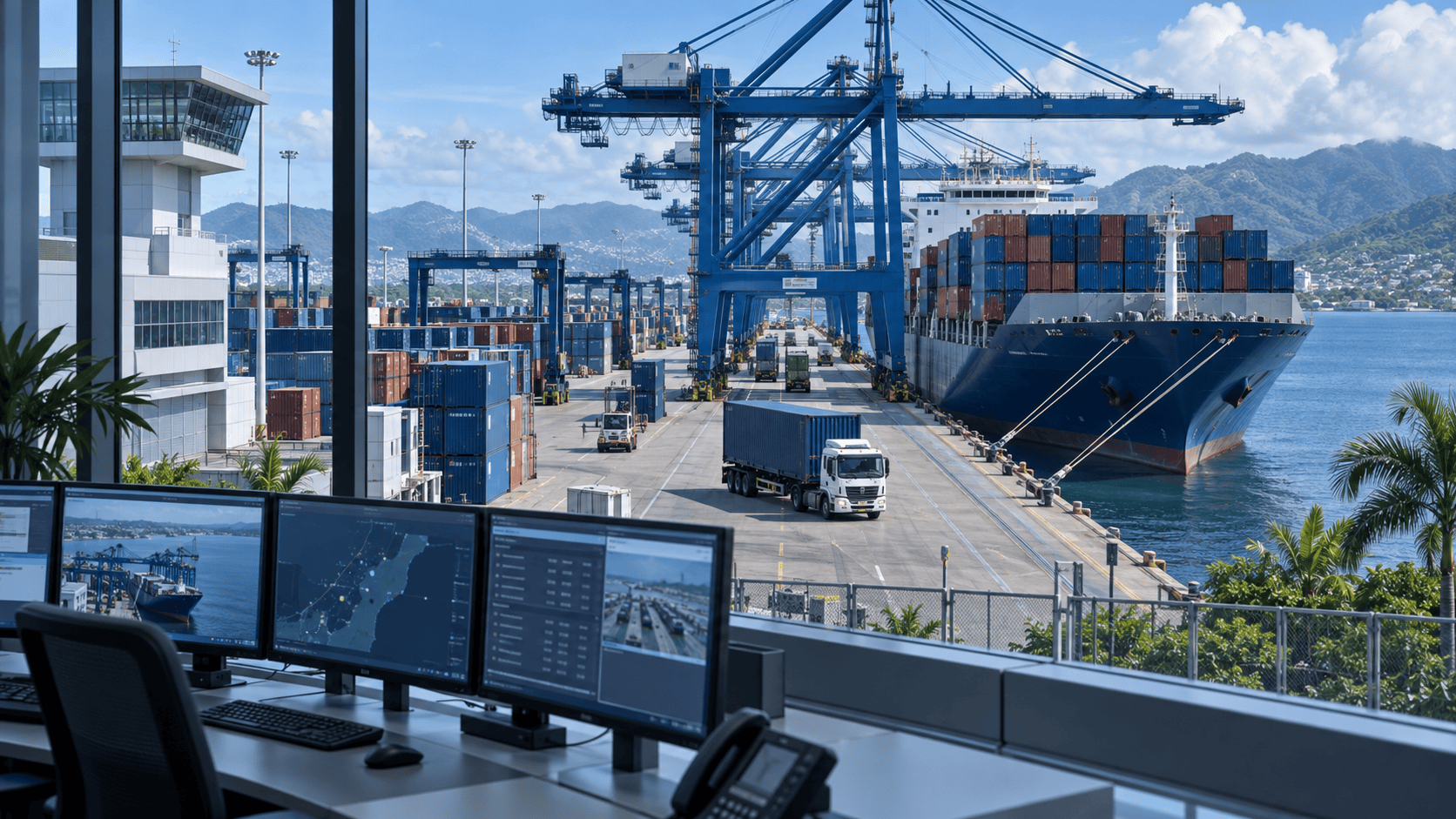
Trinidad & Tobago launched its Port Community System in March 2026 to connect vessel-clearance, port and logistics stakeholders through a shared digital environment. Voyage and maritime services are already operational, while cargo management, truck appointments and business intelligence remain under deployment, making the next phase critical to whether PortLink can connect the wider logistics chain.
The Trinidad and Tobago Port Community System (PCS) officially went live on March 23, 2026 through the national PortLink platform. The system is designed to connect government agencies, port authorities, terminal operators, shipping agents, freight forwarders and logistics providers instead of requiring each actor to exchange information through separate digital or documentary processes.
The Port Community System represents a shift from simply digitizing individual procedures toward making existing systems exchange information with one another. Trinidad & Tobago’s government described the PCS in 2023 as a neutral electronic platform linking systems including ASYCUDA, used by Customs and Excise, NAVIS, used by ports and terminals, and TTBizLink, the country’s Single Electronic Window.
From separate systems to a shared data layer
Trinidad & Tobago’s Port Community System started its phased rollout with the Administration and Voyage services on March 23, 2026. The Maritime and Invoice services followed on March 31, 2026, allowing electronic processing of vessel arrival and departure declarations, including International Maritime Organization FAL forms, alongside logistics and documentary invoicing functions.
The distinction between digitization and interoperability is important for port operations. A digital form can remove paper from a procedure, but a Port Community System creates more value when information submitted for one process can be reused by the other organizations involved in the same vessel call or cargo movement.
PortLink already provides a practical example. Information entered by a shipping agent when creating a voyage is automatically prepopulated into subsequent arrival and departure declarations, reducing repetitive manual entry and helping maintain consistency between records. Voyage data can include the vessel, carrier, estimated arrival and departure times, previous and next ports of call, intended operations and freight agents involved in the call.
The Trinidad and Tobago PCS therefore begins to create a common data layer around the vessel call. PortLink describes the platform as an information broker supporting data exchange across vessel clearance, cargo clearance, port operations and transport logistics.
Vessel clearance is already moving online
The maritime component of PortLink is already broader than a basic arrival notification. The system currently provides functions for maritime folders, arrival and departure declarations, declaration submission and withdrawal, data retrieval, Navigational Aids Dues and Harbour Master’s Certificates.
Operational guidance was still being updated several months after the March 2026 launch. PortLink published new guidance on August 12, 2026, updated on August 13, explaining how different vessel operations are treated for Navigational Aids Dues exemptions under Trinidad & Tobago’s Shipping Act. The August update provides evidence that the platform is moving beyond launch communications into day-to-day regulatory workflows.
The current PortLink portal also reports more than 500 active members and lists organizations including the Port Authority of Trinidad and Tobago, PLIPDECO, Customs and Excise Division, Immigration Division, Maritime Services Division, Trinidad and Tobago Coast Guard, Shipping Association of Trinidad and Tobago and TTBizLink. The figure indicates an established user community, although PortLink does not publish detailed usage volumes for each PCS service.
Cargo and trucks are the next test
The Trinidad and Tobago Port Community System is not yet fully deployed across the logistics chain. As of September 2026, PortLink lists Administration, Voyage, Maritime and Invoice as available, while Logistics, Forms, Truck Appointment System and Business Intelligence remain marked “Coming Soon.”
The unfinished modules are important because they move the PCS beyond vessel clearance. The future Logistics service is intended to manage cargo imports, exports and transhipments, while the Truck Appointment System is intended to manage terminal appointments and Business Intelligence is designed to provide data reporting and visualization.
Cargo processes are also expected to expand progressively from manifest management through cargo handling, release and delivery, covering both sea and air operations. Trinidad & Tobago’s March 2026 launch announcement confirms that these functions form part of later implementation phases rather than capabilities already fully available at launch.
The next phase may therefore determine whether PortLink becomes primarily an efficient vessel-clearance platform or develops into a broader logistics operating environment. Connecting vessel information to cargo release, terminal activity and truck movements would allow the digital flow of information to follow more closely the physical movement of goods through Trinidad & Tobago’s ports.
A USD 9.8 million digital infrastructure project
Trinidad & Tobago signed the implementation contract for the Port Community System with French PCS specialist SOGET on June 20, 2023. The contract was valued at USD 9.8 million and covered implementation, maintenance and support, with an estimated 24-month rollout across major sea and air ports.
The 2023 contract already identified single submission, secure information exchange and interoperability as core principles. Trinidad & Tobago expected the system to link border-clearance and port IT systems rather than replace them, while modules were planned for administration, maritime transport, port operations and road transport.
The USD 9.8 million investment is therefore better understood as digital infrastructure than as a stand-alone software purchase. The value of a Port Community System depends not only on the platform itself, but on whether customs, ports, agents, terminals, hauliers and other participants actually exchange usable data through it.
Trinidad & Tobago joins a wider regional shift
Trinidad & Tobago’s rollout comes as port digitalization gains importance across Latin America and the Caribbean. A January 6, 2026 report from the Economic Commission for Latin America and the Caribbean identified Port Community Systems and digital twins as strategic tools for improving operational efficiency, resilience and sustainability, while also noting persistent differences in digital maturity across regional ports.
The International Maritime Organization reinforced the same direction during its 50th Facilitation Committee session in London from March 23 to 27, 2026. The IMO approved a Maritime Digitalization Strategy emphasizing interoperability, system standardization, data sharing and effective data governance across organizations and jurisdictions.
Trinidad & Tobago’s Port Community System goes beyond the narrower function of a Maritime Single Window. A Maritime Single Window focuses primarily on the electronic exchange of information required for the arrival, stay and departure of ships, while a PCS can connect those regulatory processes with private-sector cargo, terminal, transport and commercial workflows.
The real measure of PortLink’s success will therefore come after the initial vessel-clearance rollout. Trinidad & Tobago has already created a functioning digital environment for voyages, maritime declarations and related payments, but the larger productivity opportunity lies in linking those processes to cargo handling, terminal appointments and logistics data across the rest of the supply chain.
Sources: PortLink Trinidad & Tobago — Launch of the Trinidad and Tobago Port Community System, March 23, 2026 PortLink
When did Trinidad & Tobago launch its Port Community System?
The Trinidad and Tobago Port Community System officially launched on March 23, 2026, with Administration and Voyage services. Maritime and Invoice services followed on March 31, 2026.
What does Trinidad & Tobago’s Port Community System do?
PortLink connects information used by government agencies, ports, terminals, shipping agents, freight forwarders and logistics providers to support vessel clearance, cargo processes and port logistics.
Is the Port Community System fully operational?
Not yet. As of September 2026, Administration, Voyage, Maritime and Invoice are available, while Logistics, Forms, Truck Appointment System and Business Intelligence remain under deployment.
How much did the Trinidad & Tobago PCS project cost?
Trinidad & Tobago signed a USD 9.8 million implementation, maintenance and support contract with SOGET in June 2023.
What is the next major step for PortLink?
The next phases are intended to connect cargo imports, exports and transhipments with additional forms, terminal truck appointments and business intelligence, extending the PCS beyond vessel clearance into the wider logistics chain.