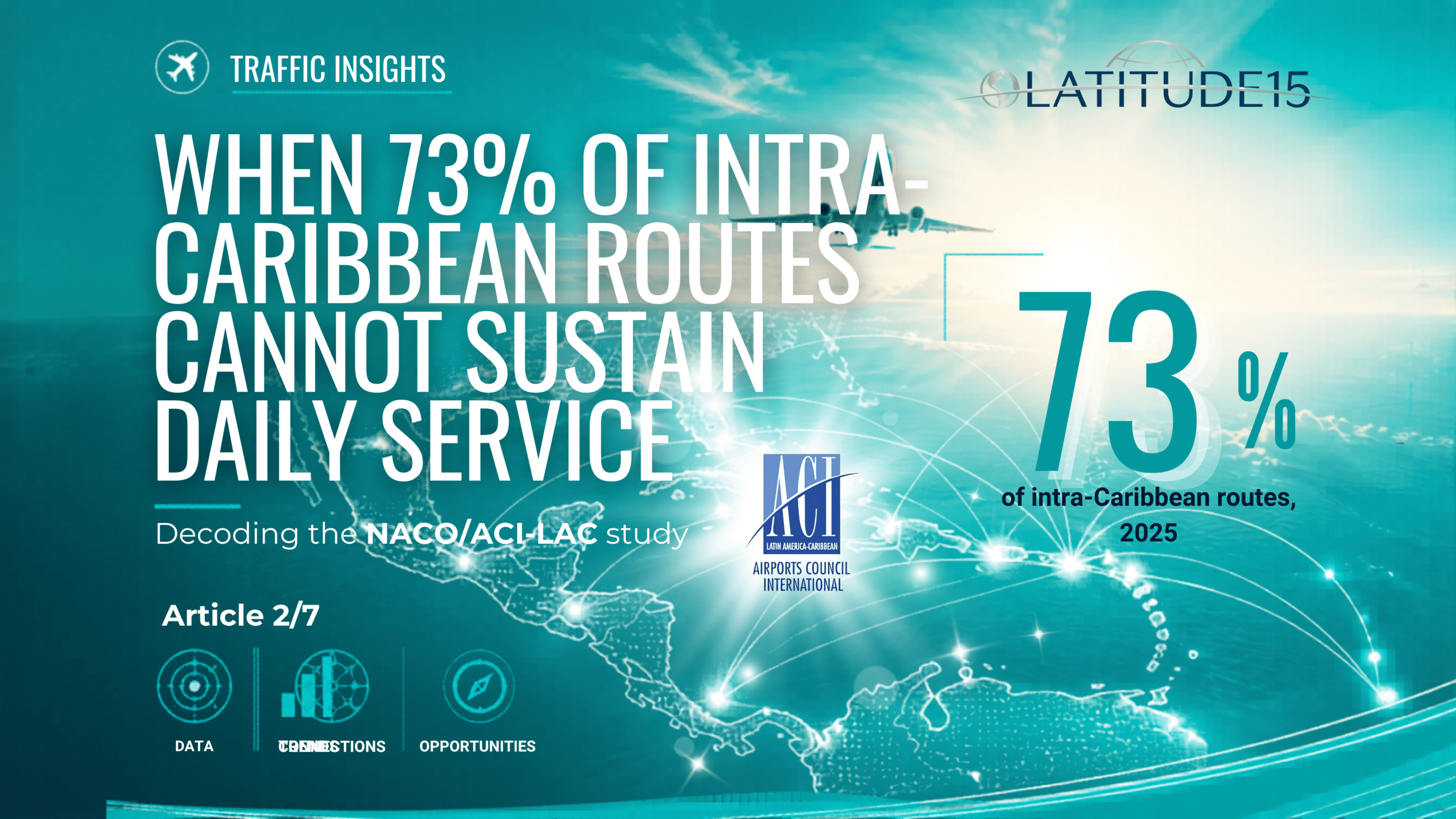
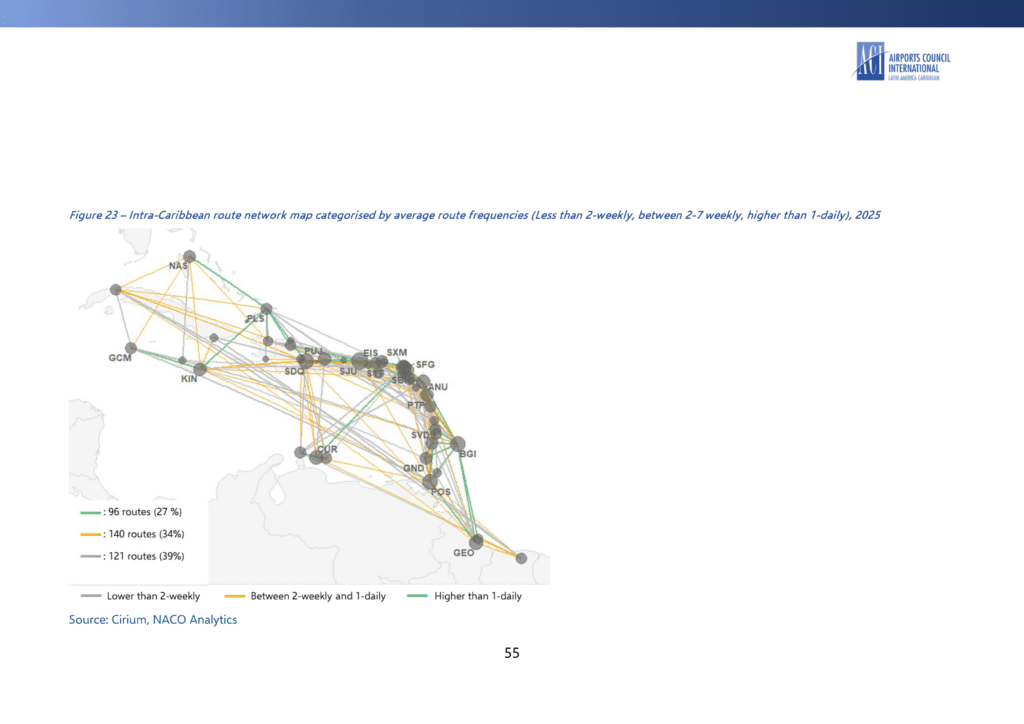
Of 357 active intra-Caribbean routes in 2025, 39% operate fewer than twice a week, 34% between two and six times, and only 27% offer at least daily service. According to the NACO/ACI-LAC study released in March 2026, it is this degraded quality of links — far more than their sheer number — that structurally undermines regional mobility. A decoding.
The study The State of Air Connectivity in the Caribbean, commissioned by ACI-LAC to consultancy NACO and published in March 2026, applies two reference thresholds to measure route quality: two weekly frequencies as a proxy for minimum connectivity, and seven weekly frequencies (i.e., daily service) as a proxy for reliable connectivity. On both thresholds, the intra-Caribbean network shows a structural deficit. The report puts it plainly: while the intra-regional route map looks broad at first glance, the reality is that the majority of intra-Caribbean routes cannot sustain seven weekly frequencies or more.
Across 357 active routes recorded by NACO in 2025 (excluding domestic segments), the breakdown is precise: 39% operate below two weekly frequencies, which the study describes as service below the minimum operational threshold. 34% sit in an intermediate band between two and six weekly frequencies — in most cases, that no same-day return is available, and that a business traveller arriving on Monday will often have to wait until Wednesday or Thursday to return. Only 27% of routes meet or exceed the daily threshold.
The hidden cost of low frequency: two documented case studies
To translate this infrequency into operational terms, NACO documents two real-world cases that illustrate the impact on otherwise short journeys. First case: an airport executive based in the Cayman Islands plans to attend a regional industry event in Martinique on Tuesday 4 November. With no direct flight available on the Sunday, she must travel from Saturday 1 November and cannot return until 9 November. For what is functionally a one-day business engagement, the round trip mobilises nine days — a direct consequence of the absence of adjustable frequencies.
Second case: a European tourist staying in Curaçao wishes to visit Trinidad and Tobago alongside her holiday. The two islands are relatively close, yet the available itinerary forces multiple stops and a rigid calendar. NACO draws a synthetic conclusion: building an intra-Caribbean itinerary remains a challenge, even between geographically close destinations.
Bonaire-Barbados: 1,000 kilometres, more than twenty hours
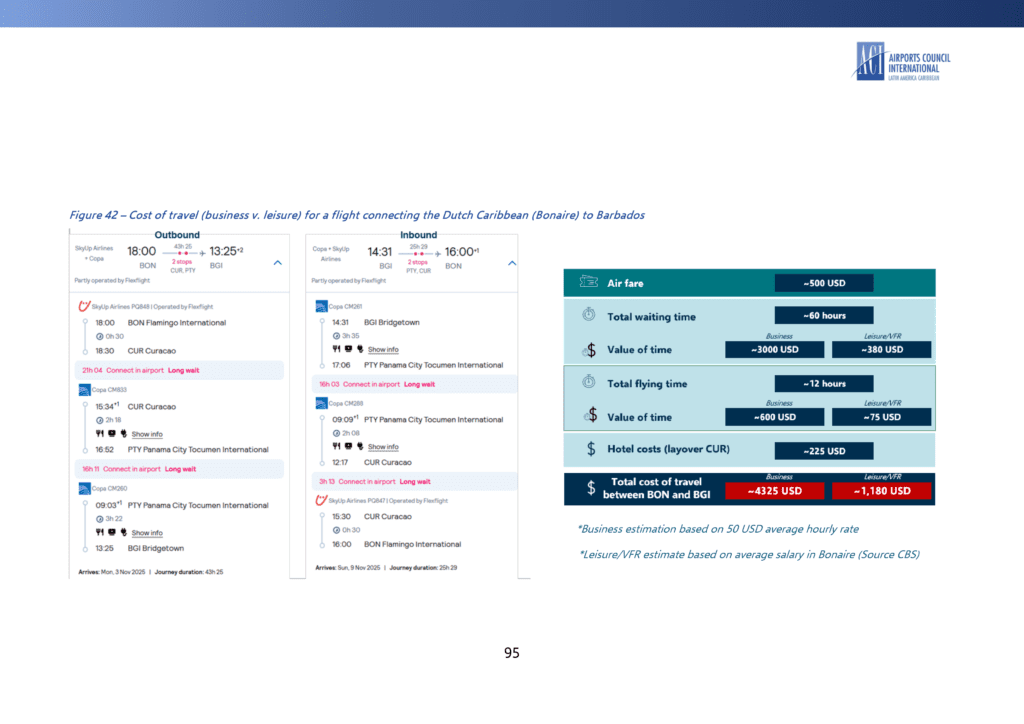
The most striking case documented by the study is the Bonaire-Barbados link. The two islands are roughly 1,000 kilometres apart. A direct flight would normally take two to three hours. With no direct service available, a flight engine search conducted by NACO on 30 September 2025 revealed that the actual journey requires at least two stops, with no schedule coordination between airlines, and that a traveller may need more than twenty hours to complete a one-way trip. In some cases, the report notes, up to two days may be required to complete a single-way journey.
Building on this case, NACO applied a total cost of travel quantification using airfare, accommodation where required, and the Value of Time (VoT) concept. The result is unambiguous: on a Bonaire-Barbados trip, the cost of waiting time represents 70% of the total cost of travel for the business segment, and 32% for the leisure and VFR segment. Put differently, time lost in connections costs more than the ticket itself for a regional executive.
A fragmentation that is not only geographic
The study highlights a point that is often overlooked: the observed fragmentation is not solely a product of insular geography. It is also the result of weak coordination between airlines operating in the region. Caribbean carrier networks, NACO writes, tend to be highly fragmented, with each airline focusing on its own intra-regional routes with little or no schedule coordination. This fragmentation limits the offering of efficient connections, both in time and in price, between islands.
By contrast, twenty-eight Caribbean countries offer on average two daily frequencies to Miami. For a regional business traveller, it is sometimes simpler, faster and cheaper to transit through Miami to reach another Caribbean island than to use a non-existent or irregular direct link. The region effectively outsources part of its own internal mobility.
A question of thresholds, not just maps
The central lesson from this section of the study is methodological as much as it is analytical: connectivity is not measured by the number of existing routes alone, but by their capacity to support same-day round trips, coordinated transfers, and frequencies compatible with modern professional and tourism uses. By that measure, the intra-Caribbean network remains massively below the standards the region applies to itself for its extra-regional links.
The next article in this series will explore what this operational fragility actually costs Caribbean travellers — and why a weekend between islands exceeds, in most countries of the region, the average monthly income of a local resident.
Source
NACO (Netherlands Airport Consultants), The State of Air Connectivity in the Caribbean: A Renewed Vision for Progress, independent study commissioned by ACI-LAC, March 2026, 128 pages. Data sources: sections 3.4.4, 3.4.7 and 4.6.4.