Four new port members and a rapidly expanding associate network are widening PMAC’s reach. The next challenge is to convert that growth into training, regional standards and projects that continue between annual meetings.
The Port Management Association of the Caribbean concluded its 29th Annual General Meeting with a larger membership and a broader operational agenda.
PMAC reported four new port members during the meeting held from 8 to 10 July 2026 in Paramaribo, Suriname. Chairman Darwin Telemaque described the increase in port membership as close to 18%, while the association’s network of associate members had expanded by nearly 40%.
The figures show growing demand for a regional platform connecting Caribbean ports, technical partners and development institutions. But membership growth alone will not determine PMAC’s regional influence. Its more difficult test will be turning a larger network into practical cooperation, shared capabilities and measurable results.
Four new members extend PMAC’s port network
PMAC’s chairman identified Santo Domingo, Haiti and two Surinamese port entities among the four additions announced during the AGM.
Their arrival expands a network that represents more facilities than its formal membership count initially suggests. One port authority can oversee cargo terminals, cruise facilities, bulk operations, oil and gas terminals and smaller docks across a territory.
Telemaque explained that while PMAC formally referred to 24 port members before the latest additions, the authorities within the association collectively oversee a much larger number of maritime facilities.
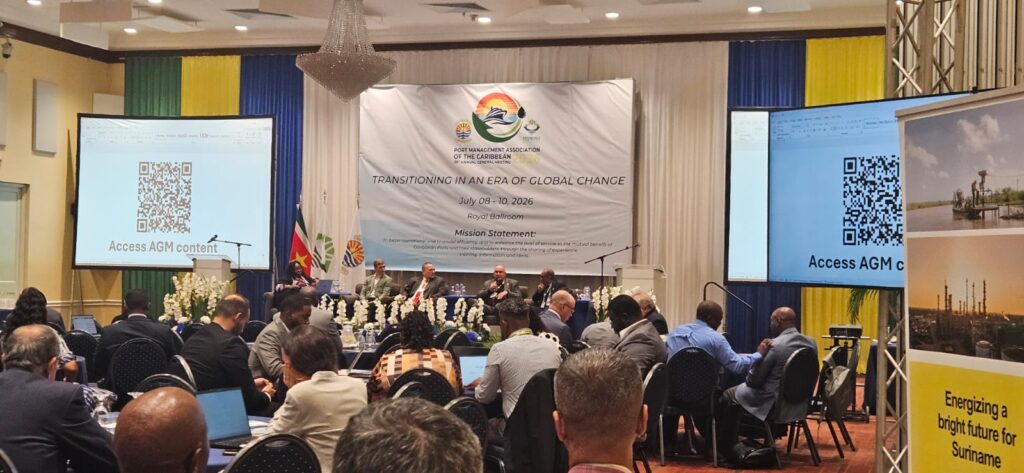
The scale of the 2026 meeting also reflected this broader reach. PMAC recorded participation from 92 organisations across 25 countries—a level of geographical representation that its chairman described as potentially the largest in the association’s history.
The three-day programme covered digital transformation, renewable energy, shore power, port security, operational efficiency, regional shipping and supply-chain connectivity. Port members and associate members also held separate business sessions to review their own priorities and working programmes.
These figures establish the size of the platform. They do not, however, show whether the participating ports can maintain the same level of engagement after the conference ends.
A 23-member associate network moves closer to port strategy
PMAC’s associate network reached 23 members, representing growth of nearly 40% over the previous year. More than half of the participants in the associate members’ meeting were attending for the first time.
The associate members include companies, consultants, universities, equipment providers and technical specialists working in areas such as digitalisation, risk management, training, energy and port operations.
During their report to the AGM, associate representatives said that this part of the membership should not function simply as a networking group or a venue for promoting commercial services. The aim is to involve associate members more directly in the technical priorities defined by the ports.
As Darwin Telemaque put it: “Our associate members are not visitors to PMAC.”
That shift is beginning to appear in the working-group structure. Port digitalisation, data and governance are assigned to the digitalisation group. Decarbonisation and the green-port transition are being connected to risk and resilience, while supply-chain resilience and regional connectivity fall under the port-efficiency workstream.
Maritime security and port-infrastructure protection are expected to remain under PMAC’s direct oversight rather than being delegated to an associate-led group.
The structure could give smaller ports access to expertise that they do not maintain internally. It also requires clear governance. Technical and commercial partners can help develop solutions, but port authorities must continue to define the operational problems, priorities and expected outcomes.
Peer learning and training become measurable activities
The association’s expansion is also being accompanied by a stronger focus on workforce development.
Ahead of the AGM, 62 non-management port employees participated in two days of training in Suriname. One day focused on digitalisation, while the second addressed port electrification and shore power.
External support covered travel, accommodation and meals for the participating employees, allowing personnel from different territories to attend without transferring the full cost to their ports.
The programme matters because infrastructure investment alone does not guarantee operational improvement. Ports introducing digital systems, electric equipment or new energy infrastructure also need employees capable of operating, maintaining and managing those assets.
Mary-Ann Abdoelkariem, PMAC’s Executive Secretary, described the exchange of country reports as another practical learning mechanism. Port representatives use these presentations to compare what they have achieved, identify their difficulties and examine how other territories have responded.
“They share what they’ve achieved, what their challenges are, so we can learn from each other.”
She also placed employee training alongside port development as one of the association’s core functions.
PMAC has discussed building a more structured training framework with support from the Caribbean Maritime University and specialist partners. The challenge will be to turn programmes linked to the annual meeting into a recurring regional offer accessible throughout the year.
The working groups reveal an uneven level of engagement
PMAC’s internal reports also exposed the gap between creating a working group and securing sustained participation from ports.
The digitalisation working group reportedly required several years to achieve a survey-response rate of approximately 90%. The port-efficiency exercise, by comparison, was still receiving responses from only about 30% of the ports approached.
Associate representatives explicitly asked port authorities to participate more consistently in working-group meetings and to respond to surveys and questionnaires.
The comparison matters because regional standards cannot be built without comparable information. PMAC may want to harmonise productivity indicators, digital practices or resilience planning, but it first needs sufficient data from the ports themselves.
The organisation also faces a financial constraint. Telemaque reported that some port and associate members had not paid their membership fees, reducing the resources available to implement planned activities.
He linked that issue directly to PMAC’s ability to strengthen its secretariat and support members more consistently:
“We need to build a system where we can be working with the ports on a regular basis.”
The association is therefore managing two forms of growth at once: a larger membership and a larger workload. More members create additional opportunities for collaboration, but they also increase the volume of coordination, data collection and project follow-up expected from a relatively limited administrative structure.
Regional representation is becoming more active
PMAC’s ambitions now extend beyond hosting an annual meeting.
In his chairman’s report, Telemaque counted 12 engagements across three continents, in addition to regional activity, during the year following the previous AGM.
These included participation in CARICOM-related discussions, meetings in Miami and the Bahamas, engagement with the European Union and presentations of PMAC’s five-pillar strategy to international partners.
Telemaque also described a meeting with the U.S. government attended by representatives of around 40 private-sector institutions and companies. The purpose was to expose Caribbean port priorities to potential technical and financial partners rather than leave each small port to pursue those conversations independently.
The association is also seeking stronger formal recognition within CARICOM. PMAC already participates in regional meetings, but its leadership wants the organisation to become a more clearly established reference point for port policy and project coordination.
That institutional position could help reduce duplication. During the AGM, participants noted that several organisations may commission similar studies or approach individual ports with comparable programmes without a shared regional framework.
A coordinating platform could instead consolidate project needs, identify common technical requirements and determine where one regional study or template could support several ports.
From representation to project preparation
PMAC’s proposed role is also moving further into the early stages of project development.
Telemaque argued that the association needs access to regional specialists and consultants capable of helping ports organise their needs before external feasibility studies or financing discussions begin.
He identified a gap between international experts and the local knowledge held by port authorities. External consultants may understand technical and financing standards, but regionally based experts can provide the contacts, operating context and institutional knowledge needed to shape an appropriate project.
The issue is one of capacity. PMAC does not yet have sufficient resources to retain all the expertise it would need across energy, digitalisation, infrastructure, security and operations.
During the financing discussions, Telemaque suggested attaching subject-matter experts or regional consultants more closely to the association so that ports could receive support during the pre-feasibility stage.
This proposal gives the membership figures a practical meaning. A larger network could allow ports to pool knowledge, spread the cost of technical preparation and approach partners collectively. Without stronger execution capacity, however, the network risks generating more dialogue than deliverable projects.
PMAC’s expansion has given Caribbean ports a wider collective platform. Its next measure of success will not be how many organisations attend the AGM, but whether the association can produce training programmes, comparable data, shared standards and investment-ready projects in the months between meetings.