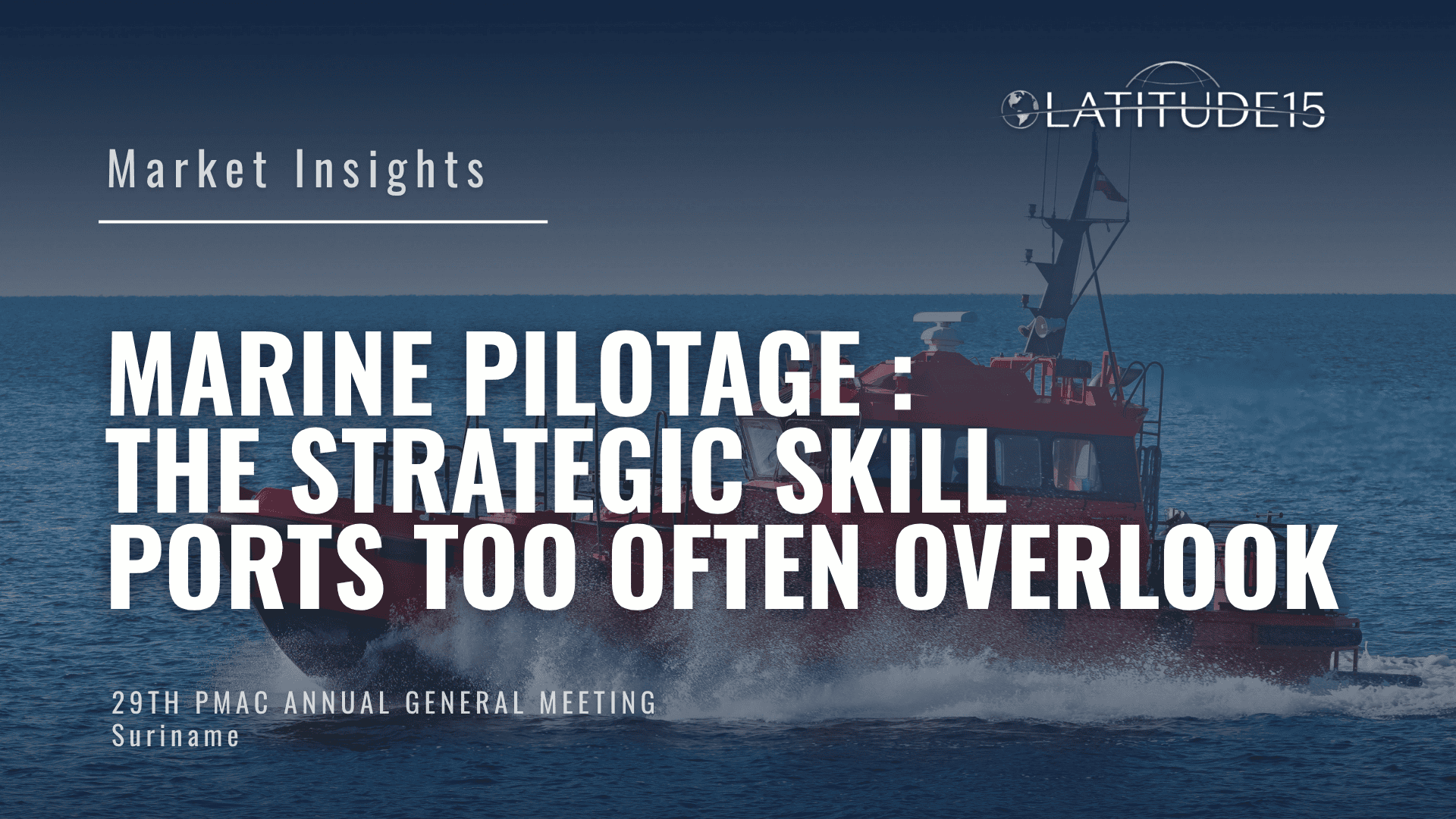
A port can invest in deeper berths, new cranes, digital platforms and larger terminals. But none of those assets creates value until a vessel can reach the quay safely. At the PMAC Annual General Meeting in Paramaribo, marine pilotage emerged as one of the less visible — but potentially most strategic — capabilities behind Caribbean port operations.
A ship may have crossed thousands of nautical miles before reaching a Caribbean island. Yet some of the most demanding moments of the voyage come at the very end: entering local waters, navigating a channel, accounting for tides and available depth, coordinating with tugboats and bringing the vessel alongside the berth.
This is where marine pilots operate.
During the Port Management Association of the Caribbean’s 2026 AGM, John-Paul Pantin, Pilot Master of the Trinidad and Tobago Pilots’ Association, challenged port leaders to look at pilotage differently. Rather than viewing it simply as another service attached to a vessel call, he argued that it should be understood as part of the infrastructure that allows the port itself to function.
His phrase was particularly concise:
“Pilotage is an invisible infrastructure.”
That description raises a wider question for Caribbean ports. As vessels grow, navigation technologies change and existing infrastructure is pushed closer to its operating limits, is enough attention being paid to the people who manage the final interface between ship and shore?
The port does not start at the quay
Pantin has worked as a marine pilot since 2013 and has served as Pilot Master of the Trinidad and Tobago Pilots’ Association since March 2023. According to the PMAC programme, his responsibilities include coordinating pilotage operations, evaluating navigational risks, training pilots and ensuring regulatory compliance.
His central argument begins with a simple operational reality:
“Until the ship is docked alongside, your operation has not started.”
Ports typically measure performance through berth productivity, cargo moves, vessel turnaround, dwell times or gate efficiency. But all of those indicators begin after a vessel has successfully completed its approach.
The pilot works before that point.
Pantin described a system that begins well before boarding the vessel. It involves examining arrival times, weather, tidal variations, cargo and vessel characteristics, draft, navigation conditions and other local constraints. Once the ship approaches port, the pilot also operates at the centre of a network involving the vessel’s command, port authorities and tugboats.
The expertise is therefore not limited to manoeuvring a ship. It is about interpreting several changing conditions at the same time and converting them into a safe port call.
The value lies partly in what does not happen
Pilotage presents an unusual management problem: when it performs well, its contribution can be difficult to see.
Pantin put it this way:
“The value of pilotage is often the things that never happen.”
There is no collision. No vessel blocks the channel. No berth is damaged. No pollution incident interrupts operations.
As a result, pilotage can appear routine precisely because the risk has been successfully managed.
That becomes more important when the infrastructure being protected is difficult to replace.
Pantin pointed to channels, turning basins, LNG and petroleum facilities and other maritime assets whose disruption can affect far more than a single vessel movement. He argued that pilotage forms a risk-management layer protecting not only ships, but also trade continuity, energy infrastructure and the wider economy connected to the port.
For small island economies, this distinction matters.
A large country may have several major gateways available when one facility is temporarily disrupted. Some Caribbean economies operate with fewer alternatives. In that context, a ship-related incident that disables an access channel or strategic terminal can move rapidly from an operational problem to a wider supply-chain issue.
Pantin described a major pilotage incident in such circumstances not as an isolated marine event, but as something capable of becoming a national event when a critical port is disabled.
Bigger ships, tighter margins
The operating environment is also changing.
Pantin noted that pilots today face technologies and vessel characteristics that differ substantially from those of previous generations. New propulsion systems, new navigation technologies and increasingly sophisticated vessels require pilots to continue developing their skills rather than relying entirely on experience accumulated under older operating conditions.
At the same time, some Caribbean ports are attempting to accommodate larger vessels within infrastructure that was not necessarily designed for current ship dimensions.
Pantin described discussions around handling vessels of approximately 320 metres, with very limited under-keel clearance in one operating example.
The specific figures relate to the case presented during the session and should not be treated as representative of every Caribbean port. But the underlying issue is broader.
As vessel dimensions increase while channels, turning basins and berths remain physically constrained, the margin for operational error can narrow.
Port expansion is therefore not only a question of concrete and dredging.
It is also a question of whether the local operational knowledge needed to use that infrastructure safely is developing at the same pace.
Bring pilots into port planning earlier
This is where pilotage becomes relevant beyond daily vessel movements.
Pantin argued that pilots should be involved earlier in discussions about port development.
He recalled cases where infrastructure decisions created operating constraints that could potentially have been identified sooner through direct consultation with the professionals responsible for bringing vessels into the facility.
His message to port developers was straightforward:
“Bring your pilots into your league. Let’s get their advice so that when you build the port, the ships can come in.”
The implication is significant.
Marine pilots accumulate practical knowledge about:
- ship behaviour in local conditions;
- available water depth;
- approach routes;
- turning requirements;
- tug requirements;
- navigation constraints;
- and the practical limits of existing infrastructure.
That knowledge can be valuable before a terminal is built or expanded, rather than only after the first vessel arrives.
For port authorities, integrating pilots into planning could therefore add another operational perspective to decisions about channels, berth layouts, navigation procedures and future vessel profiles.
It does not replace engineering or technical studies. It complements them with the experience of those who ultimately have to operate within the infrastructure being designed.
Marine pilotage : A skill that takes years to rebuild
Infrastructure can be replaced with capital.
Experience is more difficult to replace.
Pantin presented succession planning as a risk-management issue in its own right. In his assessment, the pathway from maritime education through senior shipboard experience and eventually into pilotage can take around a decade.
That estimate reflects his professional experience rather than a uniform regional training requirement, but the underlying point is clear: qualified pilots cannot simply be produced when a vacancy appears.
Local knowledge accumulates over time.
Pantin also stressed that when experienced pilots retire without structured knowledge transfer, some of the country’s operational memory can disappear with them.
For Caribbean ports, succession therefore involves more than filling positions.
It means preserving knowledge of:
- recurring manoeuvres;
- local weather patterns;
- navigational constraints;
- vessel behaviour;
- historical incidents;
- operational procedures;
- and the limits within which particular ships can safely enter.
Training the next generation must therefore happen before the previous one leaves.
Technology changes the job — and the skill requirement
Digitalisation does not remove this challenge.
Pantin said modern pilots increasingly work with tools and information that did not form part of the profession several decades ago. He referred to remote vessel monitoring and the ability to follow ships well before their arrival, alongside new navigation and propulsion technologies.
The implication is not that technology makes the pilot redundant.
Rather, the skill profile itself is changing.
A modern pilot must combine accumulated local knowledge with the ability to understand increasingly sophisticated ships and operating systems.
That creates another investment requirement for ports and pilot organisations: continuous training.
Pantin specifically called for pilots to be exposed to new technologies and methodologies so that they can make informed decisions when increasingly complex vessels enter national waters.
The technology transition affecting ports therefore has a human dimension.
Buying new equipment or deploying new systems does not automatically create the competence required to use them safely.
Safety, cost and the question of public value
Pantin also framed pilotage as a public-safety and sovereign function.
In Trinidad and Tobago, he pointed to the legislative framework governing pilotage and argued that professional judgement needs protection from commercial pressure when safety is at stake.
That does not eliminate legitimate questions about cost.
Shipping companies and ports operate under pressure to improve efficiency, reduce vessel time and control charges. Pilotage cannot simply be removed from those discussions.
But the debate changes when the service is considered alongside the risk it manages.
Pantin argued that strong pilotage should be seen as a public-safety investment rather than solely as an operating expense.
For port decision-makers, the more balanced question may therefore be:
what level of pilotage capability is required to manage the ships, infrastructure and economic exposure of the port safely — and how can that capability be delivered efficiently?
That is different from assuming either that every existing arrangement must remain untouched or that pilotage is simply another cost to minimise.
Making invisible infrastructure visible
The importance of the discussion was also reflected by other PMAC participants.
Blaize Jones, Chairman of the Dominica Air and Seaport Authority, said the pilotage session had been particularly instructive and argued that Caribbean ports do not always pay enough attention to this dimension of maritime operations.
That observation captures the broader issue.
Ports are entering another investment cycle defined by larger ships, digital systems, energy transition and pressure to increase productivity. Most of these changes are visible: new terminals, new equipment, new power infrastructure.
Pilotage is less visible.
Yet it sits directly between the ship and all of those investments.
A port can deepen a channel, extend a berth and buy more productive cranes. But those investments deliver little if vessels cannot access them safely and consistently.
The strategic challenge is therefore not simply to preserve pilotage as it exists today. It is to make sure that the expertise evolves with the ships, that knowledge is transferred before it disappears, and that pilots are included early enough in decisions that will shape future port operations.
Invisible infrastructure still has to be planned, trained and invested in.