Guyana is moving its proposed Berbice deep-water port closer to a decision point, with Bechtel expected to complete a full study of the project around November 2026. The port is being considered as part of a wider infrastructure strategy linking Region Six to new roads, bridges, industrial developments and a future trade corridor towards northern Brazil.
Bechtel study brings the Berbice port closer to a decision
The proposed Berbice deep-water port in Region Six, eastern Guyana, has entered a new stage of development. On September 11, 2026, Natural Resources Minister Vickram Bharrat said Bechtel was conducting a full study of the project and was expected to complete the work within approximately two months.
The Government of Guyana is expected to review the Bechtel study before determining how the project should move forward. Vickram Bharrat said an Expression of Interest involving both local and international investors could be considered, while also noting that the final investment structure had not yet been selected.
The proposed deep-water facility is therefore not yet a construction project. No final investment model, construction contract or definitive development schedule has been announced, making the Bechtel study an important step between Guyana’s long-standing port ambitions and a potential investment decision.
Berbice port plans are tied to a wider transport network
The proposed Berbice deep-water port is being planned as part of a much larger transport network rather than as an isolated maritime facility. Guyana’s 2026 Budget explicitly connects the completion of the Linden–Lethem corridor to an onward road link towards the new deep-water port in Berbice, including a modern four-lane, high-span bridge across the Berbice River.
The Linden–Lethem corridor is strategically important because it forms Guyana’s principal overland connection towards Brazil. The government’s longer-term infrastructure plan is intended to connect the Berbice coast with Linden, Lethem and the Takutu River crossing into Brazil, creating the possibility of moving more commercial traffic between the Atlantic coast and the northern South American interior.
The new Berbice River Bridge is another part of that strategy. The Government of Guyana plans a four-lane, high-span structure designed to allow larger vessels to pass beneath it while improving road connectivity across Region Six. President Irfaan Ali said in May 2026 that construction was expected to begin before the end of the year, while earlier government updates described negotiations over financing, price and contract arrangements as being in their final stages.
Guyana is looking beyond domestic cargo flows
The proposed Berbice deep-water port could eventually serve a broader regional role if Guyana completes the road and bridge infrastructure now being developed. Government planning increasingly presents Region Six as part of a corridor connecting domestic production centres with Suriname to the east and Brazil to the south.
On September 2, 2026, Public Works Minister Juan Edghill described an integrated transport network stretching from the Guyanese coast through Linden and Lethem towards the Takutu River Bridge and the Brazilian market. The same infrastructure strategy includes the Palmyra–Moleson Creek corridor and a future Corentyne River Bridge linking Guyana and Suriname.
The regional logistics opportunity remains prospective rather than operational. Brazilian container traffic is not yet moving through a Berbice deep-water facility, but the transport network is being designed with that possibility in mind. For Guyana, the strategic objective is to create an Atlantic gateway capable of supporting larger volumes of domestic and potentially regional trade.
Industrial plans could generate new port demand
Region Six is also being positioned for a broader industrial transformation that could create new demand for maritime infrastructure. In June 2026, Senior Minister in the Office of the President with Responsibility for Finance Ashni Singh said the government envisaged a second natural gas pipeline reaching Region Six, alongside industrial investments in areas such as petrochemicals, bauxite processing and fertiliser manufacturing.
The Government of Guyana has linked those industrial ambitions directly to transport infrastructure around the Berbice River. A deep-water port could provide import and export capacity for industrial projects while the new roads and bridges would strengthen connections with production areas and regional markets.
The industrial developments remain largely at the planning stage. The significance for the port project is therefore not existing cargo volumes, but the possibility that new manufacturing, energy and processing activities could generate additional maritime flows if the wider Region Six development strategy is implemented.
Several Berbice port projects need to be distinguished
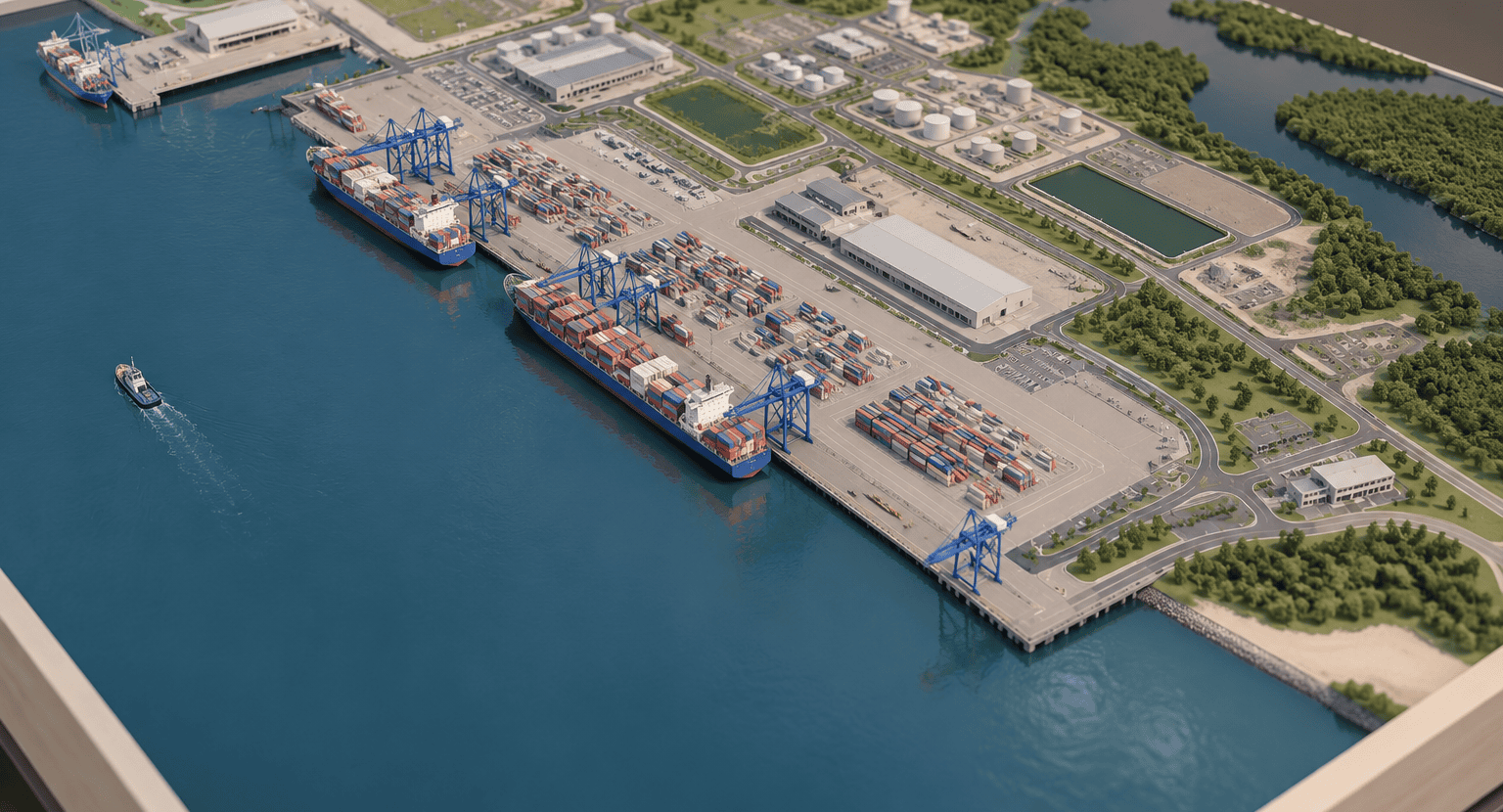
The government-backed deep-water port being studied by Bechtel is not the only maritime development in Berbice. The region already hosts port infrastructure associated with CGX Energy and Grand Canal Industrial Estates, while separate private-sector port projects have also been announced.
The latest reporting on the Bechtel study identifies the Crab Island/No. 19 area in Region Six, close to the existing CGX wharf, as the area earmarked for the proposed government-backed deep-water port.
Government infrastructure communications have, however, also continued to refer to a planned deep-water harbour at Palmyra. On September 2, 2026, the Department of Public Information quoted Public Works Minister Juan Edghill describing Palmyra as a major future development hub that would include a deep-water harbour.
Until the Bechtel study or subsequent government decisions establish the final configuration, the safest reading is that Guyana is planning a deep-water facility within the wider Berbice River and Region Six development zone, while the exact project footprint remains to be clarified publicly.
Financing interest is emerging, but no final commitment yet
The proposed Berbice deep-water port has already attracted preliminary attention from the Export-Import Bank of the United States. In April 2026, US EXIM issued a Letter of Interest relating to the project.
An EXIM Letter of Interest does not constitute a final financing commitment. The US agency describes the instrument as an indication that it is willing to consider financing a transaction, subject to further review and a formal application.
The distinction is important for the Berbice project. International financing interest adds credibility to Guyana’s port ambitions, but the next decisive step remains the completion of the Bechtel study and the government’s choice of an investment and procurement model.
The proposed Berbice deep-water port is therefore approaching a more concrete phase without having reached construction. The coming decisions will determine whether Guyana can turn its infrastructure plans for Region Six into a functioning maritime gateway connecting industrial development, domestic trade and a wider Atlantic logistics corridor.
Sources: Guyana Times – Bechtel deep-water port study, September 11, 2026
Where is the proposed Berbice deep-water port located?
The project is planned for Region Six in eastern Guyana. Reporting on the Bechtel study points to the Crab Island/No. 19 area, while government infrastructure communications have also referred to Palmyra within the wider Berbice development zone.
What is Bechtel doing on the Berbice deep-water port project?
Bechtel has been contracted to conduct a full study of the proposed port for the Government of Guyana.
When is the Bechtel study expected to be completed?
Natural Resources Minister Vickram Bharrat said on September 11, 2026 that the study was expected within approximately two months.