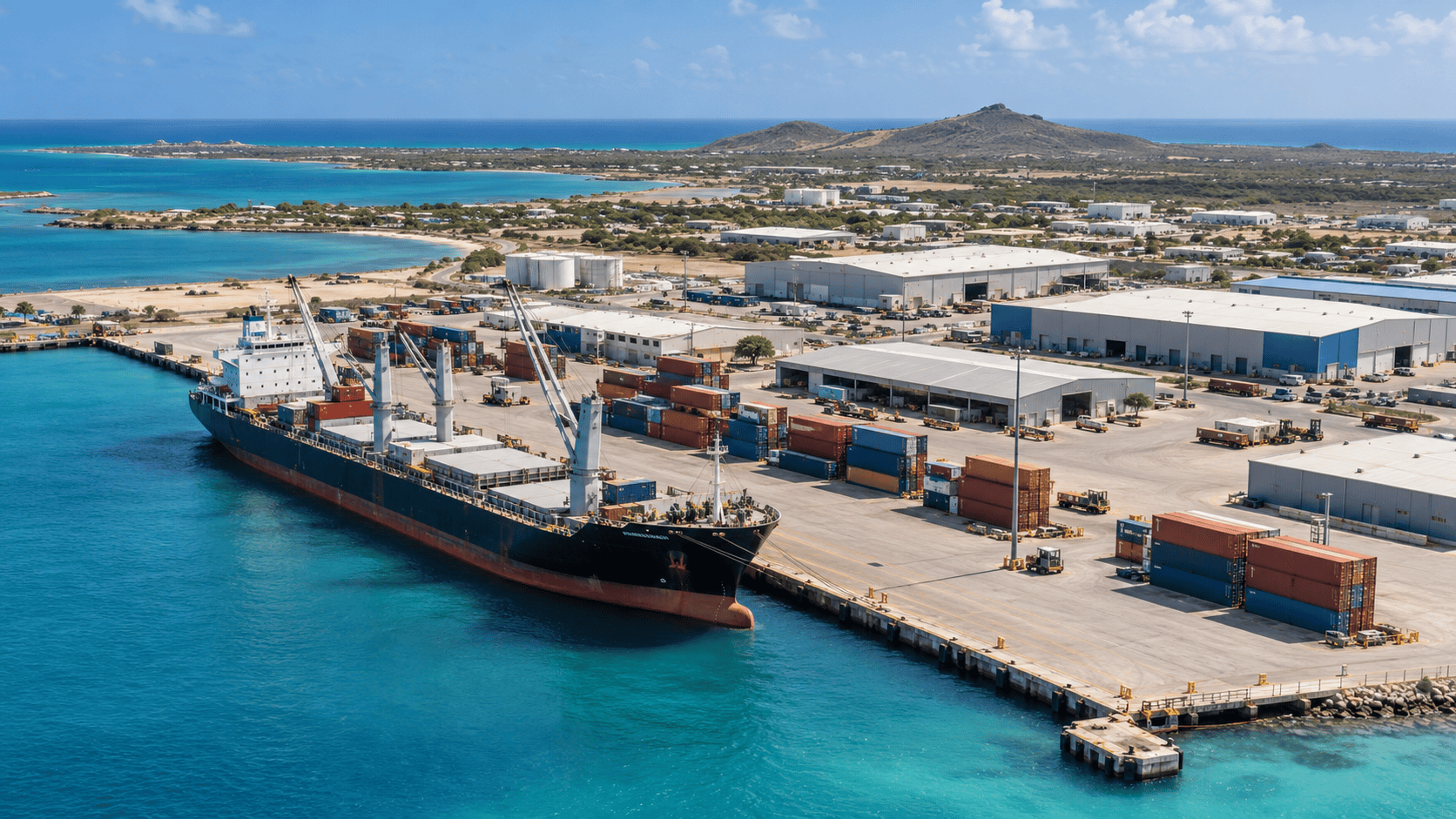
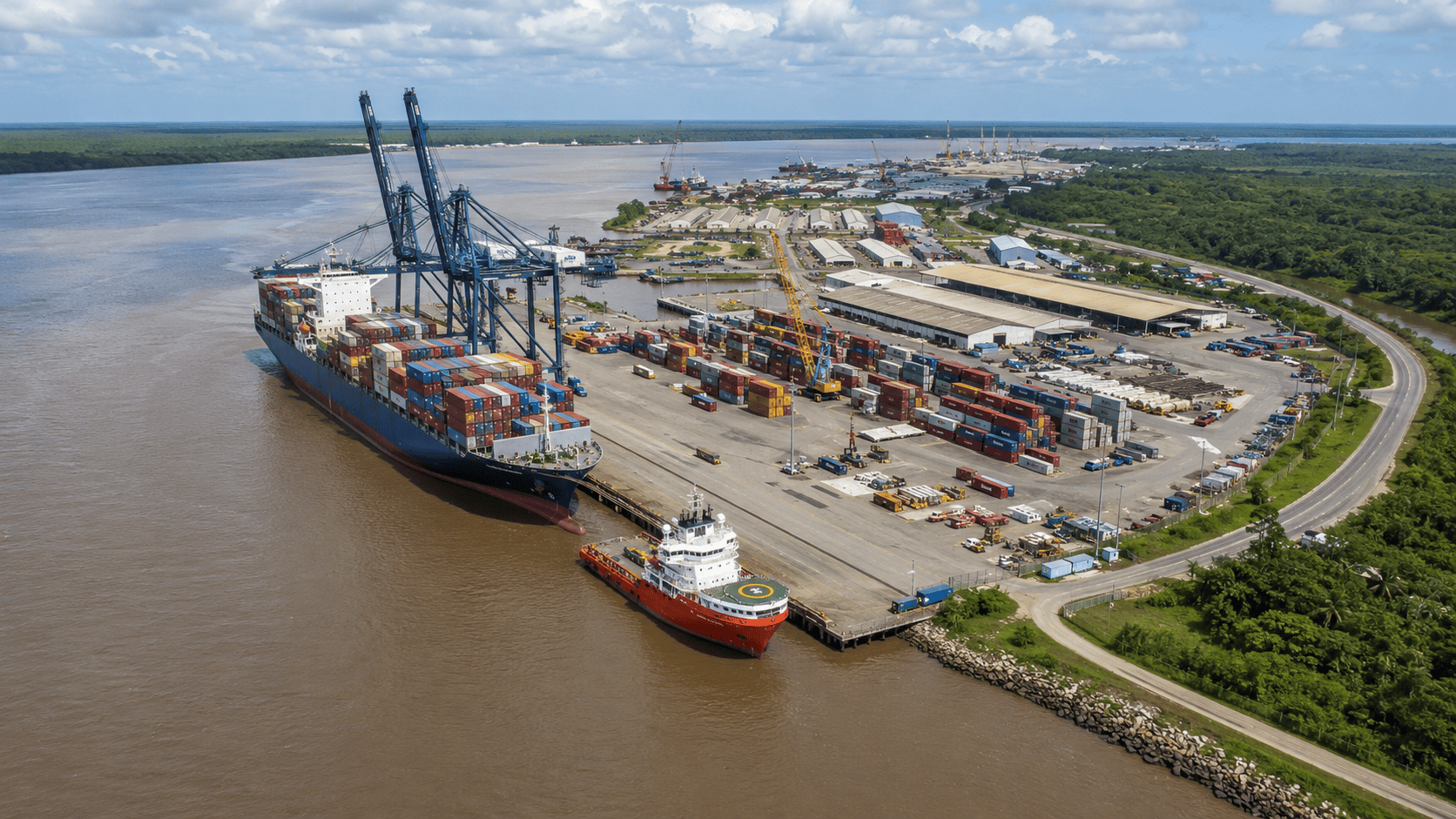
Guyana is expanding its maritime capacity at a remarkable pace, but demand is rising just as quickly. Vessel traffic has increased by 42% since 2020 and containerised imports have climbed from about 42,000 to nearly 150,000 TEUs a year, while new shore bases, dredging projects and regional trade facilities are reshaping the country’s port system. Guyana’s challenge in 2026 is therefore not simply to build more infrastructure, but to connect those investments into a maritime network capable of supporting the next stage of economic growth.
Maritime demand is scaling fast
Guyana’s maritime sector has expanded rapidly since 2020 as offshore oil production, construction, consumer demand and international trade have accelerated. Speaking in Guyana in June 2026, Minister of Public Utilities and Aviation Deodat Indar said vessel traffic had increased by 42% since 2020, while containerised imports had risen from approximately 42,000 TEUs annually to close to 150,000 TEUs.
Deodat Indar described the expansion in June 2026 as structural rather than temporary, stating that “that growth is strong and it will continue over the next two decades.” The increase creates commercial opportunities for Guyana, but it also raises requirements for vessel access, cargo handling, maritime safety, environmental oversight and port efficiency.
Guyana’s wider economy reinforces the scale of the challenge facing its maritime sector. The International Monetary Fund currently projects 16.2% real GDP growth for Guyana in 2026, meaning ports are being asked to adapt while the economy they serve continues to expand at an exceptional rate.
Before bigger ports, Guyana needs deeper access
The Demerara River in Guyana illustrates why port capacity cannot be measured by terminals alone. In May 2026, Guyana’s Maritime Administration Department signed a US$11.2 million contract with Boskalis CPG Inc. to dredge the Demerara navigational channel between Houston and Golden Grove on the East Bank of Demerara.
The Demerara River dredging programme covers approximately nine kilometres of channel, with a planned width of 100 metres and depth of five metres. Guyanese authorities stated in May 2026 that the works were intended to improve vessel access and increase port efficiency along one of the country’s main maritime corridors.
The Demerara River project highlights a basic constraint in Guyana’s port expansion: new cranes, warehouses and quays can only create their full economic value if vessels can reach them efficiently. Deeper and more reliable nautical access therefore sits at the centre of Guyana’s attempt to accommodate larger trade and energy volumes.
A new generation of energy ports
Guyana’s offshore oil industry is also changing the type of port infrastructure the country needs. The Vreed-en-Hoop Shore Base in Guyana, officially opened in January 2025, represents an investment of about US$300 million and was constructed on the country’s first artificial island. The facility provides storage, fabrication, subsea equipment handling and other services required by offshore petroleum operations.
The TriStar Shore Base and Energy Terminal on the West Bank of Demerara, Guyana, provides another indication of the scale of maritime investment. The Guyana Office for Investment announced in February 2026 a planned total investment of US$250 million, with the first phase already operational as a 24-hour multipurpose facility serving offshore oil and gas operations as well as container, general and project cargo.
The first phase of the TriStar Shore Base and Energy Terminal includes approximately 320 metres of quayside with a seven-metre draft. Planned later phases include a container terminal with capacity for 5,500 TEUs, roll-on/roll-off infrastructure, an inland container depot, pipe yards and additional logistics facilities.
The Vreed-en-Hoop and TriStar developments show that Guyana is not simply adding conventional port capacity. Guyana is developing specialised logistics centres capable of handling offshore equipment, heavy cargo, containers and industrial supply chains as petroleum production creates increasingly complex maritime requirements.
Parika takes the port strategy beyond oil
The Parika International Port Facility and Waterfront Development in Region Three, Guyana, broadens the maritime strategy beyond offshore energy. Construction reached a visible milestone in June 2026 when the first concrete was poured for the approximately G$4.5 billion development.
The Parika International Port Facility is planned to accommodate cargo vessels transporting goods across the Caribbean as well as cruise ships. Guyanese authorities expect the development to modernise export processes and strengthen Guyana’s access to markets across the Caribbean, while a later phase is expected to add marina infrastructure.
Parika, Guyana, is particularly important because the project points toward a maritime model that is not exclusively dependent on petroleum. Agriculture, exports, tourism and regional trade could all use the new infrastructure, giving Guyana an opportunity to turn growing port capacity into stronger commercial connections with CARICOM markets.
From port projects to a port system
Guyana’s central maritime challenge in 2026 is increasingly one of integration. Dredging on the Demerara River, specialised shore bases on the West Bank of Demerara and the international port development at Parika address different parts of the logistics chain, but competitiveness will ultimately depend on how effectively those assets work together.
Guyana’s port expansion will therefore require more than quay length and water depth. Customs efficiency, cargo-handling technology, road connectivity, maritime security, workforce development and effective regulation will determine how quickly goods can move between vessels, terminals, warehouses, industrial areas and regional markets. The August 2026 assessment published by the Guyana Energy Conference & Supply Chain Expo identifies those surrounding systems as important components of the country’s emergence as a logistics hub.
Guyana also faces a question familiar to emerging port economies: whether rapid investment can generate a coherent network rather than a collection of individual projects. A specialised offshore terminal, a deeper channel and an international cargo facility each increase capacity, but a competitive maritime gateway depends on predictable connections between all three.
Can Guyana become a Caribbean–South America gateway?
Guyana’s location on the northern coast of South America gives the country an unusual maritime position between the Caribbean, Brazil, Atlantic shipping routes and a fast-growing offshore energy industry. Guyana’s current infrastructure programme increasingly reflects an ambition to use that geography for more than domestic imports.
Guyana should not yet be described as an established regional maritime hub. The projects under development in 2026 instead show a country attempting to build the physical capacity required to become one, while trade volumes and offshore activity continue to increase around it.
The answer to whether Guyana’s ports can keep up with its economic boom will therefore depend less on the number of port projects announced than on how effectively Guyana connects channels, terminals, customs systems, hinterland infrastructure and regional shipping services. With vessel traffic already up 42% since 2020 and containerised imports approaching 150,000 TEUs a year, the next phase of Guyana’s maritime transformation is becoming a test of integration as much as capacity.
Guyana’s next maritime challenge is not simply to build bigger ports. Guyana now has to turn rapid port expansion into a functioning regional gateway.