On 30 October 2026, the Port Management Association of the Caribbean (PMAC) held a webinar in its Leadership Conversations series titled “Applying a Blue Ocean Shift Perspective in a Caribbean Port and Logistics Context”. It was presented by Fritz Pinnock, former president of the Caribbean Maritime University (2006-2022). After setting out five pressures on Caribbean ports, the presentation turned to the method at the heart of the webinar. This second article in the LATITUDE 15 series looks at that method.
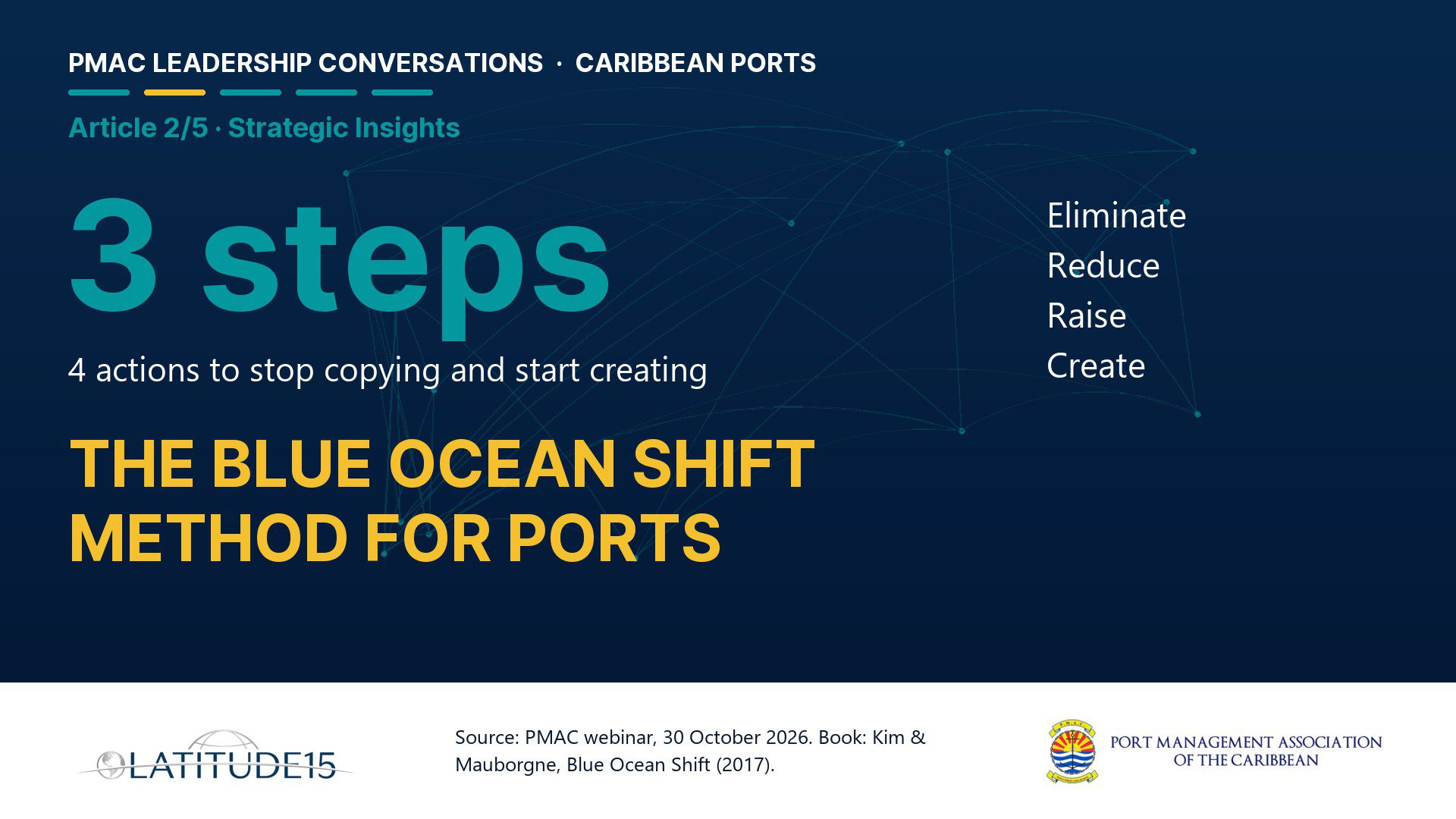
A Method From the Book Blue Ocean Shift
The presentation was based on Blue Ocean Shift: Beyond Competing, a book by W. Chan Kim and Renée Mauborgne, professors of strategy at INSEAD, published in 2017. According to the presentation, Blue Ocean Shift is a structured process for moving an organisation from competing in an existing market to creating new market space, through greater customer value and lower costs. Its central principle is value innovation: increasing what customers value, and reducing or eliminating activities that add cost without sufficient benefit.
Fritz Pinnock opened with one question: “Before we invest in a bigger port, have we imagined a bigger role for the port we already have?” In his view, the problem is often presented as a lack of money: “Many times it’s not about your resources, about your resourcefulness.”
Red Ocean, Blue Ocean: Stop Copying
He described two oceans. In the red one, many competitors watch and copy each other. “You do this, I’m going to do the same. It’s called benchmarking,” he said. He illustrated it with a personal story: one night, sent on a detour, he followed another car through unfamiliar hills until the driver stopped in his own yard. “This is what happens when you benchmark, you follow people to the wrong destination.”
He also quoted Sun Tzu’s The Art of War: “He will win who knows when to fight and when not to fight.”
Three Steps
The book describes five steps. Fritz Pinnock reduced them to three for a port and logistics audience.
1. Understand where you are. A strategy canvas compares today’s service offering against the factors customers use to choose: price, reliability, simplicity, visibility and accessibility.
2. Imagine where you could be. The aim is to identify pain points: “You look for the bottlenecks that your customers are having and how can you convert those into business opportunities.” The method also looks at three tiers of noncustomers. “Don’t look at your customers only, look across the fence at your non-customers,” he said, because “you have bigger opportunities among your non-customers than your customers.”
3. Create. Two tools are used at this stage: the four actions framework, and a six paths framework that looks across alternative industries, strategic groups, buyer groups, complementary services, functional or emotional appeal, and time.
Four Questions: Eliminate, Reduce, Raise, Create
The four actions framework asks four questions. Eliminate: which accepted activities no longer provide value? Reduce: which factors receive more resources than customers need? Raise: which factors should exceed existing industry standards? Create: what valuable offering is missing entirely?
Fritz Pinnock gave the example of a television remote control with about 90 buttons, when most users need only a few: features added because competitors had them. The aim, he said, is to give customers the functional things they need and to “reduce costs while increasing value”.
Turning Limits Into Questions
During the discussion, he returned to the method with an example from the book: a small appliance maker that questioned the assumption that frying requires a lot of oil. According to the book, the team at Groupe SEB reframed the problem as making healthy fries without frying, which led to the ActiFry. “One of the things in the Blue Ocean approach is, look at your boundaries, look at your limits, and change them into questions,” Fritz Pinnock said.
Applied to the Caribbean, he argued that size should not be read only as a constraint: “Our size can give us agility.”
Bringing People Along
The presentation stressed that the method is also about people. It quoted the authors: “Without the confidence to act, few will venture down a new path, no matter how clear the roadmap.” In the traditional approach, a strategy department writes a plan and operations execute it. “The Blue Ocean’s approach is you plan execution into strategy,” Fritz Pinnock said. “To move forward a new frontier, you have to bring people along.”
Blue Ocean Shift and Caribbean Ports: What Comes Next
The presentation summed up the idea in one line: “We all see the same ships, ports and cargo. Blue Ocean Shift challenges us to see possibilities others have overlooked – and create value others have not imagined.” The next article in the series looks at one answer put forward during the discussion by PMAC chairman Darwin Telemaque: Canergy Ports, ports that handle both cargo and energy.
Questions to Ask
Port authorities
- Which services does your port offer only because other ports offer them?
- Who are your port’s noncustomers, and why do they not use it today?
Port users and shippers
- Which bottleneck in your supply chain would you pay to remove?
Quotes are taken from the PMAC Leadership Conversations webinar of 30 October 2026 and from its presentation slides. Book: W. Chan Kim and Renée Mauborgne, Blue Ocean Shift: Beyond Competing, Hachette Books, 2017. The Groupe SEB ActiFry example is described in the book.
Previously in the series: five pressures on Caribbean ports. Next: Canergy Ports, from cargo handling to cargo and energy.