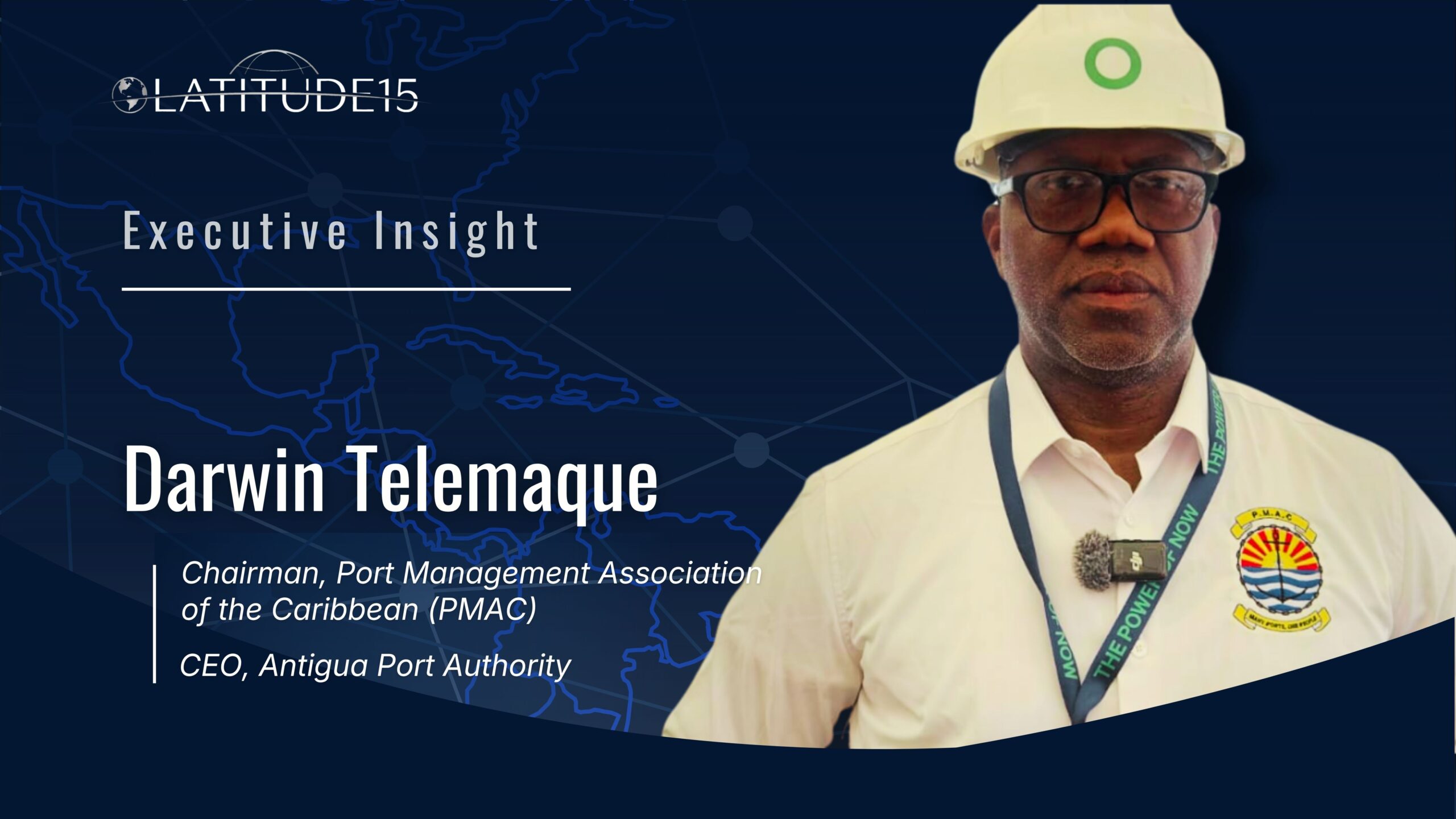
In conversation with Darwin Telemaque — CEO, Antigua Port Authority and Chairman, Port Management Association of the Caribbean (PMAC), at the association’s 29th Annual General Meeting, held in Paramaribo, Suriname, from 8 to 10 July 2026.
“Shipping is not an option for us.”
For Darwin Telemaque, that simple statement explains why Caribbean ports occupy such a strategic place in the region’s future. For island economies where around 95% of essential goods arrive by sea, ports are far more than logistics assets—they are critical infrastructure linking communities to food, construction materials, fuel and trade.
Telemaque reflected not only on the success of the association’s flagship gathering but also on what he believes should become PMAC’s next chapter.
As CEO of the Antigua Port Authority and Chairman of PMAC, his ambition extends beyond expanding membership or organising larger conferences. His vision is for PMAC to evolve from a respected regional association into a platform capable of helping Caribbean ports prepare, structure and accelerate their transformation.
A growing association with bigger ambitions
By most measures, PMAC’s 29th Annual General Meeting marked another step forward for the organisation.
Telemaque described the event as one of the association’s strongest to date, pointing to record participation, broad representation from member ports and an expanded programme designed to go beyond the traditional conference format. At the same time, he acknowledged that future editions should attract even greater participation from port CEOs, board chairpersons and senior government decision-makers responsible for the sector.
The organisation itself is also growing.
According to Darwin Telemaque, PMAC welcomed four new port members over the past year—representing roughly 18% growth—while its associate membership increased to 23 organisations, an expansion of around 40%. Those figures reflect more than organisational growth; they suggest a widening regional interest in collaborative approaches to port development.
Yet, for Telemaque, growth is not the destination.
It is an opportunity to redefine what PMAC can offer its members.
Capacity building remains the foundation
That evolution begins with a principle that has long shaped PMAC’s work: capacity building.
Ahead of this year’s General Meeting, the association introduced two dedicated training days for port professionals. One focused on digitalisation, the other on port electrification and shore power. Around 62 participants, primarily operational personnel rather than senior executives, took part in the programme.
The initiative reflects a broader understanding of port modernisation.
Infrastructure alone does not transform ports. New technologies require people capable of operating them, maintaining them and integrating them into daily operations. Whether the challenge is digital transformation, automation or energy transition, investment in human capabilities remains essential.
For Telemaque, PMAC’s role has therefore never been limited to convening annual meetings. It has been about strengthening the knowledge base that allows Caribbean ports to adapt to an increasingly complex operating environment.
A five-pillar strategy for Caribbean ports
Looking ahead, Telemaque outlined what he sees as the strategic priorities that should guide PMAC’s future support to the region.
The association’s vision is built around five pillars:
- modern infrastructure;
- automation;
- digitalisation;
- human resource capabilities;
- energy.
Taken individually, none of these priorities is new.
Taken together, however, they point to a broader philosophy.
Port competitiveness is no longer determined by infrastructure alone. It depends increasingly on how physical assets, digital systems, skilled personnel and energy solutions work together as part of a single operating model.
That integrated approach echoes many of the discussions held throughout the PMAC conference, where topics ranging from artificial intelligence to shore power repeatedly highlighted the growing interdependence between technology, operations and investment.
From training to project support
Perhaps the most significant element of Telemaque’s vision is his belief that PMAC should become involved much earlier in the development of port projects.
Rather than intervening once projects are already designed or financed, he sees an opportunity for the association to contribute during the pre-feasibility stage—when ideas are still being shaped and key decisions have yet to be made.
“I’d like to see PMAC become way more engaging,” he said, explaining that the association could help ports structure projects, identify the right technical expertise and support early planning before investments move forward.
That represents a subtle but important shift.
Historically, many regional organisations have focused on networking, conferences and knowledge sharing. Telemaque is proposing that PMAC complement those functions with practical support that helps ports navigate the earliest—and often most uncertain—phases of project development.
For smaller Caribbean ports with limited internal technical capacity, such support could prove particularly valuable.
Associate members as strategic partners
That ambition also explains how Telemaque views PMAC’s associate members.
Rather than describing equipment suppliers, consultants and technical companies as sponsors or external stakeholders, he positions them as integral components of the regional port ecosystem.
“Our associate members are not visitors to PMAC. Our associate members are partners within the port community system.”
In his view, these organisations bring expertise that can strengthen ports through technical advice, specialised knowledge, training and innovation.
The association’s webinar platform, designed to facilitate continuous knowledge sharing between members and technical partners, reflects this collaborative approach beyond the annual conference itself.
It is a model that sees capacity building not as a once-a-year event, but as an ongoing process supported by a broader professional network.
Reducing fragmentation across the region
Another challenge identified by Telemaque is less visible but equally significant.
Across the Caribbean, ports are approached by multiple organisations, development agencies and international institutions promoting similar initiatives—from digitalisation and sustainability to resilience and infrastructure development.
The result, he suggests, is often fragmentation rather than coordination.
Different organisations may work on similar themes, while ports struggle to follow every programme or participate in every initiative.
Darwin Telemaque believes PMAC can help bridge that gap by creating a more structured regional knowledge base—bringing together information, technical expertise and ongoing projects into a shared framework that benefits all members.
Such an approach could improve visibility across the region, reduce duplication and enable ports to learn more systematically from each other’s experiences.
Building a stronger regional voice
Mr. Telemaque’s vision also carries an institutional dimension.
He would like to see greater engagement from port directors, board chairpersons and ministers responsible for ports, ensuring that strategic discussions are supported at the highest levels of decision-making.
He also argues that PMAC should continue strengthening its relationship with CARICOM, positioning itself as the organisation best placed to represent the interests of Caribbean ports within broader regional policy discussions.
For him, stronger political recognition would not simply enhance PMAC’s visibility.
It would expand its ability to mobilise expertise, coordinate regional initiatives and deliver greater value to member ports.
Beyond convening, towards delivery
The conversations in Paramaribo demonstrated once again PMAC’s ability to bring together port authorities, technical experts, equipment providers and policymakers from across the Caribbean.
Darwin Telemaque’s message, however, looks beyond the conference itself.
The next stage, he suggests, is not simply to expand PMAC’s network, but to deepen its role.
Modern infrastructure, digitalisation, automation, human capital and energy will remain central to Caribbean port development. Yet delivering those ambitions will increasingly depend on how effectively projects are prepared, coordinated and supported long before construction begins.
PMAC has already established itself as a regional platform for dialogue and capacity building.
Darwin Telemaque’s next ambition is to turn that platform into one that helps Caribbean ports move from ideas to well-structured, investable projects—strengthening not only individual ports, but the resilience and competitiveness of the region’s maritime sector as a whole.