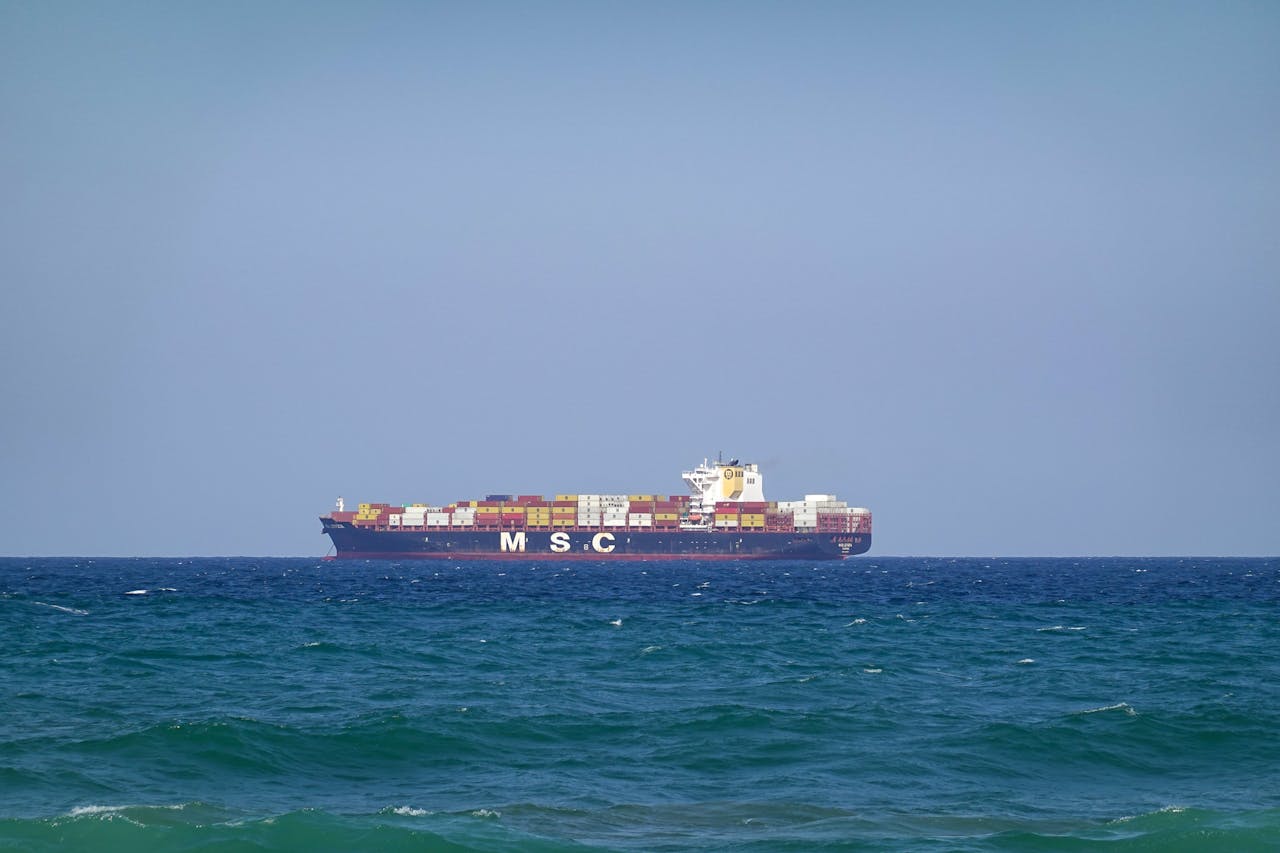
Two global shipping groups dominated container activity at Port of Spain in 2025, reinforcing the concentration trends shaping Caribbean liner shipping networks. Data published by the Port Authority of Trinidad and Tobago show that CMA CGM and MSC together accounted for the vast majority of container throughput handled at the Trinidadian port during the year.
CMA CGM recorded 159,095 TEUs in 2025, while MSC handled 132,878 TEUs. Combined, the two carriers represented nearly 292,000 TEUs of activity at Port of Spain, far ahead of other operators present at the port.
The gap becomes even more visible when compared with second-tier operators. COSCO handled 19,326 TEUs during the year, while ONE recorded 13,697 TEUs and MFT 13,848 TEUs.
The figures underline how strongly container activity at Port of Spain is tied to the network strategies of a limited number of global shipping lines.
CMA CGM’s traffic profile highlights the port’s transshipment role
Beyond overall market share, the operational structure of CMA CGM’s traffic provides insight into how the carrier is using Port of Spain within its regional network.
One of the most striking figures in the dataset concerns transshipment empty containers. CMA CGM alone generated 49,297 TEUs in transshipment empties during 2025, alongside 37,983 TEUs in transshipment full containers.
Those volumes suggest the French carrier is using Port of Spain not simply as a destination port, but as a redistribution and equipment repositioning node within wider Caribbean and South American service patterns.
Import traffic also remained significant for the group, reaching 23,022 TEUs in 2025, while export activity totaled 11,679 TEUs.
The 2026 year-to-date figures indicate that the trend remains intact. During the first four months of the year, CMA CGM handled 56,031 TEUs at the port, maintaining a clear lead over all other operators.
MSC continues to maintain a major regional presence
MSC’s operational footprint at Port of Spain also remains substantial, although its traffic profile differs somewhat from CMA CGM’s.
In 2025, MSC recorded 41,585 TEUs in transshipment empty containers and 41,474 TEUs in transshipment full containers, highlighting a relatively balanced redistribution pattern.
The carrier also generated 24,800 TEUs in imports, slightly above CMA CGM’s import total for the same year.
While MSC’s overall annual throughput remained below CMA CGM’s, the Swiss-Italian group still represented one of the key drivers of container flows through Trinidad and Tobago.
In the first four months of 2026, MSC handled 30,755 TEUs at Port of Spain.
Smaller operators remain present but far behind
Outside the two dominant carriers, container activity becomes considerably more fragmented.
COSCO remained the third-largest operator in 2025 with 19,326 TEUs, supported primarily by import traffic and local empty container activity.
ONE handled 13,697 TEUs during the same period, while ZIM recorded 9,901 TEUs.
Several other carriers maintained only marginal volumes at the port, reflecting the selective nature of regional service deployment in the Southern Caribbean market.
The concentration visible at Port of Spain mirrors broader consolidation trends affecting global liner shipping, where a small number of major operators increasingly shape regional cargo networks through alliance structures, feeder strategies and equipment allocation decisions.
A port increasingly tied to global carrier network strategies
The data also highlight an important operational reality for Caribbean gateway and transshipment ports: traffic performance is becoming increasingly dependent on the routing decisions of a limited number of large shipping groups.
For Port of Spain, the strong presence of CMA CGM and MSC can provide stability and network connectivity, particularly within Southern Caribbean and northern South American trade corridors. At the same time, such concentration can also increase exposure to future service restructurings, alliance adjustments or shifts in regional transshipment strategies.
As shipping lines continue optimizing network efficiency across the Caribbean Basin, ports capable of combining domestic cargo demand with flexible transshipment operations may remain attractive within carrier portfolios. The latest figures suggest Port of Spain currently retains that positioning.