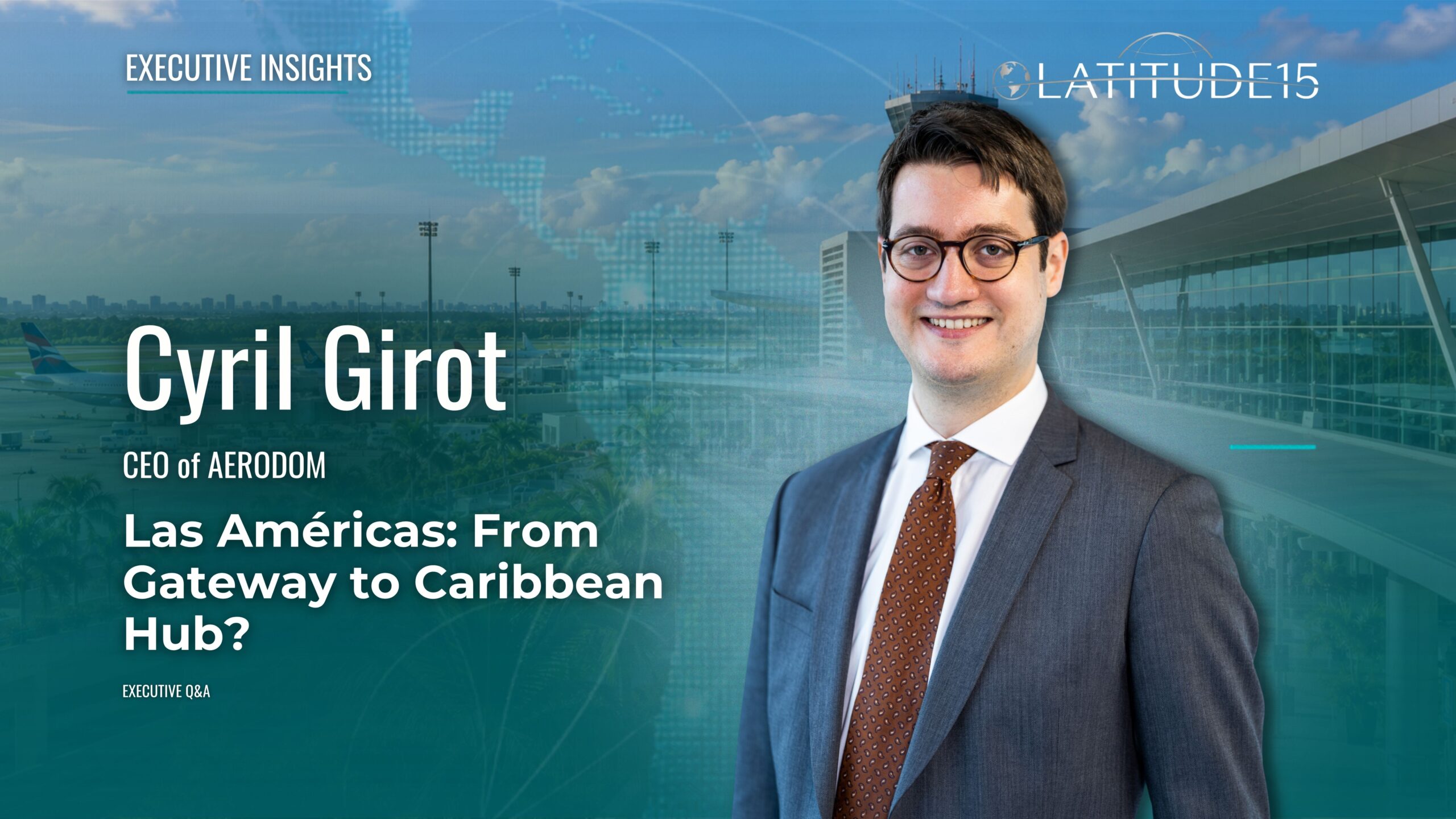
Q1 : Santo Domingo is often presented as a potential Caribbean hub. Do you share that vision? What are you specifically aiming to achieve: adding more point-to-point destinations or generating measurable growth in connecting passenger traffic?
Yes. Santo Domingo has natural advantages that can strengthen its position as one of the Caribbean’s leading air connectivity hubs: its geographic location, the size and dynamism of the Dominican economy, and the sustained growth of tourism and business activity.
Our priority is to continue expanding connectivity in both directions: more nonstop destinations and better connecting opportunities. We actively work with airlines — providing market studies, favorable operating conditions, and commercial support — to develop new routes. The results are already visible: several airlines have announced increased frequencies and new connections in recent months, confirming that this strategy is delivering results.
Q2: Copa operates five daily flights, JetBlue has tripled its frequencies, and Sunrise Airways has launched a route to Pointe-à-Pitre. Which Caribbean markets are currently priorities for SDQ’s network, and how is AERODOM working to secure new connections?
Rather than focusing on three specific routes, I prefer to discuss priority markets. We continue to identify opportunities to strengthen connectivity with the Eastern Caribbean, the Antilles, and other markets where potential demand exists.
The challenge is not simply to identify a route, but to demonstrate to airlines that sustainable demand exists throughout the year. Our role is to provide market intelligence, facilitate favorable operating conditions, and work closely with airlines to turn these opportunities into new routes. To achieve this, we have a highly skilled and professional team, supported by VINCI Airports’ global network and its experience in traffic development across more than 70 airports.
Q3: Is the future terminal being designed with connecting passengers in mind — including connection times, baggage handling, immigration, and transit flows — or primarily to accommodate growth in origin-and-destination traffic?
The terminal is designed to provide flexibility and operational efficiency while supporting the airport’s future growth in both connecting and origin-and-destination traffic. We are not simply building more physical space: we are creating infrastructure capable of accommodating different types of operations and enhancing the passenger experience at every stage of the journey.
This involves carefully considering passenger flows, technology, baggage handling, security, and coordination with the authorities involved in these processes. It also means incorporating the Dominican Republic’s sense of place throughout the terminal, so that even connecting passengers can experience something genuinely Dominican, even if only for a few hours. The modernization of the baggage handling system (BHS), which we are already implementing in the existing terminal, is part of this same comprehensive vision: greater operational efficiency in support of a better travel experience.
Q4: What is Santo Domingo’s distinctive value proposition within the Caribbean network — as a capital city, business center, or regional gateway — and which segments are currently driving its growth: business travel, diaspora traffic, MICE, or connecting passengers?
Santo Domingo is the country’s political and economic capital, a major business center, and, at the same time, a gateway for tourism and the Dominican diaspora — a combination that few cities in the Caribbean can offer.
Furthermore, the growth we have achieved in air cargo demonstrates that Santo Domingo’s connectivity extends far beyond tourism. In 2025, AERODOM handled more than 111,000 metric tons of cargo, while Las Américas International Airport (AILA) accounted for approximately 75% of the country’s air cargo. This reflects the airport’s increasingly important role as a regional logistics platform and a driver of economic development for the country.
Q5: More connecting traffic means passengers spend more time in the terminal. How can that time be converted into non-aeronautical revenue while giving the commercial experience a distinctly Dominican identity?
The key is to understand that passengers should not feel as though they are simply waiting for a flight. We want the airport to be part of their travel experience.
That means providing useful services, comfortable spaces, digital connectivity, an attractive commercial offering, and, above all, incorporating elements that represent the Dominican Republic: our cuisine, products, culture, and hospitality. The commercial experience must meet international standards while maintaining a distinctly Dominican identity.
At the same time, we are introducing digital solutions that make the passenger experience easier and more enjoyable, such as free internet access through eSIM technology and the digitalization of services such as parking.