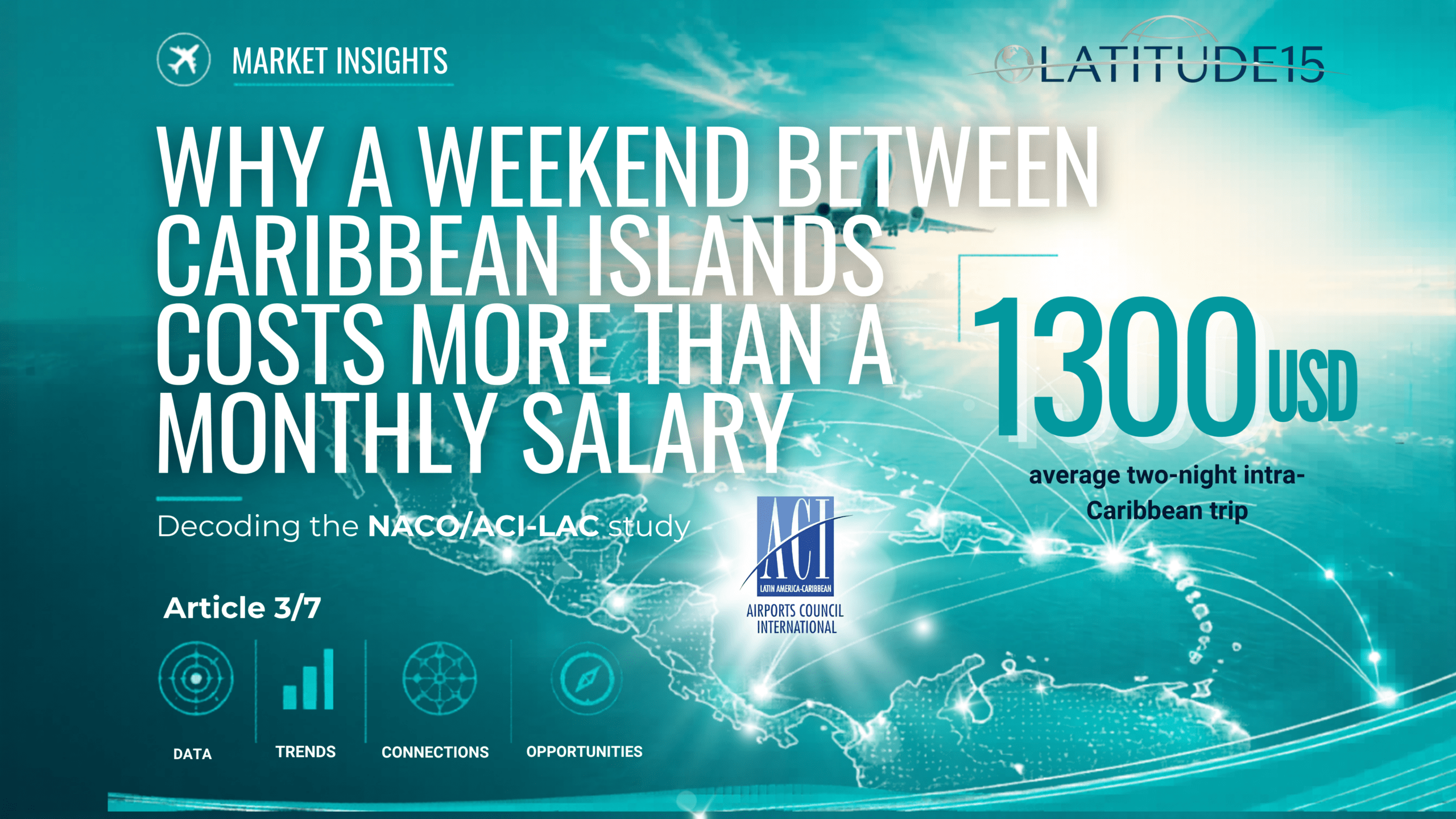
Average airfare USD 225 for 470 km, average daily hotel rate USD 437, regional monthly salaries between USD 600 and USD 1,000: a two-night weekend in a neighbouring Caribbean island exceeds, on average, the monthly income of a resident in most countries of the region. The NACO/ACI-LAC study released in March 2026 documents this economic asymmetry with rare precision. A decoding.
The finding is striking, and the study The State of Air Connectivity in the Caribbean highlights clearly that a weekend trip to another Caribbean island costs more than the average monthly salary in many Caribbean countries, making intra-regional tourism unaffordable for most local residents. Behind this statement lies a precise economic equation, which NACO breaks down across several pages.
The fare asymmetry: USD 225 for 470 kilometres
According to Sabre MIDT data analysed by NACO, the average one-way airfare on intra-Caribbean routes stood at USD 225 in 2024. The average non-stop flight distance on intra-regional routes, excluding domestic segments, is 470 kilometres. By contrast, the average one-way fare from Caribbean islands to Miami, New York, Orlando or Panama City sits at USD 275 for an average distance of 1,800 kilometres. In other words, the per-kilometre unit cost is significantly higher on intra-regional routes than on extra-regional ones.
This asymmetry is not cyclical. Across the top ten busiest intra-Caribbean routes, NACO benchmarks fare evolution against equivalent island pairs in Southeast Asia. Levels were broadly comparable in the early 2010s. Since then, ASEAN fares have dropped sharply under the combined effect of Open Skies liberalisation and low-cost carrier expansion, while intra-Caribbean fares have gradually risen.
Layered add-on costs: taxes, charges, and lodging
Airfare is only one layer of the total cost. The study documents wide disparity in airport taxes and charges across the region, ranging from USD 20 to USD 90 per passenger depending on the country. Some Caribbean states (Barbados, Saint Lucia, Antigua and Barbuda, Curaçao, Sint Maarten, Trinidad and Tobago, Puerto Rico, Dominica) impose no air travel taxes, while others stack several: aviation tax, tourism tax, sanitary tax, immigration fee or solidarity tax depending on the jurisdiction.
Lodging deepens the imbalance. According to Caribbean Tourism Organisation data referenced by NACO, the average daily rate (ADR) for an overnight hotel stay in the Caribbean region stood at USD 437 in 2024. For reference, the equivalent ADR for a four-star hotel in the United States and Southern Europe is around USD 273 and EUR 243 respectively. On certain Caribbean destinations focused on high-end international tourism — Anguilla USD 1,623, Turks and Caicos USD 1,168, Antigua and Barbuda USD 895 — the ADR substantially exceeds the symbolic USD 1,000 mark.
The equation: USD 1,300 for two nights, USD 600 to 1,000 monthly income
It is the aggregation of these layers that produces the economic disproportion identified by the study. Combining the average intra-Caribbean one-way airfare (USD 225) with an ADR of USD 437 over two nights, a two-day trip costs around USD 1,300 per person, excluding meals, local transport and additional taxes.
Yet, according to data collected by NACO from Numbeo, WageCenter, CBS and the Dominican Republic Bureau of Statistics, the average monthly salary in the Caribbean region oscillates between USD 600 and USD 1,000. A leisure weekend in a neighbouring island therefore exceeds the monthly income of a resident in most countries of the region.
The European benchmark: a different price scale
To anchor the analysis in an international perspective, the study draws on Eurostat figures. An average EU citizen spends around EUR 289 on a domestic trip and EUR 1,013 on an intra-EU trip. Set against an average EU monthly salary of EUR 3,000 before tax, these amounts allow a European resident to undertake multiple trips per year — including within the Union — without the cost exceeding a substantial share of monthly income. Caribbean residents, by contrast, must either forgo regional mobility or commit several months of savings.
Demand suppressed by the price structure
This disproportion feeds a structural loop the study identifies clearly. The inability of a substantial share of the Caribbean population to travel within the region suppresses intra-regional demand, which prevents airlines from densifying frequencies, which keeps unit operating costs high, which sustains fare levels out of reach for residents. The model is locked in by its own logic.
To unlock this equation, NACO formulates an explicit recommendation that we will explore in the closing article of this series: act across the full travel journey rather than on airfare alone. Regional connectivity incentive schemes, differentiated taxes for intra-regional travellers, optimised connections to avoid forced overnight stays — all levers requiring joint work between governments, airports and airlines.
The next article in this series shifts from economics to mapping the diversity of airlines operating in the Caribbean — InterCaribbean, Caribbean Airlines, Winair, Arajet, SKYhigh — and their contrasting business models.
Source : NACO (Netherlands Airport Consultants), The State of Air Connectivity in the Caribbean: A Renewed Vision for Progress, independent study commissioned by ACI-LAC, March 2026, 128 pages. Data sources: sections 4.6.1 to 4.6.5. Reference sources: Sabre MIDT, Caribbean Tourism Organisation, Numbeo, WageCenter, CBS, Eurostat.