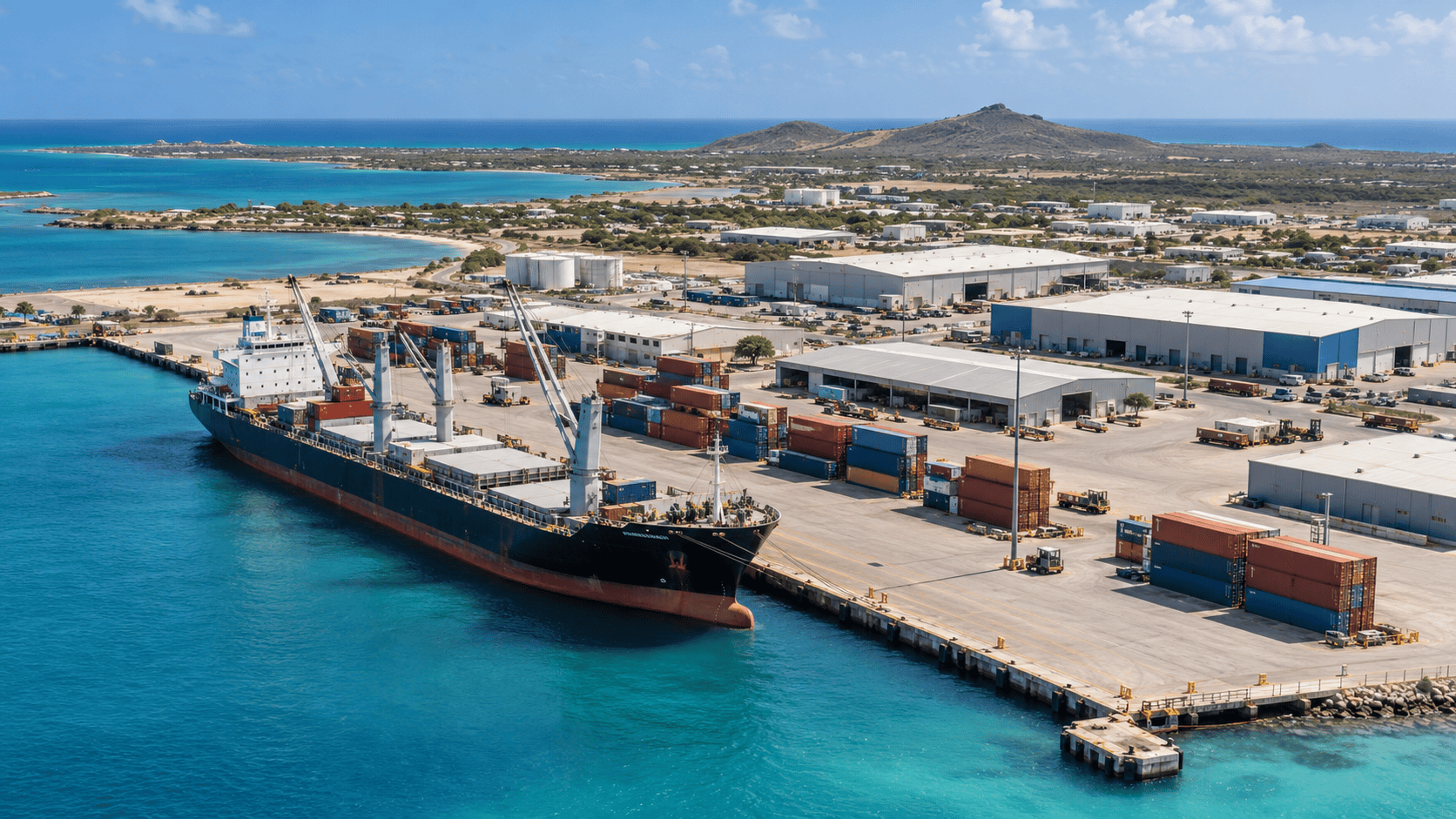
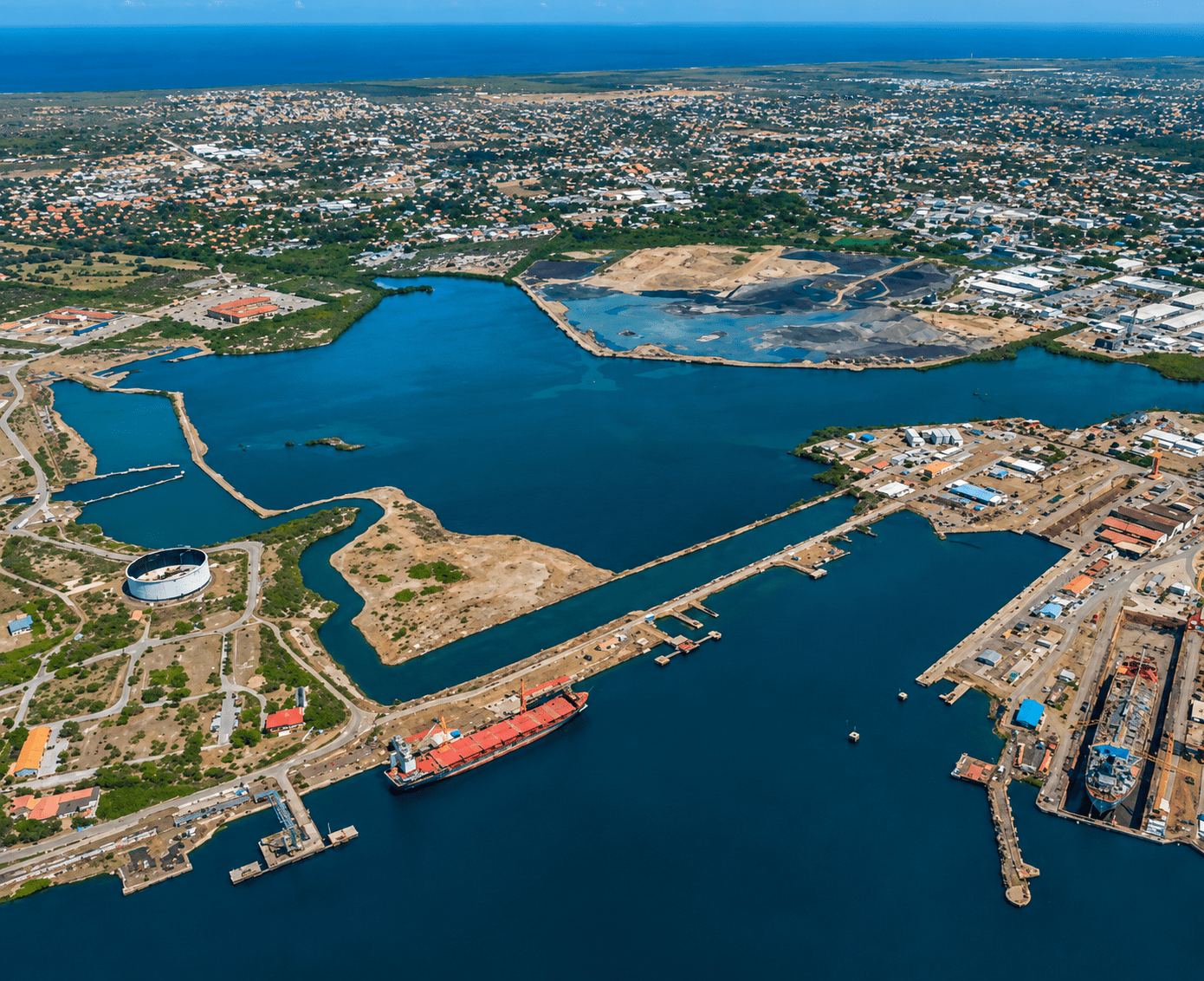
Curaçao is positioning its maritime sector at the centre of a broader economic redevelopment strategy, with the Dok–BuskaBaai zone emerging as one of the island’s most ambitious industrial and logistics projects in years.
Recent discussions highlighted in Caribbean Maritime Magazine show that the government, public-sector entities and private maritime stakeholders are now aligning around a long-term vision that goes far beyond conventional port expansion.
The objective is not simply to modernize maritime infrastructure. Curaçao is attempting to build an integrated maritime-industrial cluster capable of supporting shiprepair, logistics, circular economy activities, environmental services and future investment attraction simultaneously.
A strategic shift toward maritime-industrial development
For years, many Caribbean maritime economies have focused primarily on cargo throughput, cruise tourism or transshipment activity. Curaçao’s emerging strategy signals a more diversified industrial approach.
The Dok–BuskaBaai redevelopment plan is being framed as a multi-sector maritime ecosystem designed to connect: shiprepair, logistics, port services, industrial activity, environmental processing, and innovation-driven business development.
This positioning reflects a broader regional trend in which Caribbean territories are increasingly looking at maritime infrastructure not only as transport infrastructure, but as a platform for industrial resilience and economic diversification.
The project also aligns with Curaçao’s wider economic modernization agenda and the island’s long-term efforts to strengthen competitiveness, execution capacity and investment attractiveness.
Public-private coordination is becoming central
One of the most notable aspects of the BuskaBaai initiative is the level of institutional coordination now taking shape around the project.
The recently established Programmatische Maritieme Tafel (PMT) brings together government ministries, public-sector entities and private maritime stakeholders under a shared strategic framework.
Participants include:
- Curaçao Ports Authority,
- CDM Holding,
- BuskaBaai NV,
- Blue Harbour City,
- logistics and maritime operators,
- and industry representatives linked to the Curaçao Maritime Association.
That structure is significant because fragmentation has historically been one of the major limitations facing maritime development across several Caribbean territories. Competing institutional priorities, permitting delays and limited coordination often slow project execution.
The PMT model appears designed to reduce those barriers by aligning infrastructure planning, industrial development and maritime investment discussions within a more centralized framework.
Shiprepair and circular economy ambitions
Shiprepair is expected to become one of the core pillars of the redevelopment strategy.
As Curaçao approaches 100 years of shiprepair activity in 2026, the island is attempting to reposition itself within a changing regional maritime landscape where maintenance capacity, technical services and industrial specialization could become increasingly valuable.
The project also integrates circular economy objectives, particularly around environmental processing and maritime waste management.
The involvement of Falcon International BV in waste oil and bilgewater processing reflects growing pressure for Caribbean maritime jurisdictions to strengthen MARPOL compliance and environmental credibility.
That environmental dimension is becoming commercially relevant as global shipping operators face tighter sustainability requirements and increasingly scrutinize the environmental standards of the ports they use.
Infrastructure expansion with long-term positioning in mind
The BuskaBaai redevelopment is not being presented as a short-term infrastructure project.
According to stakeholders involved in the initiative, the long-term plan includes:
- expanded port capacity,
- modernization of shipyard operations,
- industrial clustering,
- logistics growth,
- and potential ecological improvements linked to reopening sections of BuskaBaai to the sea.
Project stakeholders also indicated that the broader development strategy could ultimately increase Curaçao’s port capacity by around 30%.
More importantly, the initiative reflects a wider strategic repositioning effort.
Rather than competing solely on cargo volumes, Curaçao appears to be focusing on becoming a more diversified maritime services platform capable of supporting multiple layers of regional maritime activity.
A broader signal for the Caribbean maritime sector
The BuskaBaai project also highlights a larger shift taking place across parts of the Caribbean maritime industry.
Ports are no longer viewed exclusively as gateways for imports and exports. Increasingly, they are being integrated into wider industrial, environmental and logistics strategies tied to economic resilience and long-term competitiveness.
For small island economies facing rising shipping costs, geopolitical uncertainty and energy transition pressures, maritime infrastructure is becoming a strategic development tool rather than simply a transport asset.
Whether Curaçao can fully execute its ambitions remains to be seen. But the direction itself is increasingly clear: the future of Caribbean maritime competitiveness may depend less on isolated port operations and more on the ability to build integrated maritime ecosystems capable of attracting investment, supporting industry and adapting to a rapidly evolving global shipping environment.