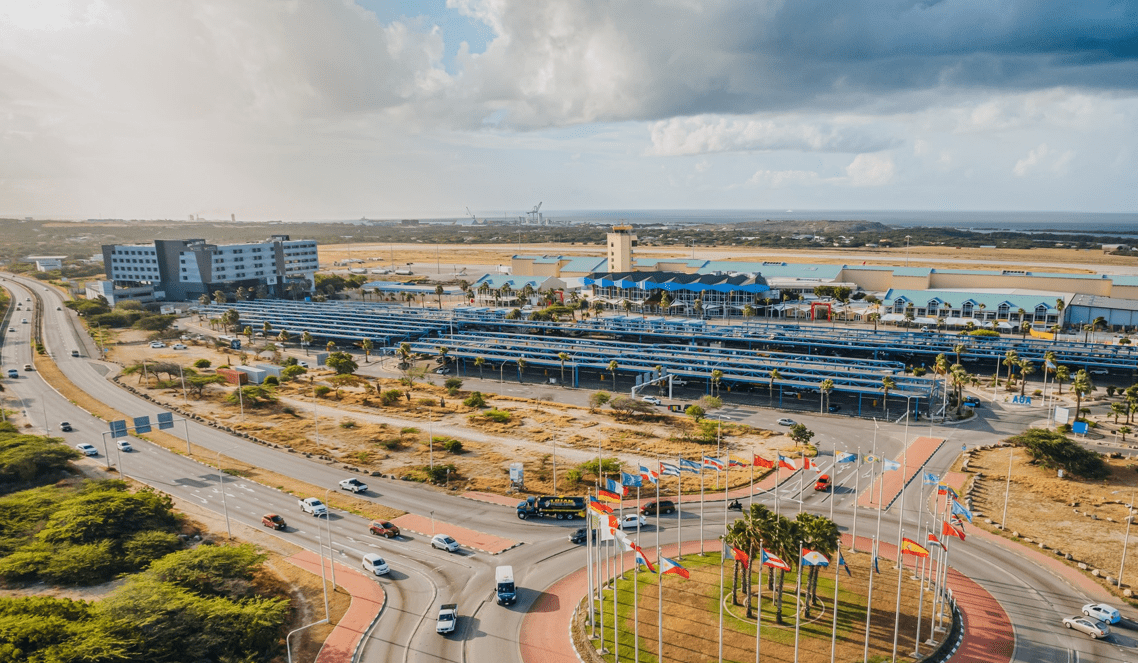
Aruba is accelerating the expansion of its Latin American air network as the island seeks to diversify connectivity beyond its traditionally dominant U.S. market. New traffic figures published by the Aruba Airport Authority show Latin America emerging as the airport’s fastest-growing region in both capacity and route development during early 2026.
While the United States still accounted for roughly 68% of Aruba’s passenger traffic in Q1 2026, Latin America represented the strongest area of growth. Seat capacity from the region increased by 28.2% during the quarter, including a sharp 32.2% rise in March alone. The figures significantly outpaced growth across North America and Europe, highlighting a strategic shift in Aruba’s regional connectivity profile.
The expansion is being driven by a combination of new routes, additional frequencies and stronger airline competition across northern South America and beyond. Several Colombian markets are seeing notable development, with carriers introducing or expanding services from cities such as Bucaramanga, Barranquilla, Cali and Medellín.
Wingo continues strengthening its footprint in Aruba through multiple Colombian routes, while Avianca is maintaining seasonal Medellín operations alongside its broader Bogotá connectivity. The report also points to expanding regional influence from Copa Airlines, whose Panama City hub remains a critical gateway linking Aruba with wider Latin American markets.
Further south, Aerolineas Argentinas is expanding its Aruba presence with additional routes and frequencies, reinforcing the island’s visibility within the Southern Cone leisure market. The airport’s latest network maps also show Lima becoming increasingly relevant within Aruba’s evolving connectivity structure, reflecting growing demand from South American travellers seeking direct Caribbean access.
The diversification strategy appears increasingly important for Aruba as competition intensifies across Caribbean tourism markets. Although the U.S. remains Aruba’s largest and most profitable source market, reliance on a single region also exposes destinations to fluctuations in economic conditions, currency movements and airline capacity decisions.
By expanding Latin American connectivity, Aruba is positioning itself to access a broader mix of leisure, diaspora and connecting traffic flows. The strategy also aligns with wider trends visible across the Caribbean aviation sector, where airports are increasingly pursuing multi-regional network development rather than relying exclusively on North American tourism demand.
The latest figures suggest that approach is already reshaping Aruba’s traffic composition. Latin America accounted for approximately 18% of total passenger traffic during Q1 2026, compared with 17% in March 2025. Although still considerably smaller than the U.S. segment, the pace of growth indicates the region is becoming one of Aruba’s most strategically important aviation markets.
At the same time, the airport’s route portfolio is evolving beyond traditional gateway concentration. Panama City, Bogotá and Lima are gradually strengthening their role within Aruba’s network structure, helping position the island not only as a Caribbean destination, but increasingly as a regional air connectivity node between North America, South America and the wider Caribbean basin.