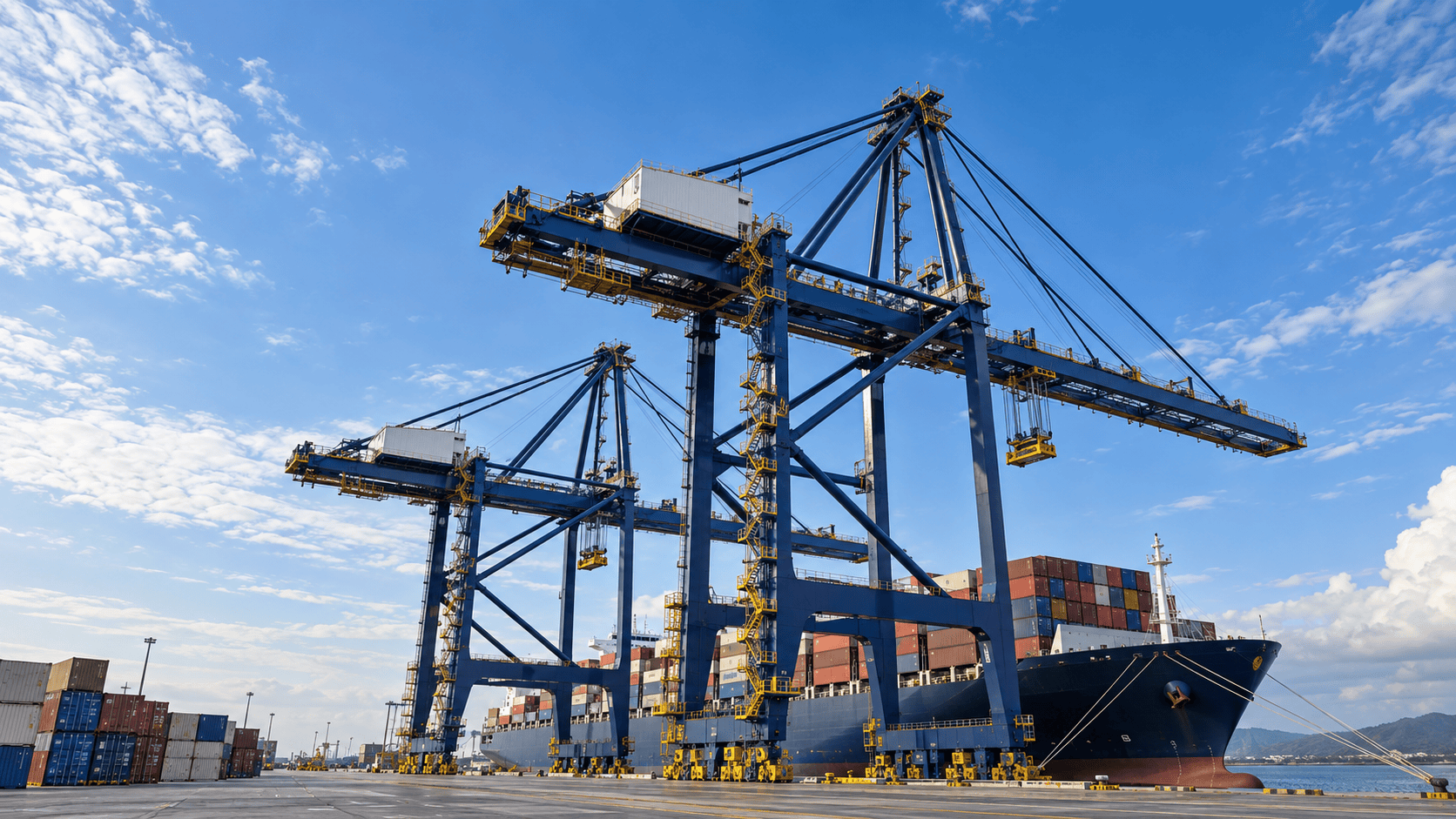
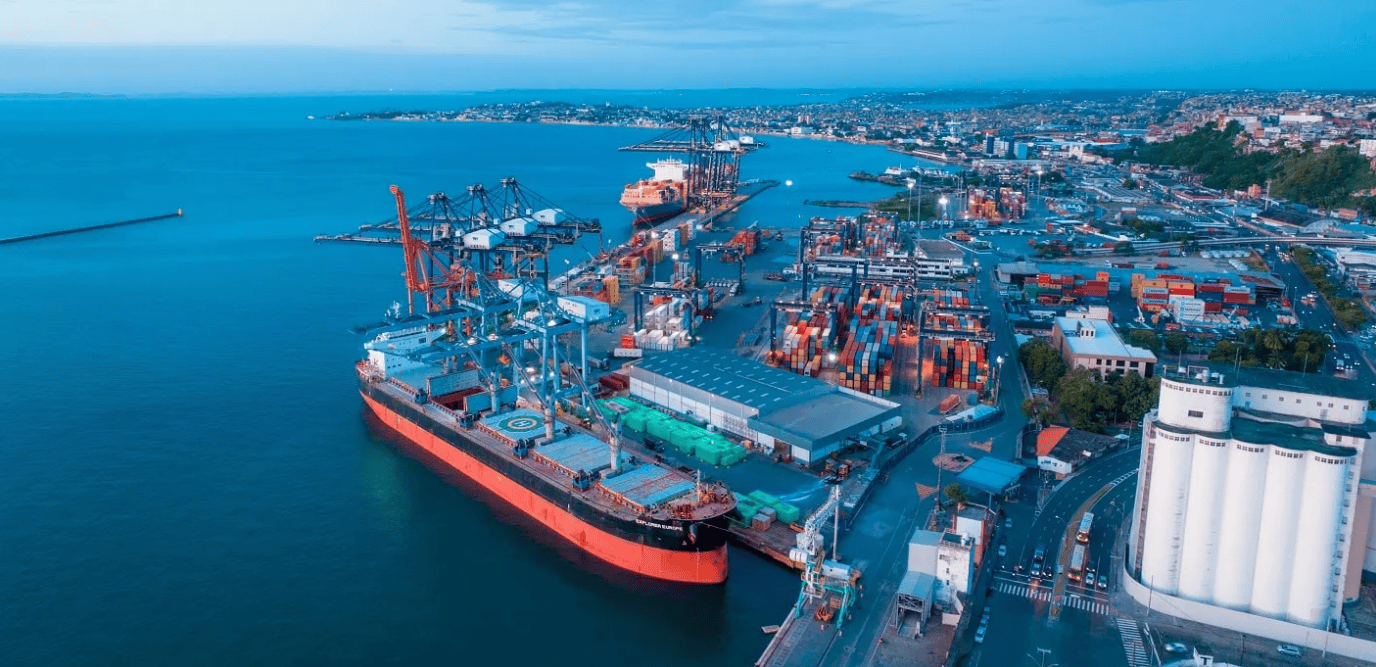
Brazil’s largest container gateway keeps getting busier. The Port of Santos handled a record 5.9 million TEU in 2025, while its wider cargo throughput reached 186.4 million tonnes. That performance makes the case for additional container capacity increasingly difficult to dispute.
The harder question is who should control it.
Tecon Santos 10, planned for the Saboó area, would occupy nearly 622,000 square metres and require an estimated R$6.45 billion in investment. At full development, the project is designed around four berths and annual dynamic capacity of 3.25 million TEU.
At that scale, deciding who operates the terminal has become almost as consequential as building it.
Santos is already adding capacity
Tecon Santos 10 is not arriving in a static market.
Existing operators are also expanding. DP World is investing an additional R$1.6 billion in its Santos terminal, targeting capacity of 2.1 million TEU by 2028, after an intermediate expansion to 1.7 million TEU. The programme includes another berth, additional yard space, gate improvements and new reefer infrastructure.
The Brazilian government, meanwhile, sees Tecon Santos 10 as the largest project in the country’s port-sector pipeline. Its current structure provides for a 25-year concession, with the government estimating that Santos’ overall container capacity could eventually reach around 9 million TEU annually following the project.
But the terminal’s competitive significance is even clearer in ANTAQ’s own market modelling. At full build-out, Tecon Santos 10 accounts for just over 32% of the modelled dynamic container capacity considered for the principal Santos terminals.
This is therefore not simply another berth extension. It is a new competitive block inside Brazil’s most important container gateway.
When shipping lines also own terminals
Santos already reflects the global trend toward vertical integration in container shipping.
Large liner groups increasingly participate not only in moving containers between ports, but also in the terminals where those containers are handled. That can bring important benefits: access to capital, committed cargo volumes, operational expertise and closer coordination between vessel networks and terminal investment.
It can also raise a different question.
When the terminal owner is simultaneously one of its largest customers, how neutral will access remain for competing carriers?
That issue becomes particularly important in Santos because Brasil Terminal Portuário is jointly controlled through terminal interests linked to MSC and A.P. Moller–Maersk, while other major shipping groups have also expanded their presence in terminal assets. At the same time, independent operator DP World continues to increase its own Santos capacity.
Vertical integration is not inherently anti-competitive. The relevant question is how much concentration a gateway can absorb before the benefits of integration begin to conflict with access and terminal competition.
MSC and Maersk have proposed a structural solution
The debate moved again in August 2026.
MSC and Maersk proposed a restructuring of their joint interests in BTP intended to address one of the central competition concerns surrounding a possible Tecon Santos 10 bid. Under that mechanism, if one of the groups eventually won the new terminal, it would exit BTP, with the other taking over its stake.
The logic is clear: the successful bidder would not simultaneously retain an ownership position in both BTP and Tecon Santos 10.
That proposed restructuring has cleared an important competition-review step. But it does not by itself settle whether MSC or Maersk will ultimately be eligible to bid for the new terminal.
The distinction matters because competition review and port-auction design are separate processes. ANTAQ’s official project page continues to list the auction as forthcoming, while revised project and tender documents were still being published during 2026.
In other words, solving the ownership overlap at BTP may remove one obstacle. It does not answer the broader policy question.
Would a divestment really create more competition?
Potential new entrant ICTSI has challenged the logic.
Its concern is that even after a divestment, Santos could end up with one major shipping group controlling BTP and another controlling Tecon Santos 10. ICTSI has argued that MSC and Maersk together accounted for 49.1% of container-handling demand at Santos in 2025, according to its own estimate.
That figure is part of ICTSI’s competitive case rather than an independent official market-share calculation, so it should be treated accordingly.
But the argument highlights an important distinction: terminal ownership concentration and cargo-demand concentration are not the same thing.
A port could theoretically have several different terminal owners while a small number of shipping lines still account for a large share of the cargo moving through those facilities.
Conversely, excluding established shipping groups from the auction could broaden terminal ownership while also reducing the number of bidders capable of financing, operating and supplying cargo to an asset of this scale.
That is why the Tecon Santos 10 debate cannot be reduced to “integrated carriers versus independent operators.” Both models involve trade-offs.
Brazil is trying to design competition before the terminal exists
The regulatory response has been unusually explicit.
The Tribunal de Contas da União confirmed the two-stage auction model developed by ANTAQ in December 2025, while recommending stronger measures to protect competition. The debate has included restrictions on established operators and mechanisms that could give new entrants the first opportunity to compete before participation is widened under defined circumstances.
That makes Tecon Santos 10 particularly interesting. Brazil is not simply asking who will offer the highest price for a terminal.
It is effectively trying to decide what the future competitive structure of Santos should look like before the asset is awarded.
And there is another reason to avoid treating the project’s original timetable as fixed. ANTAQ’s technical study contains an earlier phased-capacity schedule culminating in 3.25 million TEU, but the tender documentation was still being revised in mid-2026. The capacity targets remain relevant; the original operating dates should no longer be treated as a current construction timetable.
Santos clearly needs additional capacity. Its existing terminals are already investing, while Tecon Santos 10 promises a step-change in scale. The harder task is ensuring that new infrastructure also produces a competitive market around it.
Brazil therefore does not really have to choose between capacity and competition. The challenge is to design Tecon Santos 10 so that it delivers both.
Whoever ultimately wins the concession will obtain more than four new berths. They will control a substantial part of the next phase of container growth at Brazil’s most important maritime gateway.