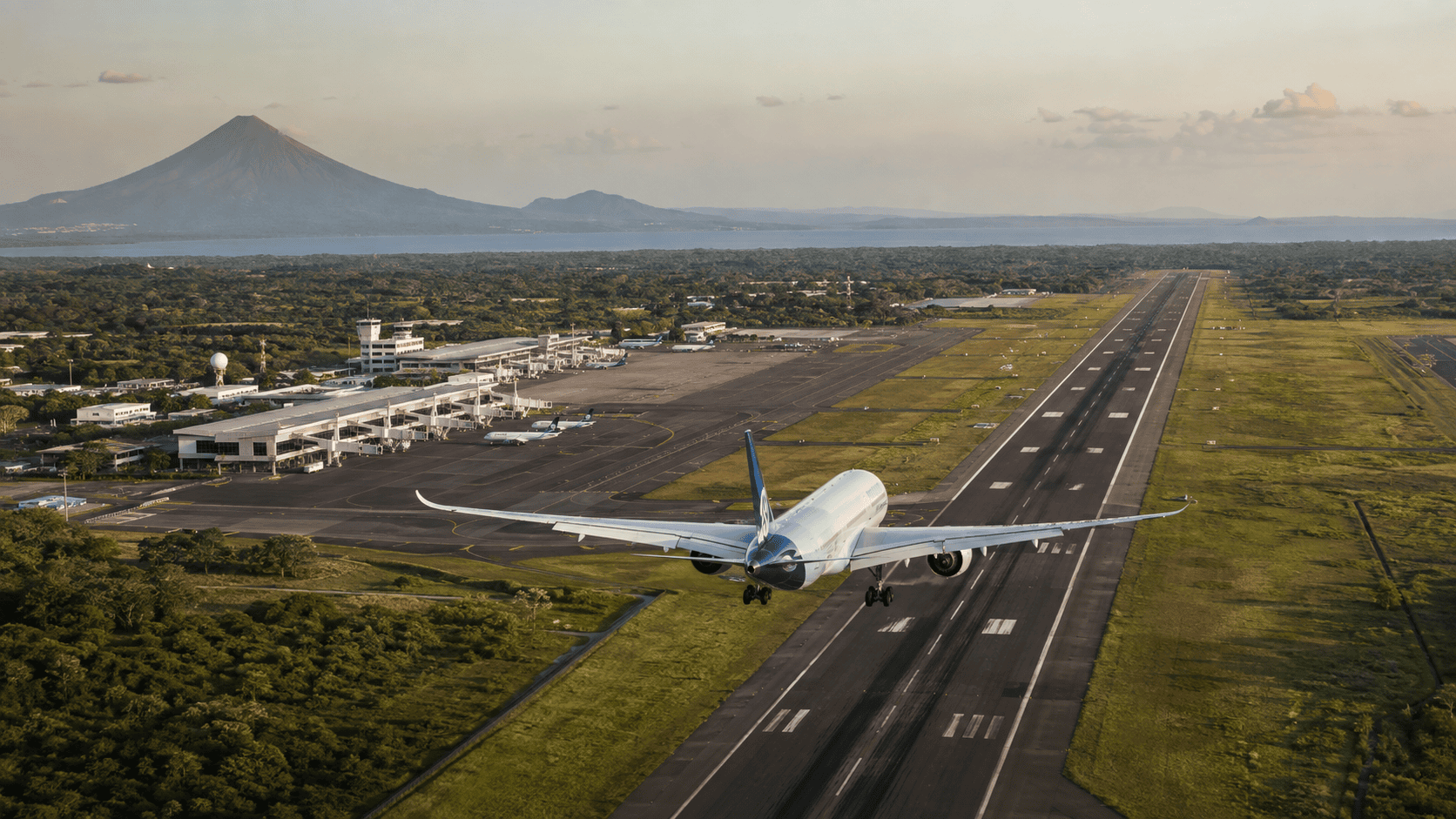
Aviation already supports USD 509.5 million of economic activity and almost 95,000 jobs in Nicaragua, according to IATA, but the country’s air market remains heavily international, concentrated around a limited number of gateways and expensive relative to local incomes. New routes and a USD 55.3 million expansion of Augusto C. Sandino International Airport in Managua show that Nicaragua is now investing to turn aviation’s existing economic value into deeper connectivity.
Aviation already supports 2.9% of Nicaragua’s GDP
Air transport and the activities it enables contributed USD 509.5 million to Nicaragua’s GDP in 2023, equivalent to 2.9% of national output, while supporting 94,700 jobs, according to IATA’s The Value of Air Transport to Nicaragua. The scale of that contribution is significant for a market whose aviation industry itself remains relatively small.
Nicaragua’s direct aviation sector employed about 1,900 people and generated USD 12.8 million of economic output in 2023. Tourism supported by aviation, by comparison, contributed USD 400.8 million to GDP and supported 75,400 jobs, showing that much of aviation’s economic value comes from the activities connectivity makes possible rather than from airlines and airports alone.
For Nicaragua, that distinction matters. Air connectivity supports tourism spending, trade and access to international markets on a scale that is much larger than the direct footprint of the aviation industry itself.
An overwhelmingly international aviation market
International travel represented 84% of origin-destination passenger departures from Nicaragua in 2023, equal to approximately 656,900 international departures, according to IATA. North America accounted for 56% of those flows, Latin America for 33% and Europe for 9%.
Miami was by far Nicaragua’s largest international city market in 2023, with approximately 146,100 departing passengers, or 22.2% of international O-D traffic. Havana ranked second with 51,100 passengers, followed by Panama City with 32,100, Los Angeles with 31,800 and Madrid with 27,200.
Nicaragua’s dependence on international aviation makes the depth of its network particularly important. IATA and OAG data for 2023 identified 12 international airports directly connected, nine countries served by direct flights and around 15 outbound international flights per day. The same report found that Nicaragua’s international connectivity index had improved since 2014, but almost all arriving international passengers ended their air journey in the country rather than connecting onward by air.
Connectivity also has an affordability problem
Nicaragua’s connectivity challenge is not limited to the number of routes available. IATA estimates that a resident needed to work approximately 41 days to afford an average airline ticket in 2023, even after the average real airfare had fallen by 4% between 2011 and 2023.
For Nicaragua, affordability therefore forms part of the connectivity equation. A route may exist on an airline timetable without being economically accessible to a large share of the population, making ticket prices and household purchasing power relevant alongside frequencies, destinations and seat capacity.
The IATA data also show that only 111 flights per 1,000 inhabitants were taken in Nicaragua in 2023. That measure reinforces the distinction between having aviation infrastructure and generating broad access to air travel.
Nicaragua’s network has started moving again
Recent airline developments show that Nicaragua’s international network has continued to evolve since the 2023 snapshot captured by IATA. Avianca announced two new Managua routes for May 2025: daily service to Fort Lauderdale, Florida, and four weekly frequencies to San José, Costa Rica. At launch, the two routes were expected to add more than 3,900 seats per week using Airbus A320 aircraft.
Managua gained another North American link in December 2025 when WestJet operated its first charter flight from Montréal, Canada, to Augusto C. Sandino International Airport in Managua. More than 170 passengers arrived on the inaugural flight on 18 December, with weekly Thursday operations planned in cooperation with Sunwing Vacations.
Air cargo connectivity also received an addition in December 2025. DHL resumed its own flight operations in Nicaragua on 11 December 2025, with four weekly frequencies on the San José–Managua–San José route. Air cargo had already reached 26,300 tonnes in Nicaragua in 2023, according to the IATA country report.
Route launches alone, however, do not demonstrate that Nicaragua’s connectivity gap has been closed. The longer-term test is whether additional links can sustain sufficient demand, frequency and competition to broaden the market.
Managua is building long-haul capability before long-haul connectivity
The largest infrastructure response is now taking place at Augusto C. Sandino International Airport in Managua, Nicaragua. In February 2026, airport operator EAAI reported an investment of USD 55.3 million to expand and modernise the airport’s runway and associated infrastructure.
The runway at Augusto C. Sandino International Airport is being extended by 858 metres, from 2,442 metres to 3,300 metres. EAAI also plans to extend the parallel taxiway from 1,100 metres to 2,000 metres and increase the separation between the runway and taxiway, enabling the aerodrome to move from reference code 4D to 4E and accommodate larger aircraft.
EAAI explicitly links the Managua investment to an ambition to pursue future connections beyond the Americas, including Europe and Asia. The authority has not announced confirmed transatlantic routes, however, meaning the infrastructure should be understood as creating the technical capability to pursue long-haul connectivity, not as evidence that such services have already been secured.
Augusto C. Sandino International Airport had recently closed a period with 1.1 million international passengers, according to EAAI, which expected traffic to grow another 4% to 5% in 2026. Passenger numbers were already up 6% in January 2026, while seven passenger airlines were operating regularly from Managua.
Domestic aviation gives connectivity another meaning
Nicaragua’s aviation investment is also extending beyond Managua. EAAI reported in February 2026 that domestic flights serving the country’s Caribbean coast carried approximately 130,000 to 140,000 passengers annually, including around 60,000 passengers at Corn Island.
Bluefields Airport, on Nicaragua’s South Caribbean Coast, was undergoing a USD 9.1 million modernisation programme, while Corn Island Airport was benefiting from a USD 27.3 million investment. The Corn Island project includes replacement of the 1,750-metre runway, works on the apron and control tower, terminal refurbishment and communications systems.
For Nicaragua’s Caribbean territories, air transport therefore performs a different function from Managua’s international network. Domestic aviation provides territorial connectivity, while the capital’s airport serves as the country’s principal interface with international tourism, business and trade.
The real test is not runway length
Nicaragua is already demonstrating that aviation matters to its economy. IATA’s 2023 assessment shows an industry supporting 2.9% of GDP and almost 95,000 jobs, while developments in 2025 and 2026 show airlines and airport authorities adding routes and investing in infrastructure.
The harder task for Nicaragua is converting that investment into a deeper, more diversified and more affordable network. Longer runways can expand the range of aircraft Managua can handle, but they cannot by themselves create commercially sustainable routes, increase competition or reduce the cost of travel for passengers.
For Augusto C. Sandino International Airport in Managua, the next measure of connectivity will therefore not simply be whether larger long-haul aircraft can land. It will be whether Nicaragua can sustain the routes, frequencies and demand needed to turn that new capability into lasting economic connectivity.
Sources: IATA, The Value of Air Transport to Nicaragua ; EAAI – Managua airport expansion and 2026 traffic outlook ; Avianca – New Managua routes to Fort Lauderdale and San José