Martinique Aimé Césaire Airport reports 2.8% growth in 2025, driven by a surge in international traffic (+15% to +37% depending on the regions). However, 2026 marks a turning point: beyond the figures, the entire passenger experience is being transformed, while 15,000 solar panels prepare for the green transition. Nathalie Sébastien and Jean-Michel Lucenay unveiled an ambitious roadmap on February 12. Their presentation was complemented by Sylvain Le Foyer, Director of Civil Aviation Security for the Antilles-Guyana region, who detailed the planned security enhancements.

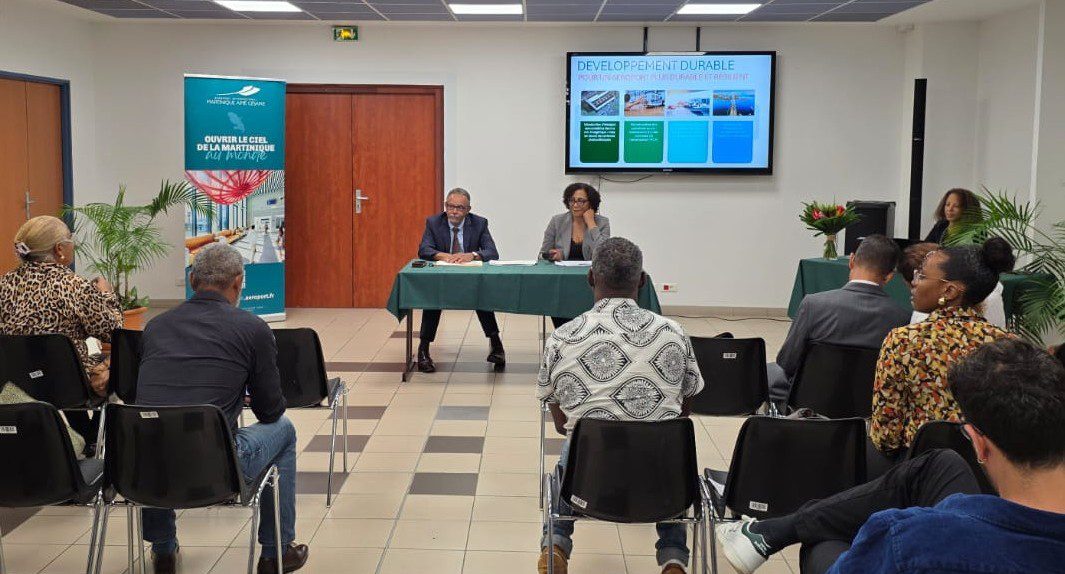
Jean-Michel Lucenay (Vice-President of the Supervisory Board), Nathalie Sébastien (Chairwoman of the Management Board), and Sylvain Le Foyer (Director of Civil Aviation Security)
2025: Growth driven by international traffic
In 2025, the platform confirmed its recovery momentum with overall traffic growth (+2.8% excluding transit). However, behind this average, there is a clear contrast: the domestic segment remains relatively stable, while international traffic recorded significant growth, even compared to 2019.
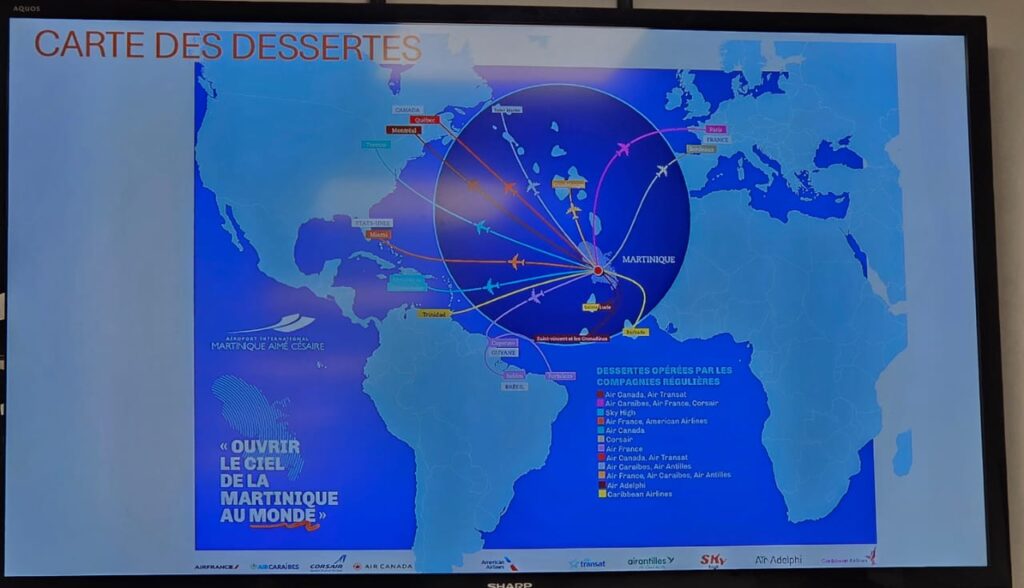
Mainland France still accounts for 65% of traffic, but North America — particularly Canada — and the Caribbean are driving growth.
Five new routes were launched in 2025: Quebec (year-round), Saint Lucia, Fortaleza (via Guyana), Saint Martin, and Bordeaux. This diversification reflects a deliberate strategy of international expansion.
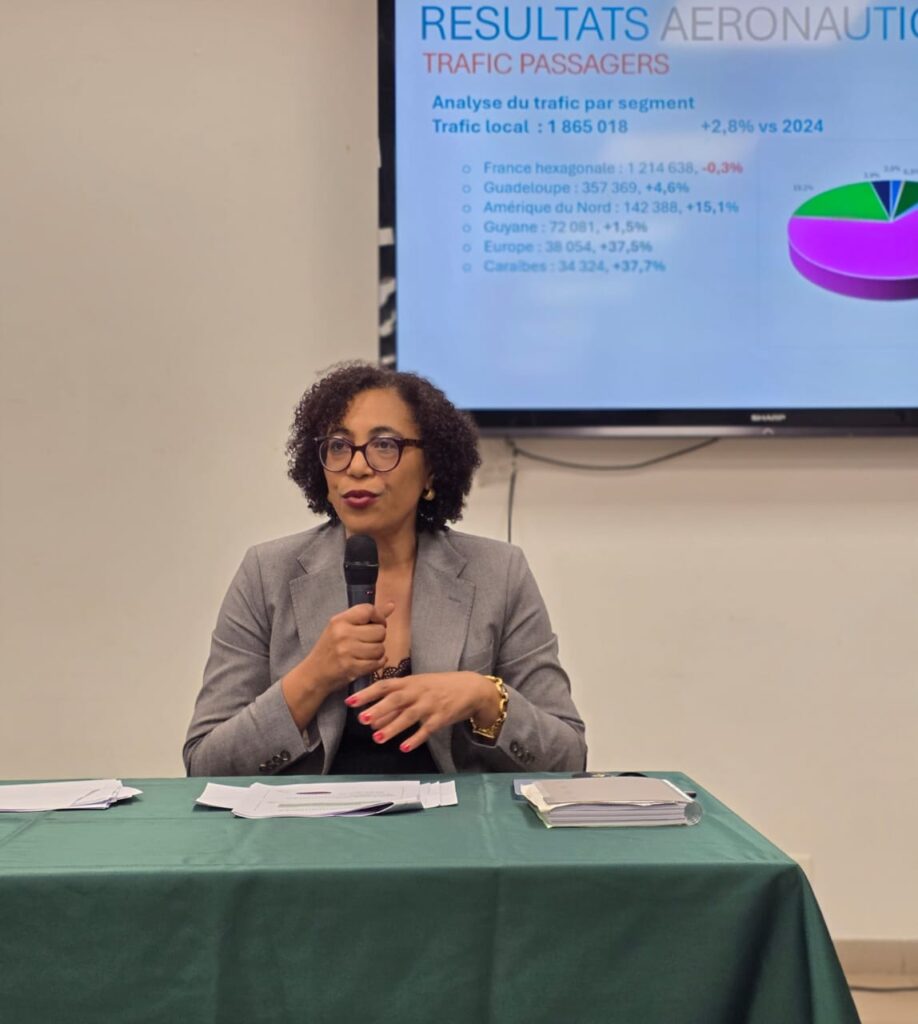
For Nathalie Sébastien, this evolution confirms a strategic shift:
“Growth will come more from international than domestic markets. Our role is to open Martinique’s skies to the world while consolidating existing flows.”
Canada has established itself as a major axis, with Montreal, Toronto (seasonal), and now Quebec City, which has been announced as a year-round service. Regional connectivity is also progressing with the return of Saint Lucia and the strengthening of Caribbean links.
Freight also showed significant progress, with nearly 13,000 tonnes transported in 2025 (+27.2%).
Combating seasonality: A territorial challenge
Beyond the figures, the issue of seasonality remains central. The airport acknowledges that activity remains concentrated in certain periods, which weakens the local economic ecosystem.

Jean-Michel Lucenay emphasizes this collective responsibility:
“We must work to smooth out activity throughout the year. Air connectivity is a direct lever for the economy, for hotels, and for the entire tourism sector.”
The 2026 goal is not just to grow, but to “grow without expanding,” by optimizing existing infrastructure and attracting new customer profiles.
2026: Transforming the passenger experience
The common thread for 2026 is clear: improving the customer experience.
The airport intends to act on three levers:
- image, with more assertive markers of Martinican identity,
- fluidity, through digitalization,
- comfort, with an upscale move in catering and lounges.
New self-service kiosks and automatic bag drops will be installed to simplify the journey. Two new lounges are also planned: a multi-airline lounge and a VIP lounge, particularly for diplomatic receptions.
The goal: to transform time perceived as a constraint into a valued moment.
Decarbonization and resilience: A coastal airport facing climate change
The energy transition constitutes the other major pillar.
As the island’s second-largest electricity consumer, the airport is directly addressing its carbon footprint. Two photovoltaic projects will deploy over 15,000 panels—on shaded parking areas and building rooftops—for an annual production of 11.5 GWh. 85% will be self-consumed, with the remainder injected into Martinique’s grid. Investment: 14 million euros.
But the challenge goes beyond energy alone. Located in a coastal zone surrounded by mangroves, the airport is undertaking climate change adaptation studies, particularly regarding rising sea levels.
The platform intends to combine development with respect for its ecosystem.
Security and facilitation: Toward greater fluidity and control
Security remains a priority focus.
Following the deployment of over a hundred cameras in 2025, two millimeter-wave scanners will be installed between April and June 2026 to strengthen controls.
Sylvain Lefoyer, Director of Civil Aviation Security for the French Antilles and French Guiana, detailed the operation of this equipment as well as the arrival of PARAFE terminals designed to streamline border controls for both arrivals and departures.
A platform at the heart of territorial strategy
More than just a transport infrastructure, Martinique Aimé Césaire Airport positions itself as a catalyst for regional attractiveness. With strengthened international connectivity, a transformed passenger experience, and accelerated decarbonization, the 2026 roadmap outlines an airport that no longer merely accommodates traffic flows but sustainably structures Martinique’s influence.