At Seatrade Cruise Global, discussions around cruise expansion increasingly point to a structural shift in how itineraries are designed and managed. During the session “Strategic Destination Development: Integrating Private Islands into the Cruise Ecosystem,” held on April 13 at the Sunset Vista Salon, industry leaders explored how private destinations are evolving from simple beach stops into core components of cruise strategy.
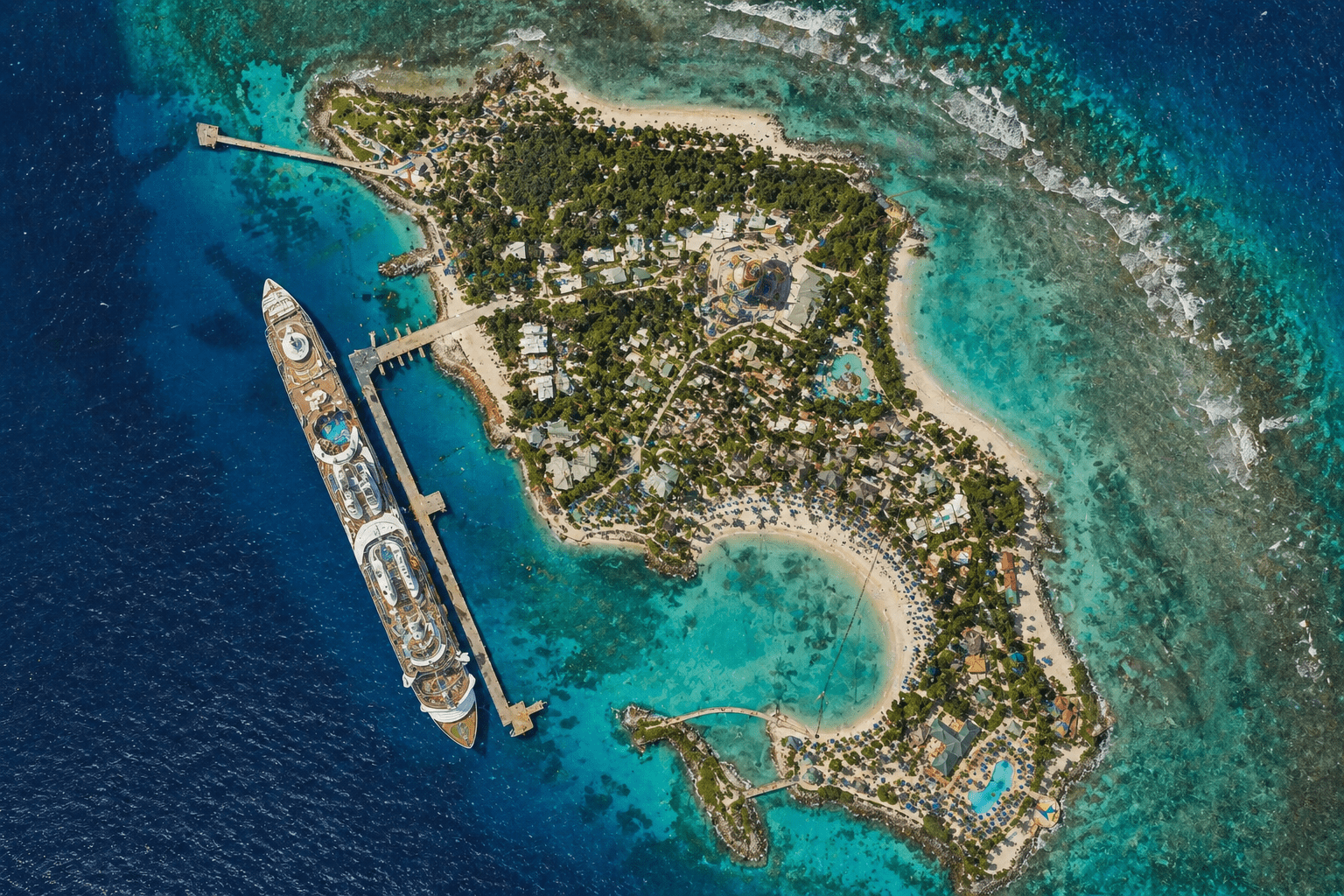
Bringing together executives from major cruise groups, the discussion suggests that private islands — or more broadly, exclusive destinations — are no longer peripheral additions to itineraries, but are becoming strategic tools to support growth, enhance control over the guest experience and integrate more tightly with regional destination networks.
Managing growth through controlled capacity
A central theme emerging from the discussion is the role of private destinations in enabling the cruise industry to manage its growth.
Josh Carroll, Senior Vice President, Destination Development, Deployment, and Port Services at Royal Caribbean Group, explained that as fleets expand, ensuring sufficient destination capacity becomes critical to maintaining the core promise of cruising — the ability to visit multiple locations within a single journey.
In this context, private destinations provide a level of predictability and scalability that traditional ports alone may not always offer. They allow cruise operators to accommodate increasing passenger volumes while maintaining control over infrastructure and visitor flows.
This level of control also suggests a shift in how value is managed within the cruise ecosystem, with operators increasingly shaping both the experience and the economic flows associated with each call.
Complementing — not replacing — traditional ports
Despite their growing importance, panelists emphasized that private destinations are not intended to replace traditional ports of call.
Renata Ribeiro, Senior Vice President, Strategic Operations at Carnival Corporation & plc, noted that “our intention is not to replace ports… but to complement them,” highlighting the role of these destinations in providing flexibility while preserving itinerary diversity.
This balance appears to be central to itinerary design. Combining private destinations with cultural, urban or nature-based ports allows cruise lines to offer varied experiences while optimizing operational efficiency.
At the same time, the discussion suggests that private destinations contribute to resolving increasing competition for berthing space and scheduling conflicts as the number of ships in operation continues to grow.
From simple stops to integrated products
Another key insight is the transformation of private destinations into fully integrated components of the cruise product.
What were once relatively simple beach experiences have evolved into complex environments combining infrastructure, programming and brand identity. As noted during the session, these destinations now reflect the positioning of each cruise line, offering curated experiences tailored to different customer segments and travel behaviors.
Josh Carroll highlighted how design decisions can vary significantly depending on target markets, with guest preferences influencing everything from amenities to spatial layout.
This level of customization suggests that private destinations function as extensions of the onboard experience, allowing cruise lines to maintain consistency in brand delivery throughout the itinerary.
Economic impact and local integration
The discussion also addressed how private destinations interact with local economies and communities.
Panelists emphasized that these developments can generate significant employment and business opportunities, often involving local stakeholders in construction, operations and service provision.
Renata Ribeiro described how large-scale projects can mobilize entire communities, with high levels of local employment and the emergence of small businesses catering to both passengers and crew — illustrating how local entrepreneurship can integrate into the cruise ecosystem.
Examples shared during the session suggest that these local dynamics can extend beyond the destination itself, contributing to broader regional economic activity.
At the same time, panelists indicated that private destinations may support growth in nearby ports by increasing overall traffic to the region. This interdependence suggests a more integrated relationship between private developments and traditional destinations than is often assumed.
Sustainability as a foundational component
Sustainability was presented as a key element of long-term development strategies for private destinations.
From infrastructure systems — including water production, energy and waste management — to landscape design and biodiversity preservation, panelists highlighted the need to adapt developments to local environmental conditions.
Renata Ribeiro emphasized the importance of using native vegetation and integrating projects into their natural surroundings, while Josh Carroll pointed to collaborations with local authorities to address environmental challenges and improve infrastructure beyond the destination itself.
These approaches suggest that sustainability is increasingly embedded in the planning and execution of private destination projects, both as an operational necessity and as part of broader industry commitments.
Expansion at scale
The discussion also points to the rapid expansion of this model.
Josh Carroll indicated that Royal Caribbean expects to operate eight private destinations by 2028, highlighting the pace at which cruise operators are investing in these assets.
This trajectory suggests that private destinations are likely to become an increasingly prominent feature of global cruise itineraries in the coming years.
Implications for Latin America and the Caribbean
For Latin America and the Caribbean, where many private destinations are located or planned, these developments carry important implications.
As cruise lines continue to invest in exclusive destinations, the region may see further growth in passenger volumes alongside increased infrastructure development. However, the integration of private destinations into itinerary planning also raises questions about how value is distributed between these controlled environments and traditional ports.
This evolution may reshape how value is captured across Caribbean destinations, particularly as private developments concentrate a growing share of passenger time and spending.
The discussions suggest that destinations in the region may need to position themselves within this evolving ecosystem, identifying how they can complement private developments while maintaining their attractiveness within broader cruise itineraries.
Reading the road ahead
The exchanges during this session point to a broader evolution in the cruise industry’s approach to destinations.
Private islands and exclusive destinations are no longer simply leisure spaces; they are becoming strategic assets that enable cruise lines to manage growth, enhance operational control and shape the overall travel experience.
These developments suggest that the future of cruise destinations may increasingly depend on how effectively traditional ports and private developments coexist within a shared ecosystem.