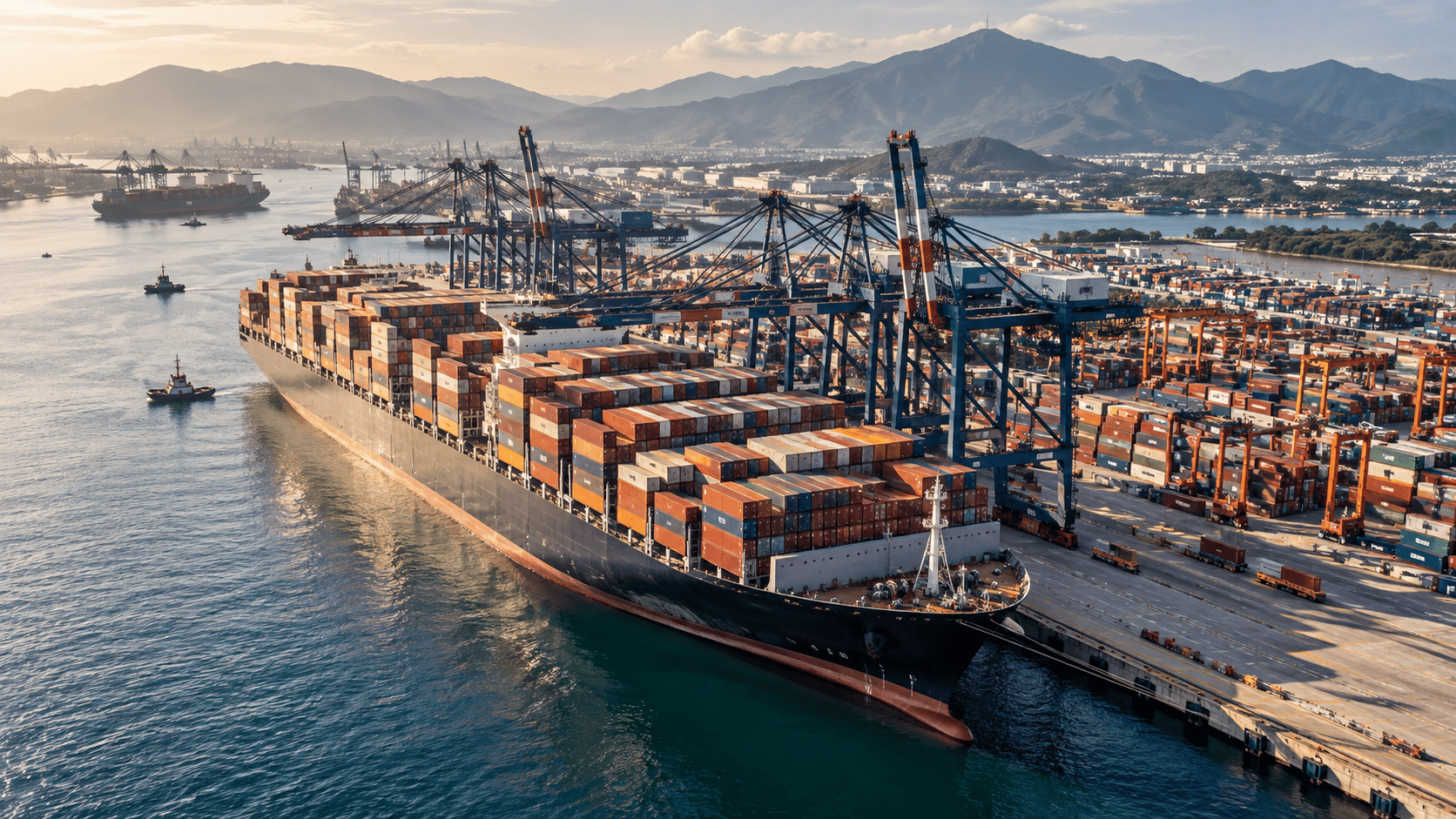
Mexico’s leading container gateway is moving into a new operational class. With Contecon Manzanillo now cleared to handle vessels of up to 24,000 TEU, the port is combining deeper access, terminal expansion and stronger Asia connectivity as container volumes continue to rise.
The Port of Manzanillo is preparing for a larger generation of container ships at a time when its own cargo volumes are accelerating. Contecon Manzanillo (CMSA), the Mexican subsidiary of International Container Terminal Services, Inc. (ICTSI), received authorization on August 31 to handle vessels with drafts of up to 15.5 meters, making it the only terminal operator at the port currently cleared for that depth, according to ICTSI.
The authorization allows Contecon Manzanillo to serve ships of up to 400 meters in length, including ultra-large container vessels with capacities of up to 24,000 TEU. The milestone is significant not simply because of the size of the vessels involved, but because it arrives as Manzanillo consolidates its position at the center of Mexico’s containerized trade.
Manzanillo opens the door to 24,000-TEU ships
The new 15.5-meter operating draft represents an intermediate step rather than the terminal’s final target. Contecon Manzanillo is aiming for an operational draft of 17 meters at its new berths, while the Administración del Sistema Portuario Nacional Manzanillo (ASIPONA Manzanillo) continues dredging and basin-conditioning works designed to accommodate deeper-draft vessels.
“This authorization reflects the investments we have made to strengthen the terminal,” said José Antonio Contreras, chief executive officer of Contecon Manzanillo, describing the approval as a step toward the 17-meter target.
The move gives Manzanillo additional flexibility as shipping lines deploy larger vessels on major trade corridors. But the ability to receive a 400-meter vessel is only one part of the equation. Berth capacity, crane reach, yard space and the ability to move containers inland must scale with vessel size if additional maritime capacity is to translate into greater cargo throughput.
Container growth is already testing a larger gateway
Manzanillo is expanding from an already substantial traffic base. Between January and July 2026, the port handled 2,455,956 TEU, an increase of 11.7% compared with the same period of 2025. That represented 43.4% of all containers handled by Mexican ports during the seven-month period.
The comparison with the national market is particularly notable. Mexico’s port system handled 5,664,007 TEU between January and July, up 4.0% year on year. Manzanillo therefore grew at almost three times the rate of the national container market over the period and continued to account for more than four out of every ten TEU moving through the country’s ports.
The wider cargo picture points in the same direction. Total cargo handled at Manzanillo reached 19.38 million tonnes between January and July 2026, including petroleum products, representing growth of 7.4% year on year. Imports remained the largest component at 12.34 million tonnes, highlighting Manzanillo’s role as an inbound gateway for the Mexican economy.
For Contecon Manzanillo, preparing for larger vessels is therefore not solely a bet on future shipping trends. It is taking place while the gateway is already absorbing rising cargo volumes.
Asia connectivity adds another layer of growth
Manzanillo’s Pacific location makes Asia particularly important to that growth story. Contecon describes the terminal as a gateway for both Asia and intra-Americas trades, with direct access to major Mexican consumption and industrial markets including Mexico City, Guadalajara and Monterrey. The terminal is also connected to Ferromex through an on-dock intermodal rail facility.
That maritime connectivity strengthened again in July 2026, when MSC launched its Sierra service at Manzanillo. The service connects Qingdao, Tianjin and Busan with Manzanillo and Lázaro Cárdenas before returning to Qingdao, and is MSC’s second dedicated Far East–Mexico service.
The new service should not be read as evidence that 24,000-TEU vessels will immediately begin calling regularly at Manzanillo. It does, however, illustrate how stronger Asia–Mexico connectivity and greater vessel-handling capability are developing at the same time.
For Manzanillo, that combination matters. More services create additional options for importers, exporters and logistics providers, while deeper berths and larger-vessel capability give terminal operators greater flexibility as shipping networks and fleet deployment evolve.
Contecon is scaling the terminal around larger vessels
The draft authorization forms part of a broader expansion cycle at Contecon Manzanillo.
ICTSI has been adding berth, yard and equipment capacity to the terminal, which has progressed through successive phases of development. The expansion is designed to raise annual handling capacity toward approximately 2 million TEU, while supporting larger vessels and higher cargo volumes.
Infrastructure alone, however, will not determine how much additional traffic Manzanillo can absorb. Contecon’s location close to the Mexican industrial heartland makes inland connectivity increasingly important as maritime volumes rise. Its direct rail connection provides access to major domestic markets, while Manzanillo also serves an industrial corridor extending through Guadalajara, Aguascalientes, San Luis Potosí, León, Silao and Querétaro.
The result is a capacity challenge that extends well beyond the berth. Larger ships can deliver greater container exchanges during a single call, increasing pressure on cranes, yards, gates, rail operations and inland distribution networks within a compressed period.
Manzanillo’s move into the 24,000-TEU vessel class therefore represents more than a technical upgrade to nautical access. With container volumes growing faster than the Mexican port market overall and new Asia services adding to its connectivity, the port is entering a phase in which nautical access, terminal productivity and inland cargo evacuation will have to expand together.
The ability to receive the world’s largest container ships is an important milestone. The more consequential test will be whether the entire logistics system behind the berth can operate at the same scale.
Sources: ICTSI