
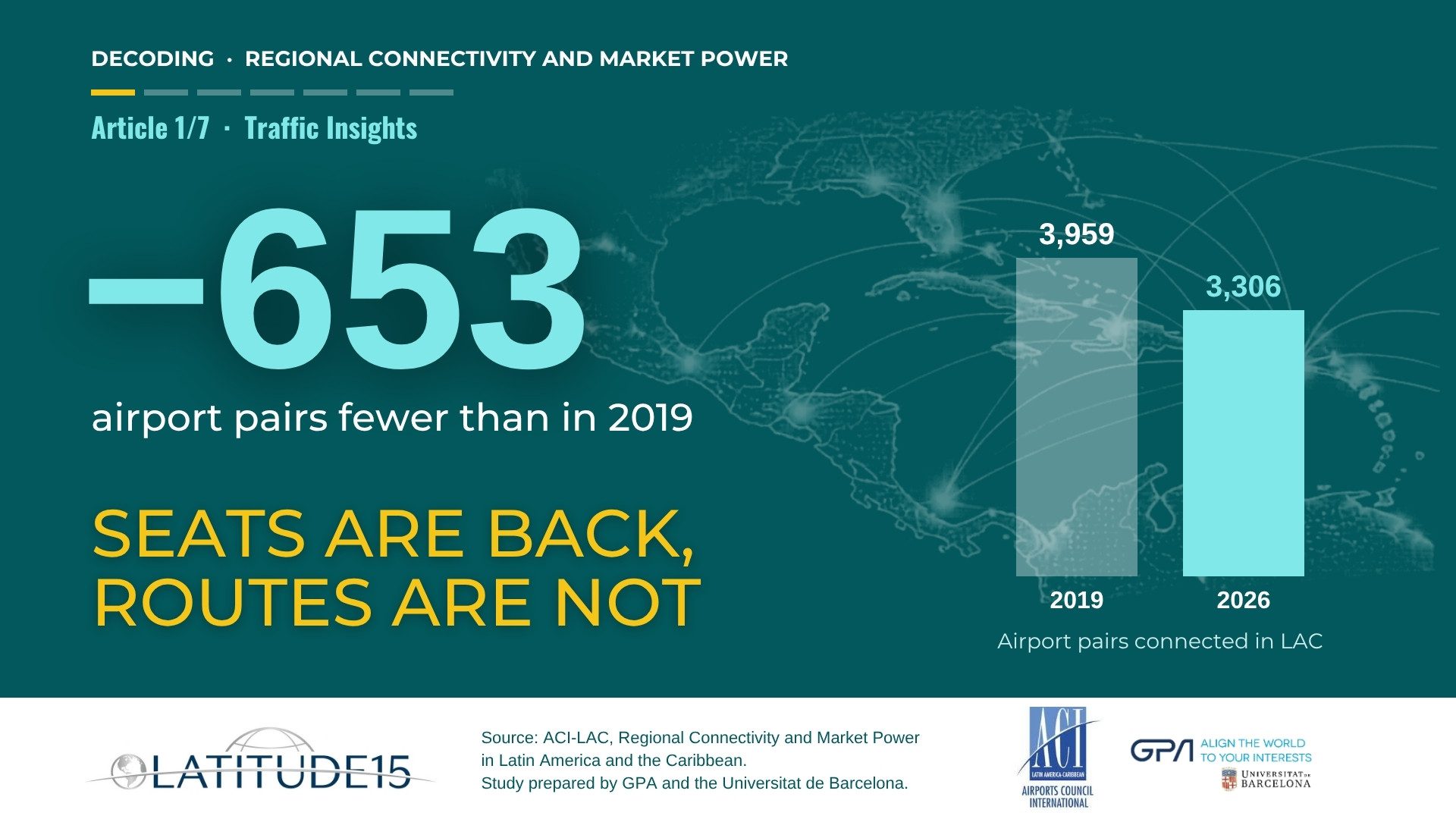
Airlines will offer more seats in Latin America and the Caribbean (LAC) in 2026 than they did before the pandemic. They will connect fewer pairs of airports: 3,306 this year, compared with 3,959 in 2019. The figures come from Regional Connectivity and Market Power in Latin America and the Caribbean, a study commissioned by Airports Council International – Latin America and Caribbean (ACI-LAC) and carried out by GPA and the Universitat de Barcelona. LATITUDE 15 presents its main findings in a series of articles, starting with the breadth of the network.
Capacity Is Above Pre-Pandemic Levels
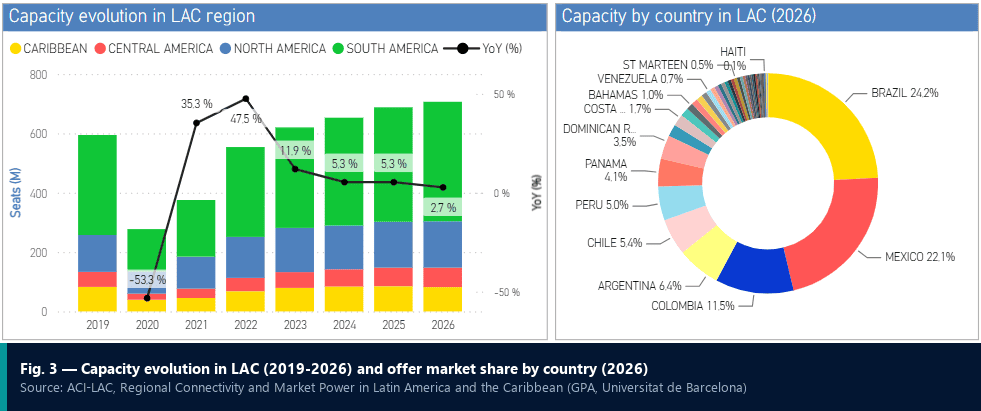
Scheduled seat capacity across the region fell by 53.3% in 2020. It returned to its 2019 level in 2023, then grew by 5.3% in both 2024 and 2025. Current schedules point to a further 2.7% increase in 2026, as growth moderates. Domestic markets recovered first; international services took longer.
Three countries hold more than half of the region’s seats: Brazil (24.2%), Mexico (22.1%) and Colombia (11.5%).
Where the 653 Airport Pairs Went
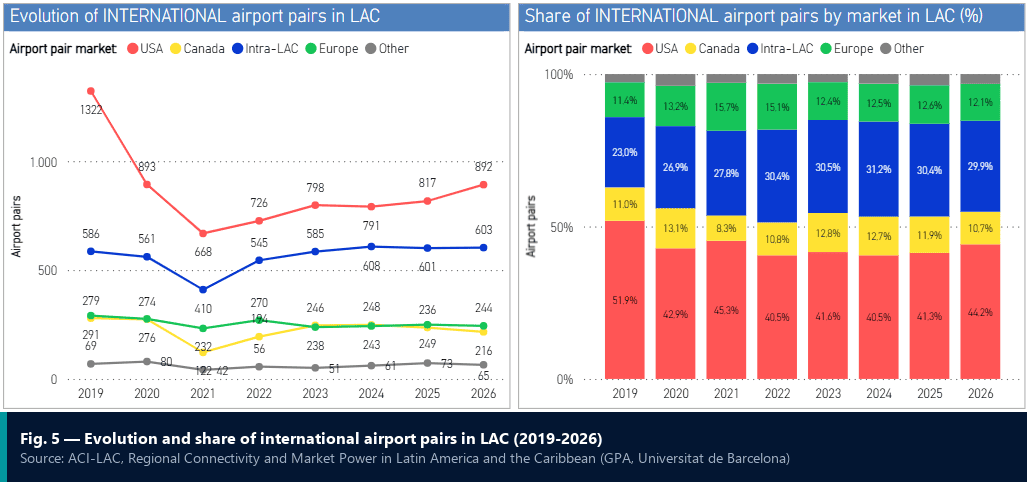
Most of the gap lies in links with the rest of the world. Airport pairs between LAC and destinations outside the region fell from 1,967 to 1,417 over the period. The study attributes an important part of this decline to connections with the United States: 1,322 airport pairs in 2019, 892 in 2026, a drop of 32.5%. The United States nonetheless remains by far the largest individual market on this measure, with 44.2% of international airport pairs, or 54.9% when Canada is included.
Domestic networks also contracted, though moderately, according to the study. Links within the region have fully recovered: intra-LAC airport pairs rose from 586 to 603 and now represent 29.9% of international pairs.
In 2026, LAC airports are connected to 110 airports in the United States and Canada, 34 in Europe, 10 in Asia, 8 in Africa and 3 in Oceania.
More Seats Concentrated in the Largest Gateways
The region has 546 commercial airports with scheduled services. Only 23 of them offer more than 10 million seats a year, yet together they hold 55.7% of capacity. At the other end of the scale, 399 airports, 73% of the network, offer fewer than one million seats and account for 7.6% of capacity. In the Caribbean, the airport system is made up overwhelmingly of smaller airports.
The weight of the largest airports is growing. Those above 20 million annual seats held 34.9% of regional capacity in 2019 and 42.4% in 2026.
How LAC Compares
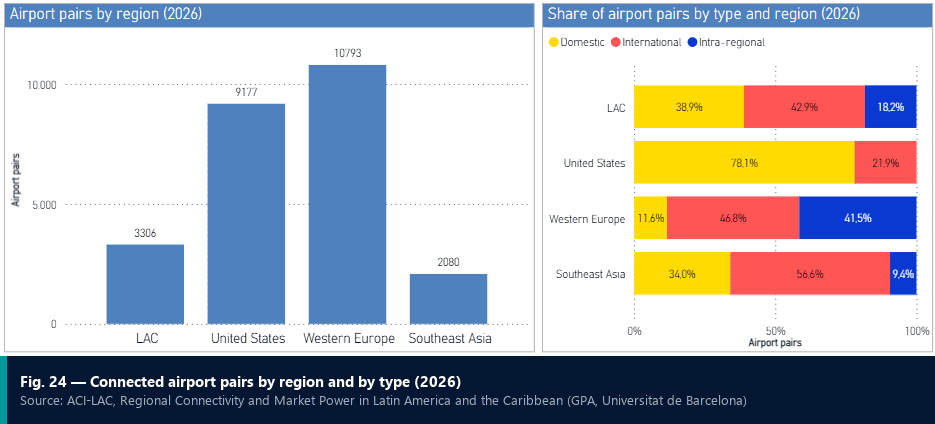
The study benchmarks LAC against the United States, Western Europe and Southeast Asia. Western Europe counts 10,793 airport pairs in 2026 and the United States 9,177, against 3,306 in LAC and 2,080 in Southeast Asia. On average, an LAC airport has 12.1 direct airport connections, compared with 15.0 in Southeast Asia, 27.5 in the United States and 51.2 in Western Europe. The authors point out that geography, population, market size and territorial structure all influence these indicators.
What the Study Recommends
The authors tie this finding to one of their four strategic priorities. With capacity back above 2019 while airport pairs remain below that level, they consider that strengthening connectivity should not only mean adding capacity at the largest gateways, but also widening the network and improving access to air services in secondary markets. The levers they cite include airport incentive schemes, proportionate regulatory frameworks and operating conditions adapted to smaller aircraft and markets, so that thinner routes can develop and last.
The study also highlights multi-stop and triangular services. Several European and intercontinental airlines use intermediate stops within the region to serve LAC markets that may not support a standalone long-haul service.
Questions to Ask
Airports
- Of the destinations served from your airport in 2019, how many are served again in 2026?
- Does your growth come from more seats on existing routes or from new destinations?
Tourism boards and destinations
- Which of your source markets have lost their direct link since 2019?
- Do your indicators track the number of destinations served as well as the number of seats?
Civil aviation authorities and governments
- Do your incentive schemes and regulatory conditions take thinner routes and smaller aircraft into account?
Read also: WAGA 2026: Rafael Echevarne highlights LAC’s persistent connectivity gap
About the Data
Figures for 2026 are based on current airline schedules. Commercial airports are those holding a three-letter IATA code and offering scheduled commercial services. Airport pairs are the pairs of airports connected by scheduled services. Source: ACI-LAC, Regional Connectivity and Market Power in Latin America and the Caribbean, Deliverable 3 – Final Report, prepared by GPA and the Universitat de Barcelona.
Next in the series: seats on offer versus where passengers actually travel.