

Almost one in three passengers travelling from one Latin American or Caribbean country to another does not fly non-stop and has to change planes on the way. Within Western Europe, fewer than one in ten do. The finding comes from Regional Connectivity and Market Power in Latin America and the Caribbean, the study commissioned by Airports Council International – Latin America and Caribbean (ACI-LAC) and carried out by GPA and the Universitat de Barcelona. This third article in the LATITUDE 15 series looks at how often passengers fly non-stop, country by country.
How Many Passengers Fly Non-Stop
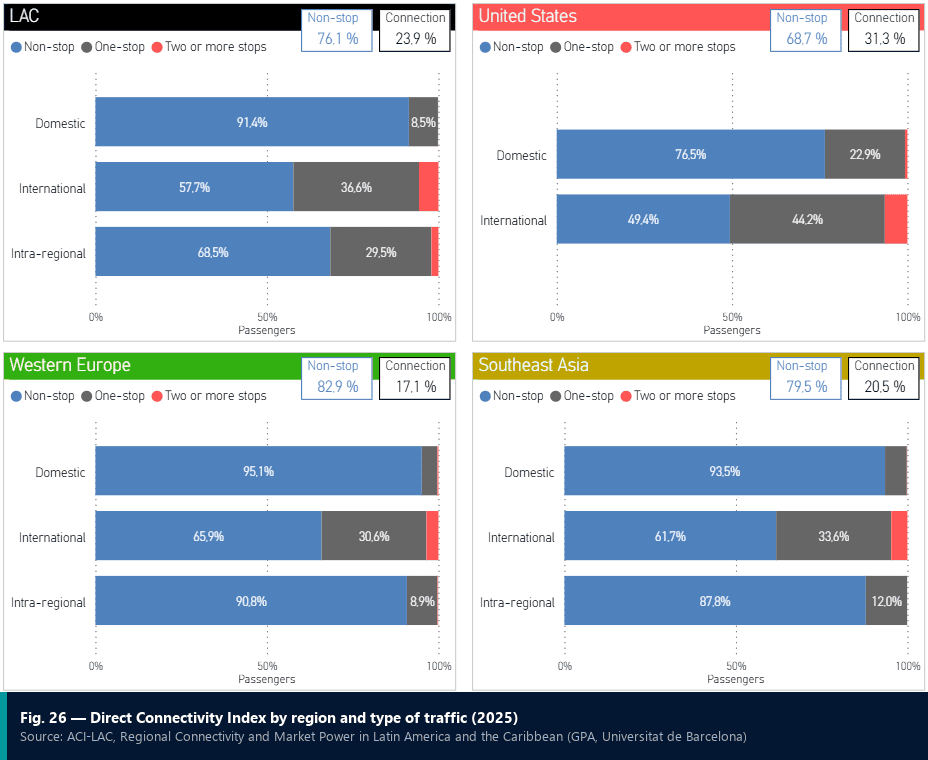
To measure how well demand is served, the study uses a Direct Connectivity Index: the share of origin-and-destination (O&D) passengers who reach their final destination on a non-stop flight. Across LAC, the index stood at 76.1% in 2025, which means 23.9% of passengers needed at least one connection.
The score depends heavily on the type of trip. It reaches 91.4% for domestic travel, falls to 68.5% for journeys between LAC countries and to 57.7% for travel outside the region. For trips within their own region, Western Europe records 90.8% and Southeast Asia 87.8%. According to the study, LAC’s main connectivity gap with these regions lies in international travel; domestic connectivity is close to theirs.
For travel outside each region, LAC also records the lowest index of the three multi-country regions compared: 57.7%, against 65.9% in Western Europe and 61.7% in Southeast Asia.
Wide Differences Between Countries
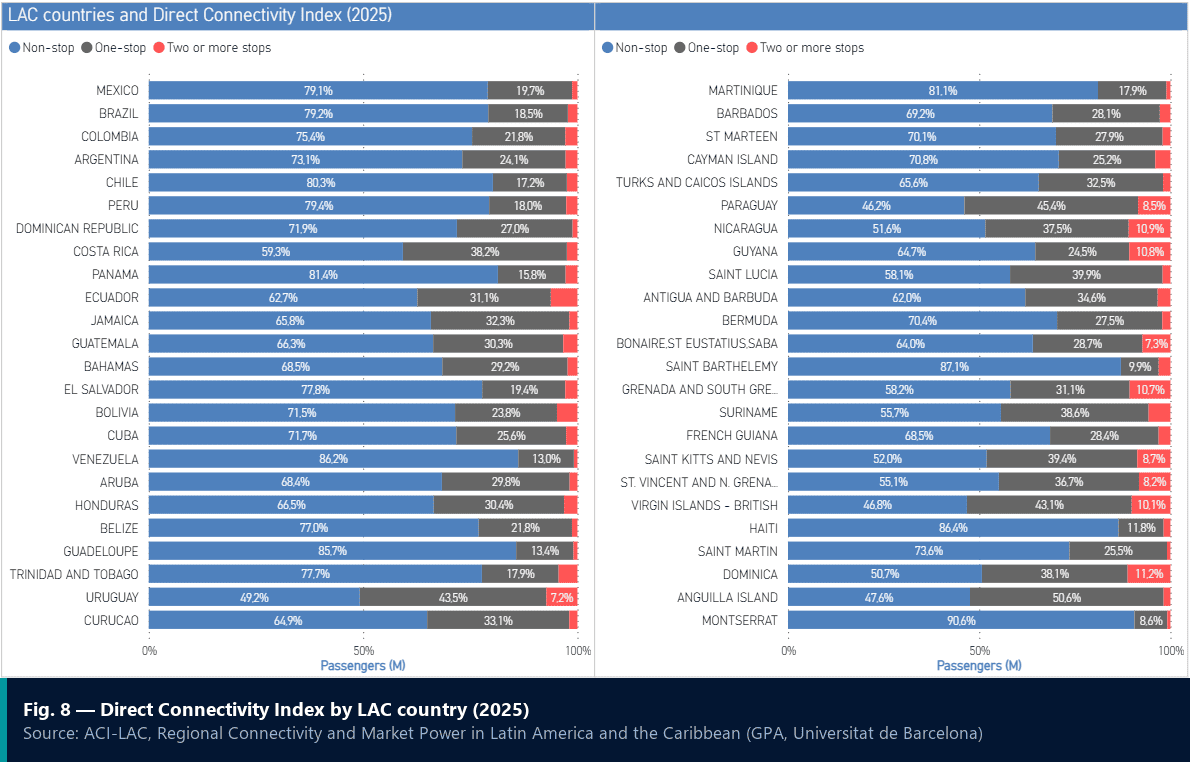
Among the largest markets, about four in five passengers travel non-stop in Mexico (79.1%), Brazil (79.2%), Chile (80.3%), Peru (79.4%) and Panama (81.4%). Costa Rica records 59.3%, the lowest score among the eight largest O&D markets.
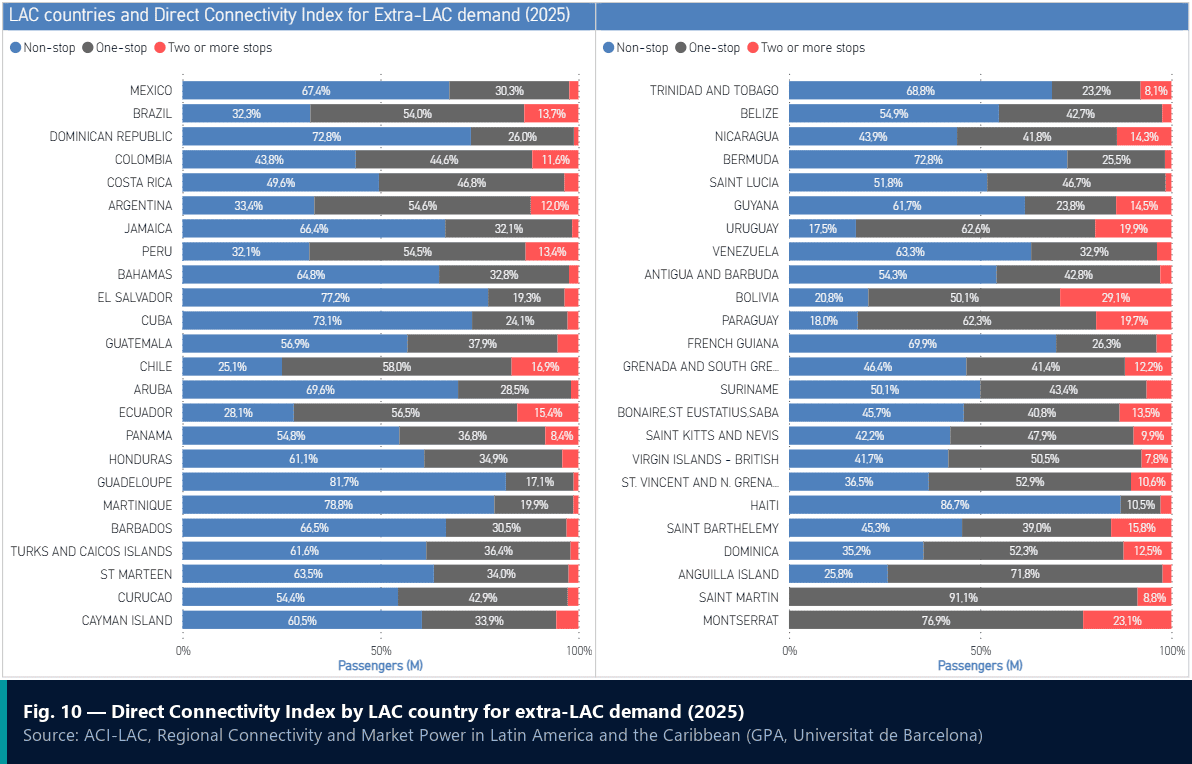
The contrast sharpens for travel outside the region. The Dominican Republic (72.8%) and Mexico (67.4%), with their extensive direct networks to North America, keep comparatively high scores. In South America, the figures drop to 33.4% for Argentina, 32.3% for Brazil, 32.1% for Peru and 25.1% for Chile.
Within the region, Panama stands apart with an index of 93.0% for intra-LAC travel, reflecting the network available through Tocumen and Copa Airlines. Almost half of Copa’s own intra-LAC O&D passengers travel on connecting itineraries, which the study attributes to the central role of its hub-and-spoke network at Tocumen.
Island Markets: Share of Passengers Flying Non-Stop (2025)
| Market | All O&D demand | Travel outside LAC |
|---|---|---|
| Montserrat | 90.6% | 0%* |
| Saint Barthélemy | 87.1% | 45.3% |
| Haiti | 86.4% | 86.7% |
| Guadeloupe | 85.7% | 81.7% |
| Martinique | 81.1% | 78.8% |
| Trinidad and Tobago | 77.7% | 68.8% |
| Saint Martin | 73.6% | 0%* |
| Dominican Republic | 71.9% | 72.8% |
| Cuba | 71.7% | 73.1% |
| Cayman Islands | 70.8% | 60.5% |
| Bermuda | 70.4% | 72.8% |
| Sint Maarten | 70.1% | 63.5% |
| Barbados | 69.2% | 66.5% |
| Bahamas | 68.5% | 64.8% |
| Aruba | 68.4% | 69.6% |
| Jamaica | 65.8% | 66.4% |
| Turks and Caicos Islands | 65.6% | 61.6% |
| Curaçao | 64.9% | 54.4% |
| Bonaire, Sint Eustatius and Saba | 64.0% | 45.7% |
| Antigua and Barbuda | 62.0% | 54.3% |
| Grenada | 58.2% | 46.4% |
| Saint Lucia | 58.1% | 51.8% |
| Saint Vincent and the Grenadines | 55.1% | 36.5% |
| Saint Kitts and Nevis | 52.0% | 42.2% |
| Dominica | 50.7% | 35.2% |
| Anguilla | 47.6% | 25.8% |
| British Virgin Islands | 46.8% | 41.7% |
Read from the study’s charts (Fig. 8 and Fig. 10), ranked by the share for all O&D demand. *No non-stop share appears on the chart for travel outside LAC: in Saint Martin, 91.1% of these passengers travel with one stop; in Montserrat, 76.9%.
What the Study Recommends
Deepening regional market integration is one of the study’s four strategic priorities, which the authors describe as a key opportunity for the region. In their view, further liberalization of intra-LAC air services, including greater flexibility over market entry, pricing and capacity, together with reduced barriers to cross-border airline operations and ownership, could facilitate airline expansion across national markets, strengthen competition and support greater economies of scale.
Questions to Ask
Tourism boards and destinations
- For your main source markets, how many visitors arrive non-stop, and how many connect on the way?
Airports
- Among your main intra-LAC markets, which ones still have no non-stop service from your airport?
Civil aviation authorities and governments
- Do your air services agreements with neighbouring countries leave room for new non-stop routes?
About the Data
Passenger figures are 2025 origin-and-destination (O&D) data. The Direct Connectivity Index is the share of O&D passenger demand travelling non-stop between its true origin and final destination. Source: ACI-LAC, Regional Connectivity and Market Power in Latin America and the Caribbean, Deliverable 3 – Final Report, prepared by GPA and the Universitat de Barcelona.
Previously in the series: where LAC’s international passengers really travel. Next: regional aviation.