
Across Latin America and the Caribbean (LAC), freight operations continue to rely heavily on paper-based processes, despite ongoing efforts to modernize logistics systems. From transport documents to administrative checks, information is often handled through fragmented workflows that limit visibility and slow down operations.
During the LAC eFTI4ALL webinar, these constraints were highlighted as part of a broader discussion on how data could reshape logistics practices. Rather than focusing solely on infrastructure, the exchanges pointed to the role of information flows in improving coordination across the supply chain.
In this context, digital freight frameworks such as eFTI raise a practical question: how does the shift from paper to data actually transform logistics operations?
A system still largely paper-based
One of the key starting points of the discussion lies in the current structure of logistics processes, which remain largely document-driven.
Sandra Casanova noted that “information does not circulate easily,” pointing to persistent inefficiencies in how data is exchanged between stakeholders. In many cases, transport documentation still relies on physical formats, requiring manual handling at multiple stages of the supply chain.
From an operational perspective, this results in repeated administrative checks and duplicated processes. Victor Dolcemascolo described how authorities often need to access transport documents during inspections, a process that, in its current form, can involve multiple steps and delays.
Together, these elements suggest that logistics systems continue to depend on fragmented and time-consuming workflows, limiting both efficiency and responsiveness.
Fragmented data, limited visibility
Beyond the reliance on paper, another structural constraint highlighted during the webinar concerns the fragmentation of data.
Sandra Casanova pointed to the absence of “statistics and an observatory with data collection and exploitation,” underlining the lack of structured information across the logistics ecosystem. Without shared data frameworks, operators often work with partial or delayed information, making it more difficult to coordinate flows effectively.
This lack of visibility also affects industrial operations. Charles Larcher emphasized the importance of real-time tracking, noting that companies need “full visibility on the flow of goods in real time” to manage supply chains efficiently. In the absence of such visibility, businesses are often required to maintain higher inventory levels, which can increase costs and reduce flexibility.
These constraints indicate that data fragmentation does not only affect administrative processes—it directly impacts operational performance.
What is eFTI, in practical terms
Within this context, the eFTI framework was introduced as a way to structure and standardize how freight data is exchanged.
Casanova described eFTI as “a common language of harmonized data,” designed to enable “secure exchanges between operators and public authorities.” The objective is to move away from isolated systems toward a shared framework where information can circulate more seamlessly.
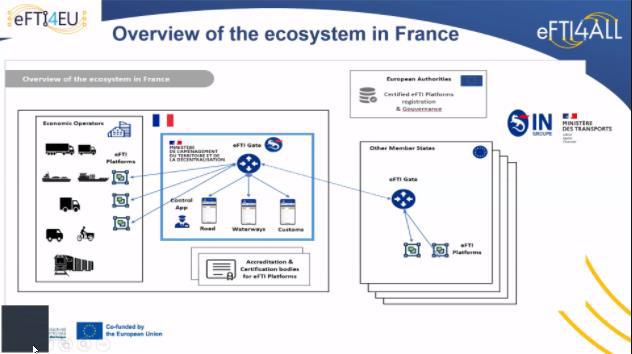
From a technical standpoint, Heiti Mering explained that the system functions as “a distributed network of services,” connecting public and private actors through standardized gateways. This architecture allows data to be shared across different platforms while maintaining interoperability and security.
Victor Dolcemascolo provided further insight into how this operates in practice, describing the role of national access points, or “gates.” When a transport operation is subject to control, “a request is sent to the national access point, which retrieves the relevant data from the appropriate platform,” enabling authorities to access documents in real time.
Taken together, these elements suggest that eFTI is less about a single platform than about an interconnected infrastructure for data exchange.
What changes for operations
The transition from paper-based processes to digital data exchange has several potential operational implications.
For public authorities, access to transport information could become faster and more direct, particularly during roadside inspections or customs checks. As explained by Victor Dolcemascolo, “when a vehicle is controlled, a request is sent to the national access point, which retrieves the relevant data,” allowing authorities to access documents in real time. This could reduce the time required for controls and limit administrative bottlenecks.
For companies, the reduction of paper-based processes could limit manual data entry and the associated risks of errors. Improved traceability may also support better planning and coordination across the supply chain. In that sense, Sandra Casanova highlighted that eFTI enables “real-time data and traceability of flows,” suggesting a shift toward more informed decision-making.
At a broader level, more consistent data exchange could contribute to smoother logistics flows. By enabling stakeholders to access the same information in real time, digital frameworks may help reduce delays linked to document verification and administrative procedures.
These changes, however, are presented as gradual improvements rather than immediate transformations.

From logistics to data-driven systems
Beyond operational gains, the discussions also point to a more structural shift in how logistics systems are organized.
As data becomes more central to operations, logistics increasingly relies on the ability to collect, process, and share information across multiple actors. In this context, data can be seen as an underlying layer that supports coordination, decision-making, and performance monitoring.
This could progressively shift logistics from document management toward real-time data coordination, where information flows continuously between operators, authorities, and service providers. As a result, logistics processes may become less dependent on document handling and more oriented toward data-driven decision-making.
Conditions for impact
At the same time, the potential impact of digital freight frameworks remains conditional.
Their effectiveness depends on several factors, including the level of adoption among stakeholders, the ability to ensure interoperability between systems, and the establishment of shared standards. Without alignment across these dimensions, digital tools may coexist with existing processes rather than fully replacing them.
The discussions also suggest that coordination between public and private actors will play a critical role in determining how these systems evolve. As with other large-scale digital initiatives, implementation is likely to be gradual and uneven across regions.
Conclusion – A gradual shift rather than a disruption
The LAC eFTI4ALL discussions suggest that digital freight frameworks could contribute to improving logistics operations by enhancing data exchange, reducing administrative complexity, and supporting better coordination.
At the same time, the transition appears to be evolutionary rather than disruptive. While the move from paper to data introduces new possibilities, its impact depends on how effectively systems are implemented and adopted across the logistics ecosystem.
In this context, digital freight frameworks point toward a shift in how logistics is managed—one where data becomes a central component of operations, but where progress remains closely tied to the broader dynamics of coordination and implementation.