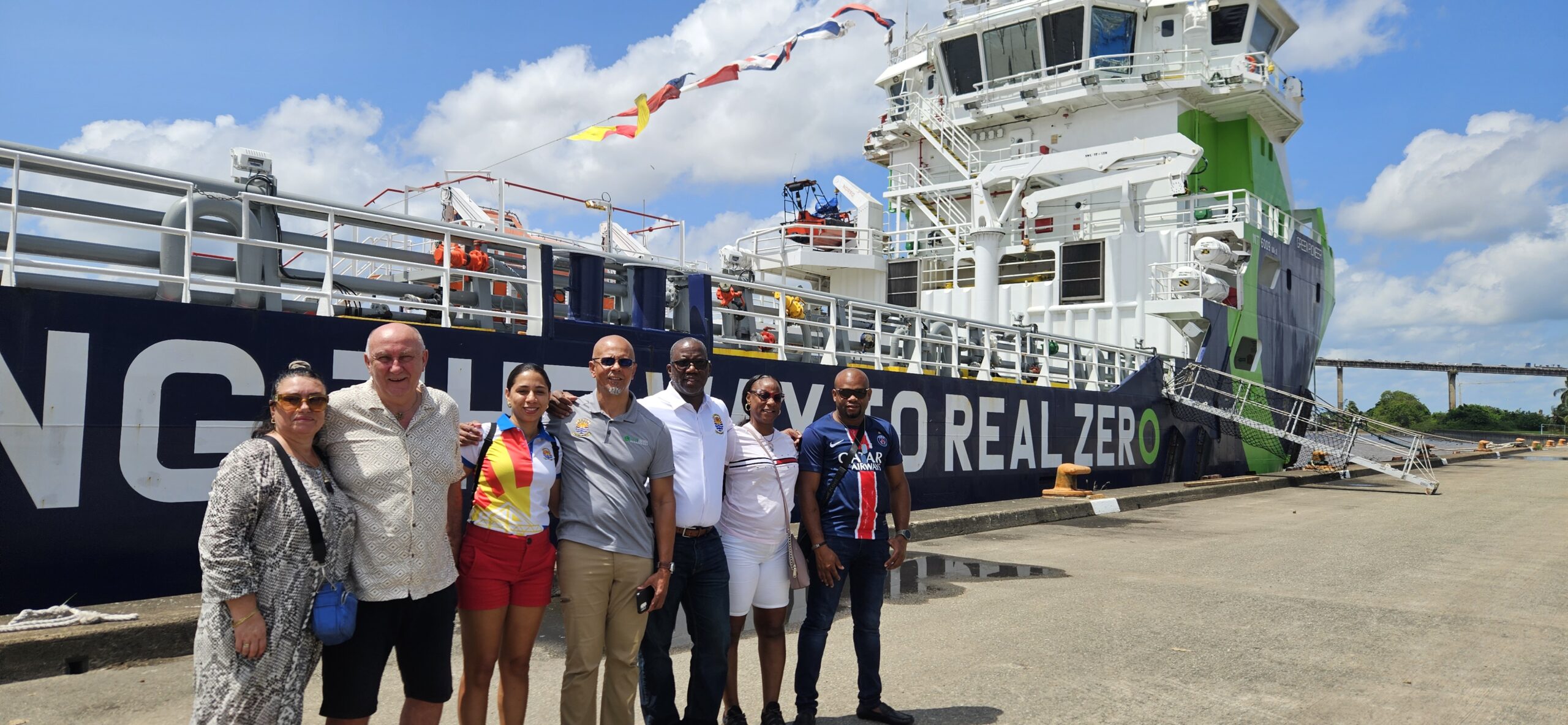
During the 29th Annual General Meeting of the Port Management Association of the Caribbean (PMAC) in Suriname, Fortescue presented its pioneering ammonia-powered vessel to regional maritime professionals. Speaking aboard the Fortescue Green Pioneer, Senior Project Manager Matthew Garland explained how the technology works, the challenges of scaling its adoption and the role of international regulation in supporting the transition.
The Fortescue Green Pioneer arrived at the Dr. Jules Sedney Port in Paramaribo, Suriname, in July 2026, offering maritime professionals attending the 29th PMAC Annual General Meeting an opportunity to examine ammonia propulsion technology firsthand.
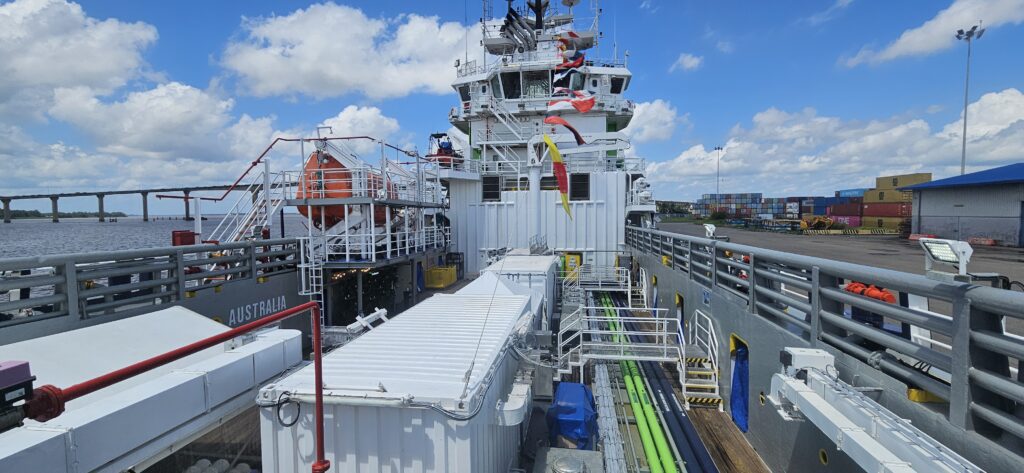
During an onboard visit, we explored the vessel’s fuel storage, safety installations and engine systems before speaking with Matthew Garland, Senior Project Manager at Australian group Fortescue, about the prospects for ammonia-powered shipping.
The visit formed part of Fortescue’s efforts to demonstrate the technology and encourage its adoption across the maritime industry.
Demonstrating ammonia propulsion at sea
The Fortescue Green Pioneer is a demonstration vessel converted to operate using ammonia alongside conventional fuel. Two of its four engines have been modified to accommodate ammonia and diesel combustion, while the remaining engines retain their conventional configuration.
Unlike the large bulk carriers used to transport Fortescue’s iron ore from Australia to China, the Green Pioneer serves as a platform for testing and showcasing alternative propulsion technology.
Fortescue is pursuing ammonia as part of its strategy to decarbonise maritime operations, particularly the long-distance transport of iron ore.
Ammonia contains no carbon, allowing it to avoid direct CO₂ emissions from the ammonia component of combustion. However, its overall environmental performance depends on how the fuel is produced, the use of supplementary fuels and the control of other emissions.
Green ammonia is produced using hydrogen obtained through electrolysis powered by renewable electricity, combined with nitrogen extracted from the air.
Matthew Garland explained that Fortescue sees the technology as particularly relevant to large oceangoing vessels, where battery electrification presents different operational constraints.
Smaller vessels, including tugboats and leisure craft, may be better suited to electrification, depending on their operating requirements.
Safety and fuel handling remain central to operations
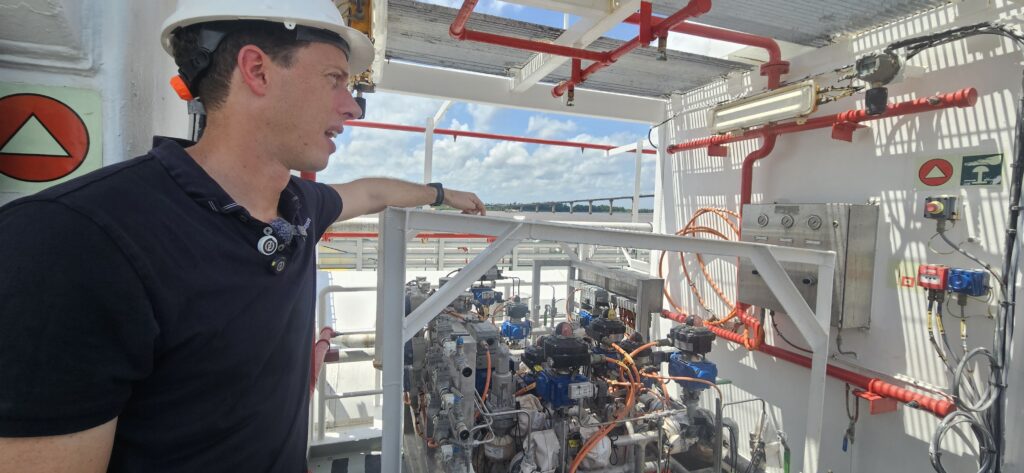
The onboard tour highlighted the infrastructure required to accommodate ammonia as a marine fuel.
Ammonia can be stored as a liquid through refrigeration or pressurisation. On the Fortescue Green Pioneer, pressure is used to deliver fuel from its relatively small storage tank towards the engines.
Larger ammonia-powered vessels require different arrangements to manage the substantially greater quantities of fuel involved. The demonstration also focused on toxicity, one of the principal operational hazards associated with ammonia.
Fortescue’s fuel-handling system incorporates double-walled piping, gas detectors and secondary containment around valves and other equipment. Nitrogen purging and an ammonia treatment system are used to manage residual fuel during handling operations.
Crew protection forms another part of the safety approach, with specialised protective equipment, respiratory apparatus and emergency procedures available on board.
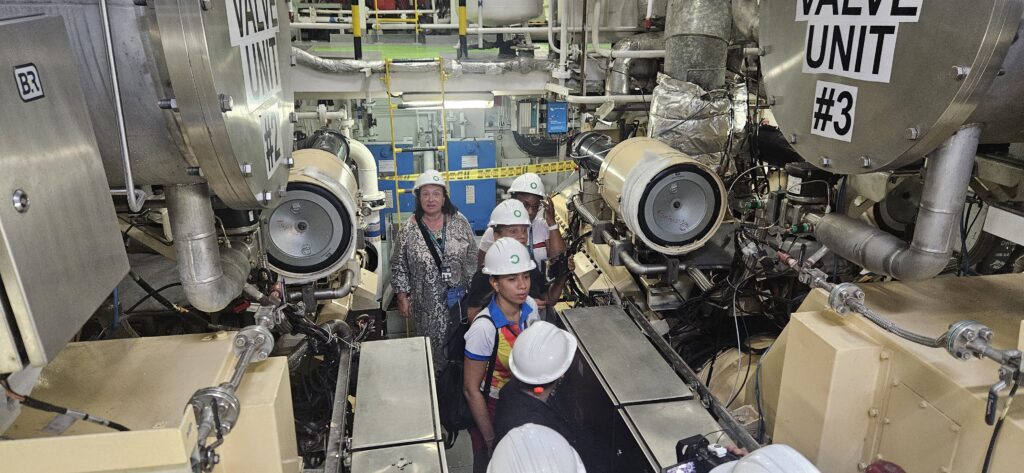
The engineering presentation also addressed emissions management. While ammonia combustion avoids CO₂ emissions from the ammonia itself, it can produce nitrogen oxides, unburnt ammonia and nitrous oxide, a potent greenhouse gas.
Controlling these emissions is therefore essential to achieving the intended environmental benefits.
For port operators, the demonstration illustrates that adopting ammonia requires more than compatible engines. Fuel storage, bunkering procedures, monitoring systems and crew training must also be considered.
From prototype to commercial shipping
Fortescue’s ambitions extend beyond its demonstration vessel.
During the visit, Garland outlined the group’s plans to introduce ammonia-capable bulk carriers into its iron ore transport operations.
In June 2026, Fortescue and CMB.TECH announced an agreement involving 12 Newcastlemax bulk carriers. Up to three vessels equipped with dual-fuel ammonia engines were expected to enter service by the end of 2026, while the remaining nine would be prepared for potential conversion.
The transition nevertheless presents different challenges for existing fleets.
Matthew Garland explained that retrofitting depends on engine compatibility, the additional fuel-delivery infrastructure required and the remaining operational life of each vessel.
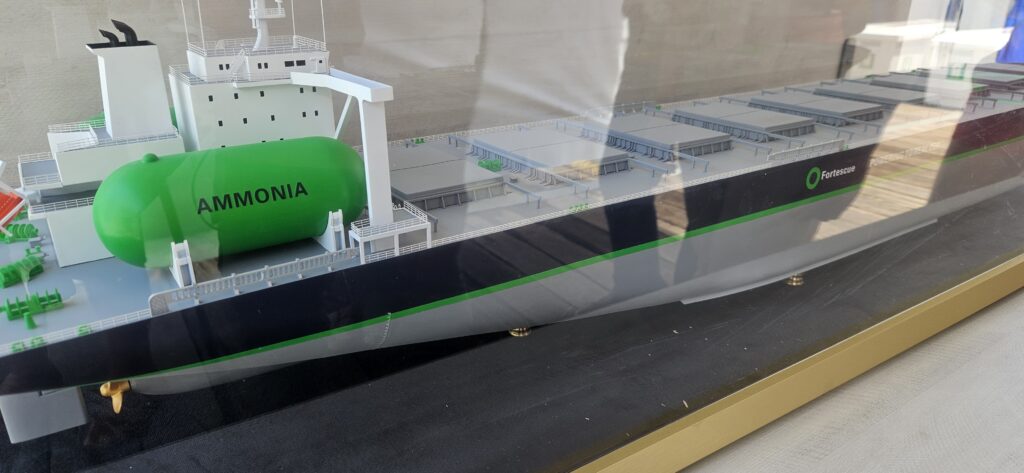
Older ships may not have compatible conversion kits, making investment difficult to justify when replacement is approaching.
The technology could also be considered for other maritime segments, including cruise shipping.
During the LATITUDE15 interview, Matthew Garland suggested that operators could gain experience by testing the technology on a limited number of vessels before considering wider deployment.
“If you’ve got a fleet of 20 cruise ships, maybe you can start looking at what you can do with one of them.”
Such experimentation could help operators understand the practical requirements of conversion without committing an entire fleet at once.
Costs and regulation shape the next stage
Despite the progress demonstrated by the Green Pioneer, fuel economics remain a major obstacle.
Matthew Garland explained that green ammonia can appear competitive with conventional marine fuels when prices are compared by weight. Its lower energy density, however, means that greater quantities are needed to provide equivalent propulsion energy.
The cost of modifying vessels and installing new fuel systems adds to the investment required.
For Fortescue, overcoming these barriers will require both technological development and an international regulatory framework that helps narrow the economic gap between conventional and alternative fuels.
“The technology exists, it’s available today, the Green Pioneer has proved that.”
Matthew Garland’s remarks also reflected Fortescue’s support for the International Maritime Organization’s proposed Net-Zero Framework, which aims to introduce a global marine fuel standard and a greenhouse gas pricing mechanism.
As of September 2026, the framework had not been formally adopted. Discussions were continuing ahead of the IMO Marine Environment Protection Committee’s 85th session, scheduled for November 30 to December 3, with a possible resumption of the extraordinary adoption session on December 4.
Fortescue is advocating for a regulatory approach that would encourage investment in lower-emission fuels and support their commercial adoption.
The Green Pioneer’s visit to Suriname brought these questions directly to maritime professionals from across the Caribbean. Beyond the demonstration of an alternative propulsion system, the vessel illustrated the technical, operational and economic decisions involved in bringing ammonia-powered shipping into commercial service.
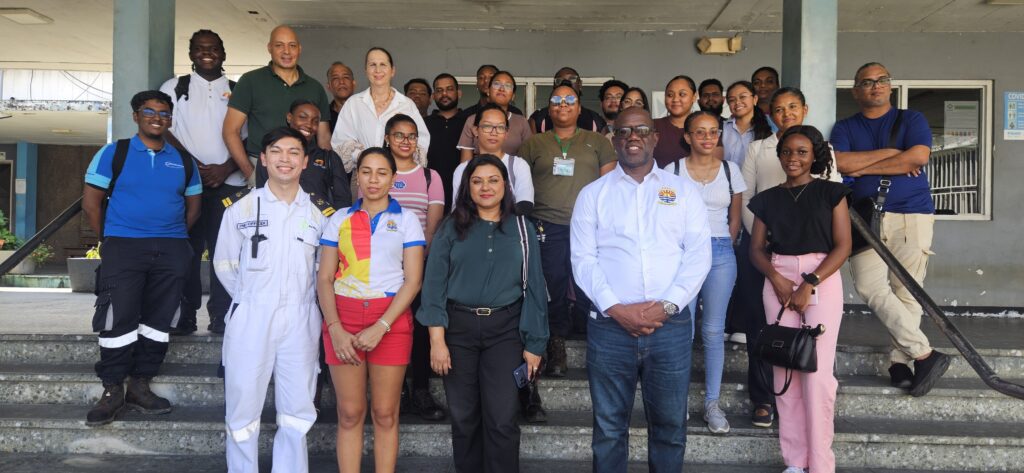
Photo credits : LATITUDE15
FAQ
What is the Fortescue Green Pioneer?
The Fortescue Green Pioneer is a demonstration vessel equipped with dual-fuel engines capable of using ammonia alongside diesel. It was developed to test and showcase ammonia propulsion technology.
Why did the Fortescue Green Pioneer visit Suriname?
The vessel visited Paramaribo in July 2026 as part of activities associated with the 29th Annual General Meeting of the Port Management Association of the Caribbean. Maritime professionals were invited aboard to learn about ammonia propulsion and its operational requirements.
Can existing ships be converted to use ammonia?
Some existing vessels can be converted, depending on engine compatibility, available space, fuel-system requirements and their remaining operational life. Converting older vessels may be technically difficult or economically unattractive.
What is preventing the wider adoption of ammonia in shipping?
Major challenges include fuel costs, lower energy density, investment in compatible vessels and bunkering infrastructure, safety requirements and the development of an international regulatory framework.