When major shipping services are disrupted, the smallest vessels can become some of the most important. Across the Caribbean, schooners and small inter-island freighters continue to connect farmers, traders and island markets — while also providing a form of logistical resilience that becomes most visible during a crisis.
After Hurricane Luis struck Saint-Martin in 1995, shops emptied and normal maritime connections were severely disrupted. One participant at the 29th Annual General Meeting of the Port Management Association of the Caribbean recalled that, for a period, small vessels were the only ships still reaching the French side of the island.
People waited for them because food and other supplies had become difficult to obtain.
Three decades later, the example remains relevant to a wider regional debate: what happens if the Caribbean loses the small vessels that connect markets too small, too fragmented or too specialised for conventional liner services?
During the PMAC discussions in Paramaribo, the message was unusually direct:
“Small islands need small ships.”
The statement captures an often-overlooked part of Caribbean maritime connectivity. Regional shipping policy tends to focus on container terminals, larger vessels, port modernisation and international routes. Yet below that network sits another layer of trade made up of smaller operators moving food, agricultural products, parcels and other cargo between neighbouring islands.
Their economic footprint may be limited individually. Their strategic value can be much larger.
Small ships for small markets
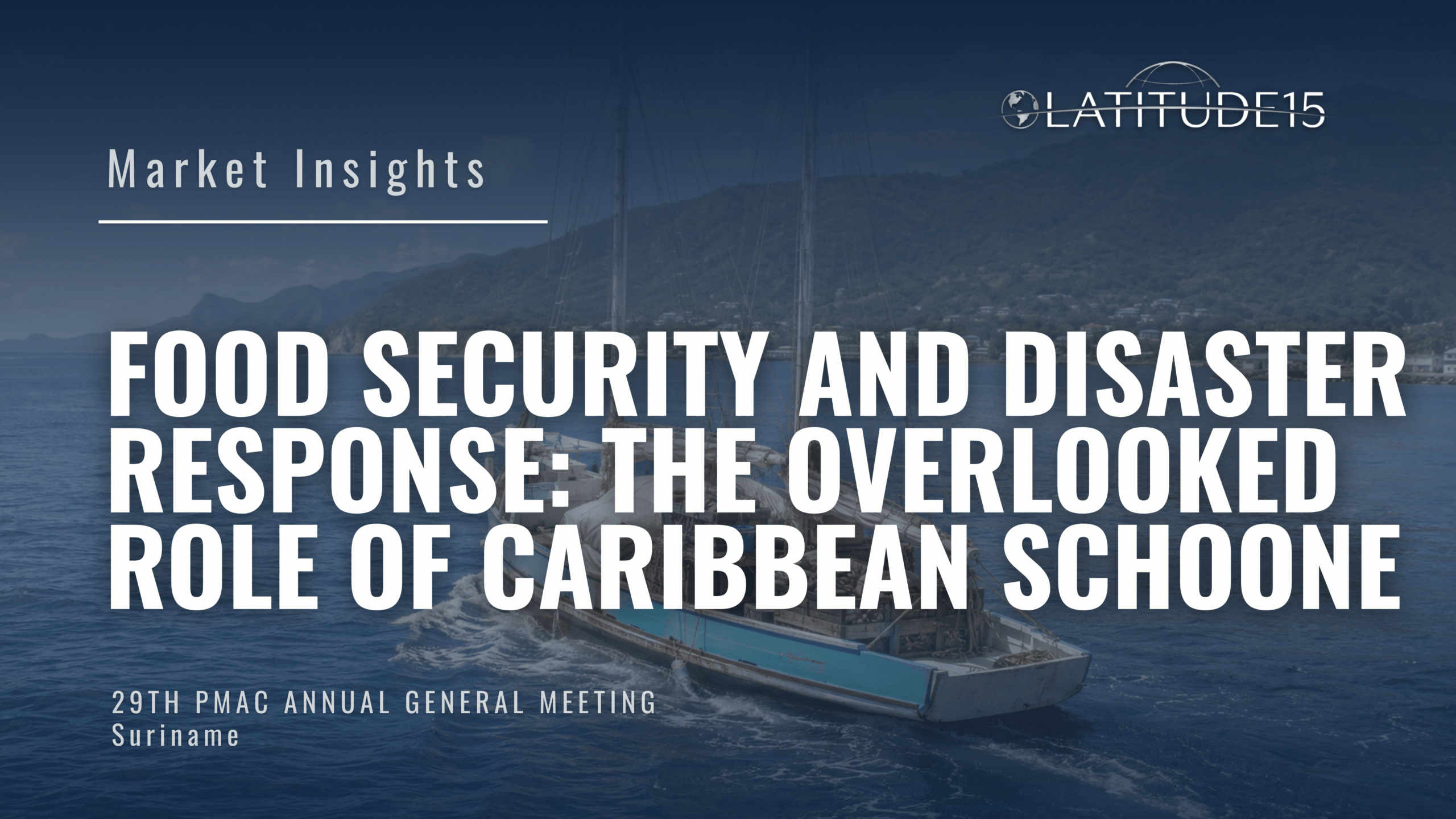
The term schooner has historical roots in Caribbean trade, but the discussion in Paramaribo extended beyond traditional sailing vessels to small steel freighters and other inter-island cargo ships.
One operator described vessels of approximately 120, 150 or 300 tonnes serving markets where the volumes may simply be too small for the economics of a larger container service.
That distinction matters.
A large shipping line is designed around scale. Ships, containers, terminal equipment and schedules become more efficient when cargo volumes are sufficiently large and predictable.
Small island markets do not always fit that model.
A farmer may need to send only a limited quantity of produce to a neighbouring island. A cooperative may not have enough cargo to fill a container. A retailer may need frequent deliveries rather than a large shipment arriving at longer intervals.
Small vessels can occupy that space between local production and large-scale liner shipping.
One operator participating in the discussion described current services linking Saint Lucia, Martinique, Dominica and Guadeloupe, saying that food movements through those routes also support small farmers, cooperatives and businesses.
Their relevance is therefore not simply maritime. It reaches directly into agricultural trade and local market access.
Food security is also a transport problem
Caribbean food-security strategies often focus on increasing agricultural production. But producing more food does not automatically create stronger regional trade.
Products still need to reach another island at the right time, in the right quantity and, for perishables, under appropriate temperature conditions.
The European Union has placed maritime connectivity within that wider food-security agenda.
A presentation by Mariana Arias of the Delegation of the European Union in Barbados identified the EU Regional Food Security Programme 2023–2027, initiatives to improve intra-regional agricultural trade and a study aimed at improving the efficiency of the schooner shipping sector. It also highlighted an EU-Caribbean food-trade corridor initiative between Martinique and Saint Vincent and the Grenadines, including the need for adequate cold-storage facilities, loading areas and refrigerated transport.
That framing changes the way small shipping services can be viewed.
They are not only transport businesses. They can be part of the infrastructure that determines whether regional agricultural production can actually reach regional consumers.
For small producers in particular, connectivity may be as important as production capacity itself.
If transport is too expensive, too infrequent or unavailable for small consignments, nearby markets can remain commercially distant even when they are geographically close.
When the main network stops
The value of smaller vessels becomes even clearer when normal transport systems are disrupted.
During the Covid-19 period, speakers at the PMAC session recalled larger lines consolidating services or reducing calls. Smaller ships, by contrast, continued operating.
PMAC Chairman Darwin Telemaque described them as “natural connectors”, noting that they continued returning even under difficult conditions.
The Saint-Martin experience after Hurricane Luis provides another example.
According to the testimony presented during the session, when normal supplies were interrupted and stores were empty, smaller vessels continued reaching Galisbay and became an important link for the population.
This does not make schooners formal emergency-response vessels, nor does it mean they perform search-and-rescue missions.
Their resilience role is logistical.
They can provide an alternative channel for goods when larger networks are temporarily disrupted, infrastructure is damaged or commercial services are reduced.
Mariana Arias summarised the European Union’s view during the same discussion:
“For the European Union, the small vessels, we really see their role in disaster response, in food security, in support of small farmers.”
In that sense, the small-vessel network can function like reserve capacity: rarely the most visible part of the system, but potentially critical when the primary network fails.
The economics are becoming harder to sustain
The problem is that the network itself appears increasingly fragile.
An operator participating in the discussion said that his business had once used vessels of around 2,500 tonnes in the 1980s but now operates ships closer to 200 tonnes. He also estimated that 40 to 50 other operators known to him had disappeared from the business. These figures are individual testimony rather than regional industry statistics, but they illustrate the pressure described throughout the session.
Port costs are one of the difficulties.
Small vessels may encounter charges or operating requirements designed around much larger commercial ships. During the discussion, participants questioned whether pilotage, mooring, labour and other port-service structures always reflect the economics of a vessel carrying only a few hundred tonnes.
Telemaque cited historical arrangements in Saint Kitts where provisions protected schooners from some standard shipping and port charges, arguing that smaller vessels require a different operating framework if their services are to remain viable.
The challenge is not to make small operators exempt from every cost or rule.
Ports also have legitimate expenses. Berths, workers, equipment, security and infrastructure must be financed.
The question is whether a charging structure designed for much larger ships can inadvertently eliminate a service whose regional value extends beyond the revenue generated by a single port call.
Modernise the sector without regulating it out of existence
Preserving small-vessel connectivity cannot mean preserving every existing practice unchanged.
Operators themselves acknowledged the pressure to modernise through digitalisation, cleaner energy and more efficient logistics.
Safety is another priority.
The European Union presentation identifies safety training and a schooner registry under the RIGHT Programme with the OECS. It also refers to support for improving the efficiency of the schooner-shipping sector.
That points towards a more useful policy question than simply whether the region should “save the schooners”.
The challenge is to modernise the network without removing the conditions that make it viable.
That could mean examining:
- proportionate port charges for small vessels;
- dedicated or appropriately designed berthing areas;
- streamlined procedures for frequent inter-island operations;
- stronger safety standards and vessel registration;
- access to digital systems that match the scale of smaller operators;
- cold-chain infrastructure for agricultural cargo;
- and financing mechanisms suitable for fleet renewal and efficiency improvements.
None of these measures alone will guarantee the survival of the sector.
But treating a 200-tonne inter-island freighter exactly like a much larger commercial vessel may also fail to recognise what each is expected to deliver.
A backup network worth understanding
The Caribbean is trying to strengthen regional trade, improve food security and build resilience against increasingly disruptive shocks.
Those objectives depend on more than large infrastructure projects.
They also depend on whether a farmer can move a small shipment to the next island, whether a market can receive food when a normal service is interrupted and whether alternative maritime capacity still exists after a hurricane or another major disruption.
The value of schooners and other small inter-island vessels lies partly in that flexibility.
They cannot replace the region’s principal container lines, nor should they be expected to. They serve a different layer of the maritime economy — one where volumes are smaller, distances are short and the commercial margins can be thin.
That layer becomes easiest to ignore when the main network is functioning.
It becomes hardest to replace when it is not.
For Caribbean ports, the question is therefore not whether small vessels belong to the past. It is whether the region can modernise them, regulate them proportionately and preserve the connectivity they still provide.
Because for some of the Caribbean’s smallest markets, small islands still need small ships.