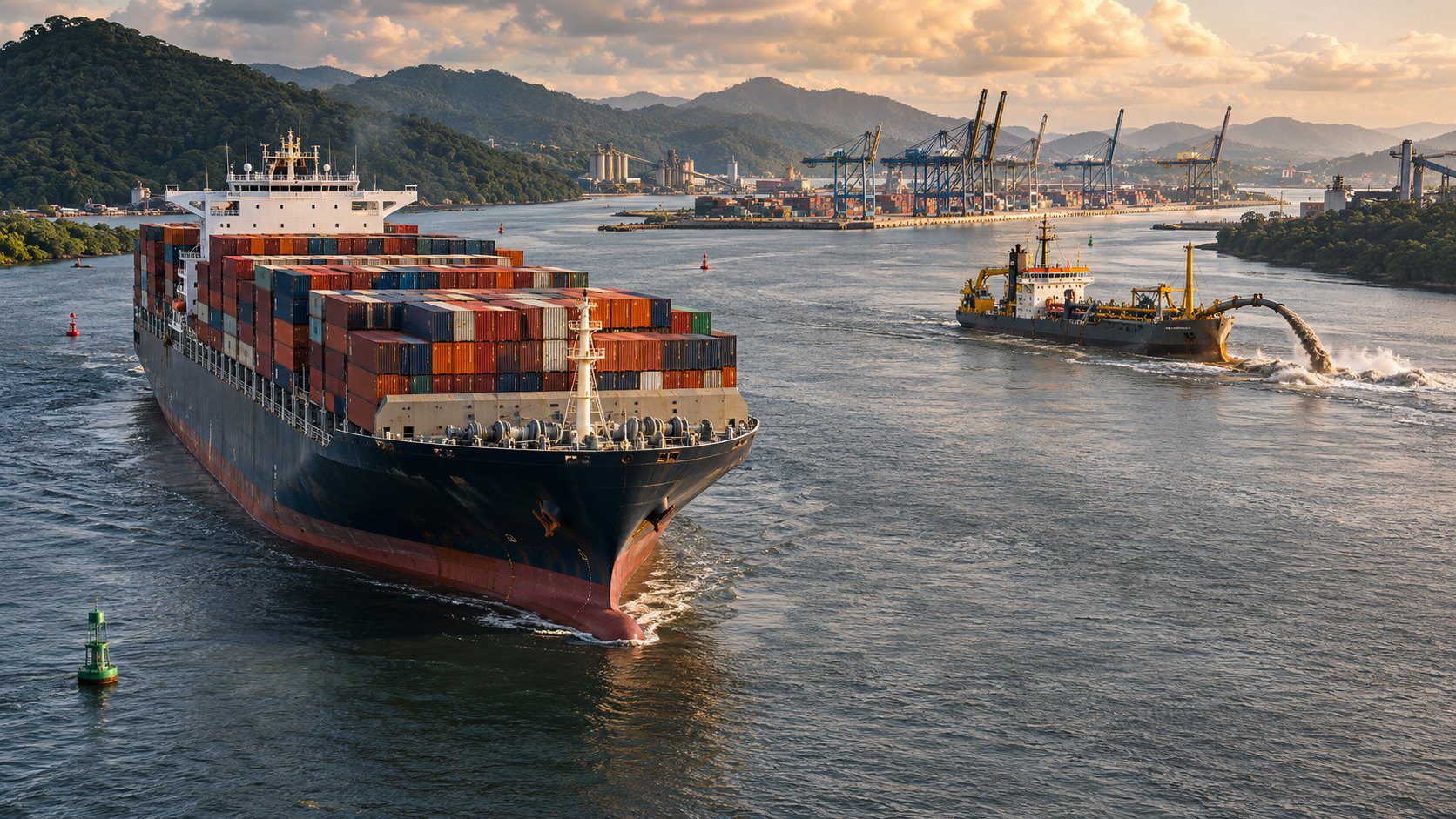
On 30 October 2026, the Port Management Association of the Caribbean (PMAC) held a webinar in its Leadership Conversations series on applying a Blue Ocean Shift approach to Caribbean ports and logistics. It was presented by Fritz Pinnock, former president of the Caribbean Maritime University (2006-2022), and followed by an exchange with PMAC chairman Darwin Telemaque and Dr Curtis Dennie of the CARICOM Secretariat. Before turning to strategy, the presentation set out five pressures facing Caribbean ports that are members of PMAC. This first article in the LATITUDE 15 series on the webinar looks at those five pressures.
1. Costs Decided Thousands of Miles Away
For PMAC member ports, global supply-chain disruption means that events far from the region change when cargo arrives and how much shipping costs. A shipment can become more expensive even when the Caribbean port has made no change to its own charges.
The Panama Canal is a case in point. The canal depends on fresh water to operate its locks. During the 2023 drought, the Panama Canal Authority cut daily booking slots to 22 in December 2023, against a usual capacity of 38 to 40 transits a day. In November 2023, a priority slot sold at auction for US$3.975 million, a record at the time.
Fritz Pinnock gave his own example: a container he had been waiting to ship since February of the previous year. When he started watching, the freight rate was around US$5,000 to US$6,000. “I end up having to ship the container at $14,000,” he said. “The longer I waited, the more it went up.”
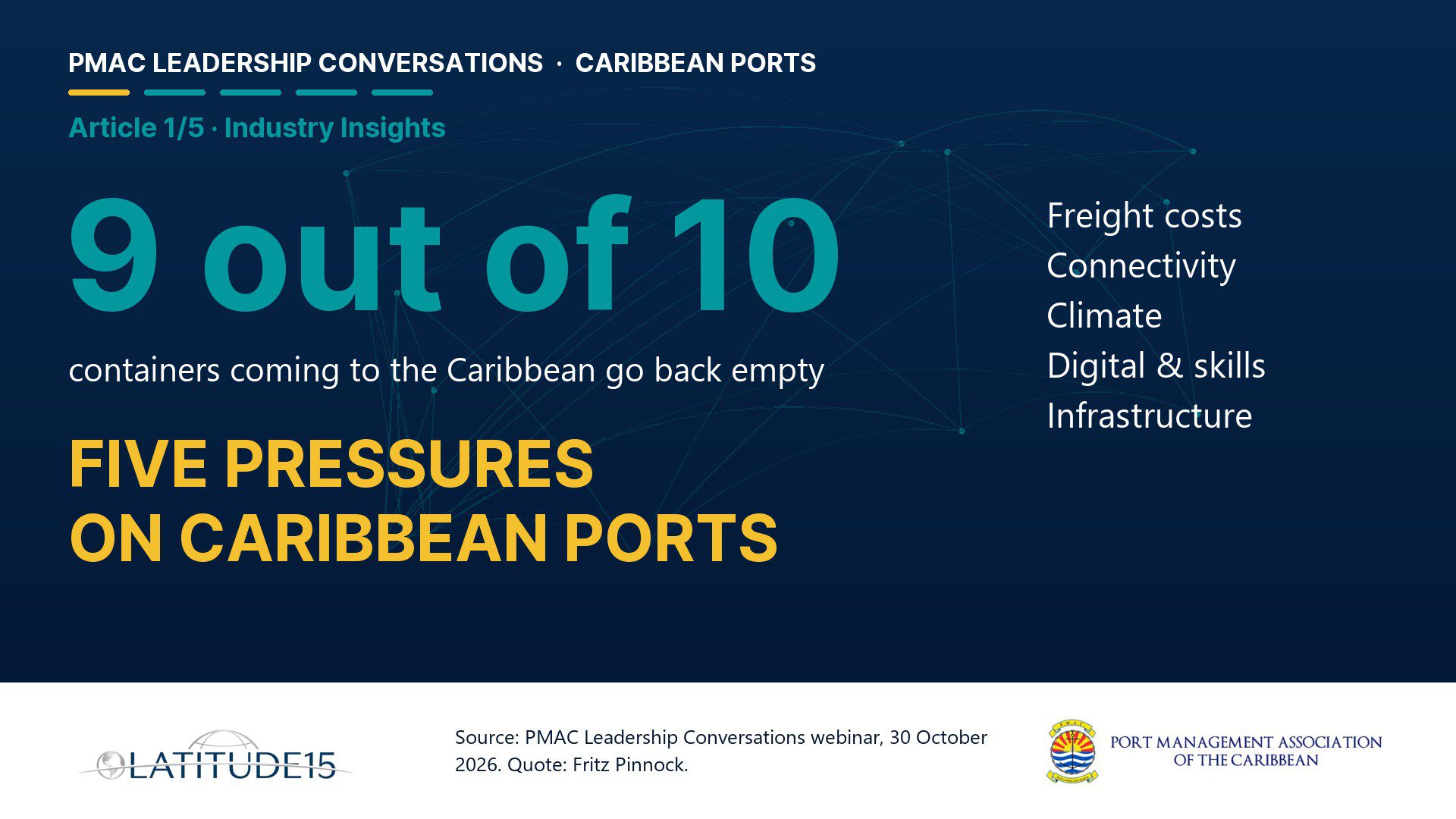
He also pointed to the imbalance of Caribbean trade. The region imports goods but exports mostly services, such as tourism, that do not travel in a container. “Nine out of every 10 containers coming to the Caribbean goes back empty,” he said, so the price of freight into the region has to include the empty return. In his view, ships bound for the Caribbean are also at the back of the line at the canal and can miss their feeder connections.
2. Small Volumes, Weak Connectivity
Small cargo volumes, dispersed islands and imbalanced trade flows make shipping services expensive to operate, and dependence on feeder connections adds handling, time and cost. “Sometimes shipping cargo from one Caribbean country to another cost you more than even shipping it from the Far East,” Fritz Pinnock said.
He drew a parallel with air transport, where an airline may ask for a guaranteed number of passengers to keep serving a destination: “We have to end up paying for seats that are not here, just to have some connectivity.”
LATITUDE 15 looked at the same bottleneck for the region’s food trade in Maritime Connectivity Remains a Bottleneck for Caribbean Food Trade.
3. Climate: Resilience and Modernisation Compete for the Same Funds
Ports must protect their infrastructure against storms, flooding and rising seas while investing in cleaner equipment and energy systems. With limited funds, both have to be covered. “The sad thing, they end up becoming competing parts of the equation,” Fritz Pinnock said. A port closure interrupts an island’s essential supplies, tourism and economic activity.
He linked decarbonisation to tourism: “The same space that we are in polluting is the water that we are inviting people to come to share.”
4. Digital Fragmentation, Cyber Risk and Skills Gaps
Global logistics increasingly depends on timely, shared information. Where ports, customs, shipping agents and hauliers use disconnected processes, delays follow and cargo visibility is limited. Since 1 January 2024, the IMO Convention on Facilitation of International Maritime Traffic (FAL) requires member states to use a Maritime Single Window to exchange information with ships calling at their ports. Fritz Pinnock cited the work under way towards a shared single-window platform for the OECS.
Cyber risk is part of the same picture. He cited a logistics company represented in the webinar audience that had been attacked in cyberspace, with a management system that resulted in “losing all their data for about two and a half years”. And technology alone is not enough: digital transformation requires trained people and institutional cooperation. “Buying software alone cannot deliver an integrated supply chain.”
5. Ageing Infrastructure and Seasonal Revenue
Berths, cargo equipment, storage and inland connections must keep up with changing vessel and customer requirements, while a small revenue base constrains investment. For Caribbean ports that depend on cruise calls, revenue is seasonal: in Fritz Pinnock’s words, the season runs “from October to about April”.
He added a point specific to the region: “In many islands, the port is the single largest employer of labor.” Efficiency models designed for North America, Europe or Asia, he argued, do not take that balance into account. The presentation called for sustainable financing and stronger governance.
Caribbean Ports: From Pressures to Strategy
The webinar then turned to strategy, with one question: “Before we invest in a bigger port, have we imagined a bigger role for the port we already have?” The next article in the series looks at the Blue Ocean Shift method and how the presentation applied it to Caribbean ports.
Questions to Ask
Port authorities
- Which of these five pressures weighs most on your port today?
- Do resilience and modernisation projects compete for the same budget?
Governments and regional bodies
- Is the Maritime Single Window in place, and does it connect every party at the port?
- How is the cost of empty container returns taken into account in trade policy?
Quotes are taken from the PMAC Leadership Conversations webinar of 30 October 2026. Figures on the Panama Canal: Panama Canal Authority booking-slot announcements (December 2023) and reports of the 8 November 2023 auction. Maritime Single Window: IMO, FAL Convention amendments in force since 1 January 2024. The figure of nine empty containers out of ten is Fritz Pinnock’s statement during the webinar.
Next in the series: the Blue Ocean Shift method applied to Caribbean ports.