Seatrade Cruise Global 2026 : Caribbean destinations highlight experience-led strategies
At Seatrade Cruise Global, one of the cruise sector’s most influential annual gatherings, Caribbean destinations once again used the event as a platform to engage directly with cruise operators and position themselves within an evolving global market.
Interviews conducted on-site with representatives from Saint Martin, Saint Vincent and the Grenadines, Dominica and the French Caribbean territories suggest that the cruise sector continues to perform strongly across the region. Yet the conversations also reveal a noticeable shift in priorities. Rather than focusing solely on passenger volumes, several destinations now emphasize experience quality, visitor distribution and stronger coordination between stakeholders.
Taken together, these perspectives point to a region that remains central to the cruise industry while gradually adapting its strategies to evolving expectations from both cruise lines and travelers.
Cruise growth continues across key Caribbean destinations
For several Caribbean ports, cruise traffic continues to expand, confirming the region’s importance within global cruise itineraries.
In St. Maarten, cruise volumes remain particularly strong. According to Alexander Gumbs, CEO of Port St. Maarten Group, the island is expecting further growth in the coming year.
“Business in St. Maarten has been fantastic. We’ve seen a huge growth in our arrivals from cruise passengers. In 2026 we’re expecting more than a 10 percent increase in volume, where we will be exiting around 1.8 million cruise passengers, which is a significant number for a Caribbean destination.”
At the same time, he emphasized that this growth is accompanied by efforts to strengthen the destination’s long-term competitiveness.
“Looking at the volume on one end, we’re also making certain strategic investments to ensure that we can further enhance the experience when the guests come to St. Maarten.”
A similar positive trajectory appears in Dominica, where the cruise sector has rebounded strongly after Hurricane Maria in 2017.
Benoit Bardouille, Chairman of Discover Dominica Authority, highlighted the scale of the recovery.
“The cruise industry is in fact doing well in Dominica. We suffered immensely in 2017 with Hurricane Maria, but we have bounced back and we’re doing extremely well in terms of cruise visitors.”
The island now receives roughly 350,000 cruise passengers annually, surpassing earlier visitation levels recorded in the early 2010s.
Experience and destination quality moving to the forefront
While growth remains important, several speakers indicated that destinations are increasingly focusing on the quality of the cruise experience rather than purely on passenger numbers.
Dominica provides a clear example of this approach. Benoit Bardouille explained that the objective is not simply to increase arrivals but to ensure visitors meaningfully engage with the destination.
“We want to grow cruise responsibly. We’re not running a numbers game. We want to make sure that we provide quality experience for the visitors that come to Dominica so they may return later as stayover visitors.”
This perspective reflects a broader effort to use cruise tourism as an introduction to the destination rather than as an isolated tourism segment.
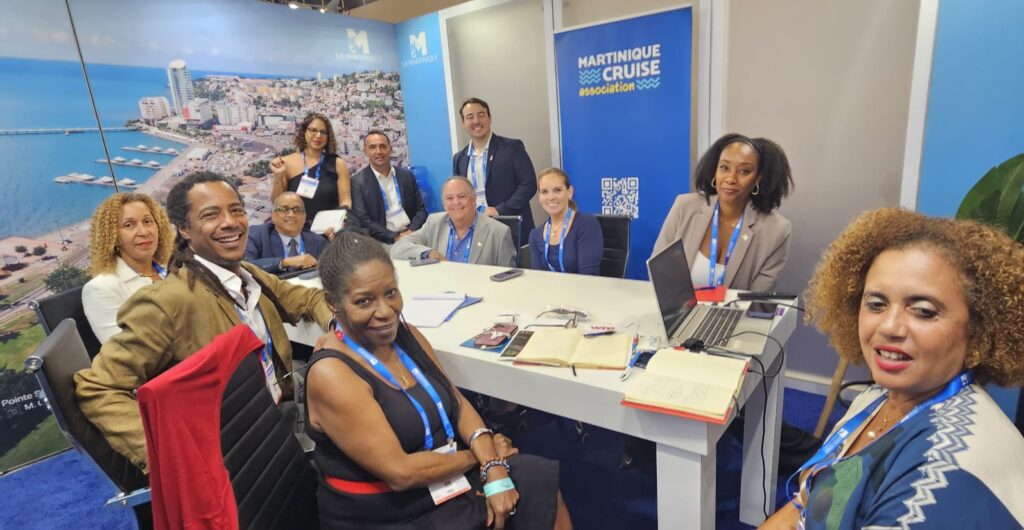
A similar emphasis on passenger experience emerged in discussions with representatives from Antilles Shipping Services, which represents cruise operations in Martinique and Guadeloupe. During meetings with cruise companies at Seatrade, stakeholders highlighted that improving cruise guest satisfaction was a central objective.
Catherine Defontis(right), Director of the Guadeloupe and Martinique agencies at Antilles Shipping Services, emphasized this focus on experience-driven improvements:
“This year we placed a strong focus on the customer experience. Through discussions with cruise companies and analysis of passenger feedback and data, we can better identify where to focus efforts to improve the experience for cruise guests.”
This approach suggests that Caribbean destinations are increasingly using data and feedback mechanisms to refine their tourism offerings.
New positioning strategies across Caribbean ports
Beyond experience management, the interviews also highlight evolving positioning strategies among destinations.
In Saint Vincent and the Grenadines, growth dynamics appear somewhat different. According to Carl James, CEO of Modern Port Operations Company, the destination is seeing increasing interest from the luxury cruise segment.
“This year was a reasonably good year. We saw increases in the number of calls, and the growth was more specific to the luxury sector. A lot of luxury cruise lines are showing interest in the Grenadines because each island has a unique and distinct appeal.”
This positioning reflects the geographic and cultural diversity of the archipelago, where smaller islands offer distinctive experiences that align with the expectations of high-end cruise passengers.
At the same time, destination managers are paying increasing attention to how cruise visitors move within territories. Carl James noted that distributing passengers across multiple areas can reduce congestion while creating opportunities for local communities.
“We want to ensure that passengers are not clustering in one area but are moving efficiently to other communities where they can experience different activities.”
Such strategies indicate a growing awareness of the operational challenges associated with concentrated visitor flows.
A stronger call for regional cooperation
Another theme emerging from the discussions is the importance of closer coordination across Caribbean destinations.
For Alexander Gumbs in St. Maarten, strengthening regional cooperation could play a significant role in reinforcing the Caribbean’s position within the global cruise industry.
“I would love to see the Caribbean become more one. I would love to see more investments in the Caribbean and see the value of the cruise industry translated further into Caribbean destinations.”
He suggested that stronger regional alignment could help destinations better capture the economic value generated by cruise tourism.
Industry gatherings such as Seatrade Cruise Global therefore remain an important platform for building relationships, sharing information and positioning Caribbean destinations within a highly competitive global market.
Reading the road ahead
Taken together, these conversations suggest that Caribbean destinations are entering a more mature phase in their engagement with the cruise sector.
Passenger demand remains strong and cruise activity continues to grow across multiple territories. Yet the strategic focus appears to be gradually shifting toward experience quality, destination differentiation and more balanced visitor management.
For the Caribbean and Latin America, the cruise industry therefore continues to represent both a major economic opportunity and an evolving strategic landscape — one where collaboration, experience design and sustainable visitor management may increasingly shape the region’s competitiveness in the years ahead.
The Martinique team in a meeting during Seatrade Cruise Global2026 in Miami
To provide the best experiences, we use technologies like cookies to store and/or access device information. Consenting to these technologies will allow us to process data such as browsing behavior or unique IDs on this site. Not consenting or withdrawing consent, may adversely affect certain features and functions.
Functional
Always active
The technical storage or access is strictly necessary for the legitimate purpose of enabling the use of a specific service explicitly requested by the subscriber or user, or for the sole purpose of carrying out the transmission of a communication over an electronic communications network.
Preferences
The technical storage or access is necessary for the legitimate purpose of storing preferences that are not requested by the subscriber or user.
Statistics
The technical storage or access that is used exclusively for statistical purposes.The technical storage or access that is used exclusively for anonymous statistical purposes. Without a subpoena, voluntary compliance on the part of your Internet Service Provider, or additional records from a third party, information stored or retrieved for this purpose alone cannot usually be used to identify you.
Marketing
The technical storage or access is required to create user profiles to send advertising, or to track the user on a website or across several websites for similar marketing purposes.