Airport capacity is usually visible. It comes in the form of runways, gates, aircraft stands and terminal buildings. Some of the constraints that determine how much traffic an airport can actually handle, however, sit largely out of sight.
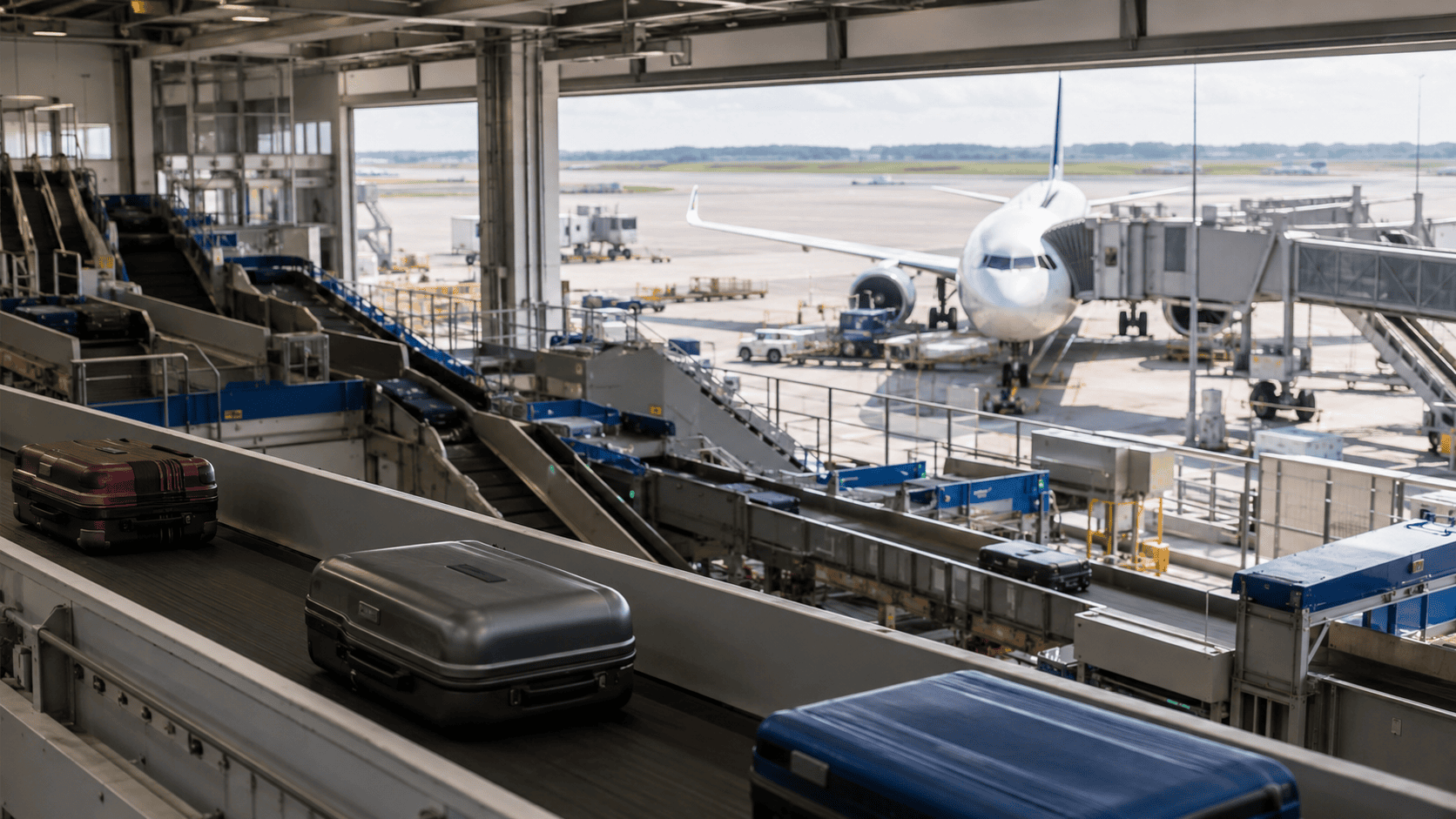
At Santo Domingo’s Las Américas International Airport, one of those hidden systems is being expanded significantly. AERODOM is investing more than RD$900 million in a new automated Baggage Handling System (BHS) that is expected to increase departure baggage-processing capacity by 80% once fully operational. The first phase is already in service, while completion of the remaining work is scheduled for the end of 2026.
The project illustrates a broader airport-planning issue: passenger growth does not only create pressure on the parts of the terminal travellers can see. It also increases the workload of the systems screening, identifying, routing and tracking their bags.
A hidden capacity constraint
Passenger throughput and baggage throughput ultimately have to grow together.
An airport may have sufficient check-in desks, security lanes and departure gates to accommodate additional flights, but another bottleneck emerges if its baggage system cannot process the corresponding number of bags during peak periods.
The consequences can extend beyond the baggage hall. Greater pressure on the system can complicate aircraft loading, flight preparation and departure reliability when several flights need to be handled within the same operating window.
That makes baggage infrastructure more than a back-of-house service. It becomes part of the airport’s effective capacity.
At Las Américas, the new system combines automated sorting, 360-degree baggage-tag readers, centralised supervision and computed-tomography-based EDS Standard 3 screening. But maximum throughput is only part of the equation.
Capacity before the new terminal
The timing of the investment is particularly important.
Las Américas handled approximately 5.3 million passengers in 2025, while AERODOM is simultaneously preparing a much larger expansion of the airport.
A new passenger terminal, representing an investment of more than US$350 million, is scheduled to be completed by the end of 2028. It is designed to accommodate around 4 million passengers annually in addition to the airport’s existing facilities.
The baggage expansion is arriving more than two years earlier. That creates a useful distinction between physical expansion and operational headroom.
A new terminal can provide additional check-in positions, passenger-processing space and gates. But airports do not necessarily have to wait for a new building before improving how much traffic their existing infrastructure can support.
Increasing baggage-processing capacity inside the current terminal can remove one potential operational constraint before the wider expansion becomes available.
The BHS is therefore not a substitute for the new terminal. It is part of the infrastructure required to make future passenger capacity usable.
Design capacity is not available capacity
The headline 80% increase captures the scale of the project, but baggage systems cannot be evaluated only by how many bags they can process under ideal conditions. What matters operationally is also how much capacity remains available when part of the system is undergoing maintenance or experiences a failure.
That is where redundancy becomes important.
A system capable of directing baggage through alternative processing paths can preserve a larger share of its throughput when individual scanners, conveyors or other components become unavailable.
In practical terms, an airport needs to distinguish between design capacity and available capacity.
A BHS might have a high theoretical bags-per-hour figure. But if a single equipment failure removes a substantial share of that throughput, the nominal figure provides an incomplete picture of how the airport performs on a normal operating day.
AERODOM has emphasised greater redundancy, preventive maintenance and spare-parts availability as part of the Las Américas upgrade. In that sense, reliability itself becomes a capacity issue.
Moving bags is also becoming a data operation
Modern baggage infrastructure is also doing more than physically transporting luggage between check-in and the aircraft. It increasingly generates the data required to know where each bag is in the journey.
IATA’s Resolution 753 requires baggage tracking at key points including passenger handover, aircraft loading, transfer and delivery. Airports often control much of the infrastructure — including baggage handling, reconciliation, sortation and scanning systems — that produces those tracking events.
That means a modern BHS increasingly combines several functions: screening, routing, identification and visibility.
The ability to read baggage tags consistently is part of that process. Las Américas’ new system includes 360-degree tag readers designed to improve automated identification even when a label is not presented in one fixed orientation.
The result is a baggage system that is increasingly connected to the wider digital operation of the airport and the airline.
Mishandled bags remain a US$6.3 billion problem
The business case extends beyond airport throughput.
According to SITA Baggage IT Insights 2026, the global baggage mishandling rate fell by 23% in 2025, reaching approximately 4.9 mishandled bags per 1,000 passengers.
That still represented around 24 million bags across a year in which the industry carried about five billion passengers. SITA estimates the annual cost of baggage mishandling at approximately US$6.3 billion, or around US$260 per mishandled bag.
The implications extend directly to airline economics. A bag that fails to reach its passenger may have to be traced, rerouted and delivered after arrival, while also generating customer-service and potential compensation costs.
Baggage infrastructure therefore affects not only how many bags an airport can process, but how accurately it can process them. For airports and airlines, increasing throughput without maintaining reliability simply shifts the operational problem elsewhere.
Transfers make the problem harder
The challenge becomes more complex when passengers connect between flights.
SITA estimates that 39% of mishandled baggage cases in 2025 were associated with transfers.
Unlike a simple origin-to-destination journey, a transfer bag may have to move from an arriving aircraft, through the baggage system and onto another departure within the same connection window available to the passenger.
Every additional handoff creates another point at which timing, identification and routing matter.
For airports developing stronger connecting networks, this makes baggage infrastructure part of the broader connectivity proposition.
Santo Domingo is not a connecting hub on the scale of Panama City or Bogotá, but its international network continues to expand. As connectivity becomes more complex, the performance of the systems supporting connections becomes increasingly important.
The ability to move the passenger is only one part of the connection. The bag has to make it too.
Expanding while the airport stays open
There is one final challenge at Las Américas: the upgrade is taking place inside an operating airport.
The southern section of the new BHS entered service in June 2026, and AERODOM says the work was implemented without interrupting normal airport operations. The northern section is expected to be integrated before the end of the year while the terminal remains active.
This is a different challenge from installing a baggage system in a greenfield terminal. For brownfield airports, new capacity has to be introduced while preserving the capacity passengers and airlines are already using.
Poorly phased work can temporarily create exactly the constraint that an upgrade is intended to remove. The success of such projects therefore depends not only on the final system, but on how installation, testing and commissioning are sequenced around live operations.
Runways and terminal buildings will remain the most visible symbols of airport expansion. But effective capacity is ultimately determined by the performance of every system connecting passengers and their baggage to the aircraft.
As Las Américas prepares for a larger passenger terminal in 2028, its baggage upgrade shows that some of the most important capacity investments can happen long before travellers see a new building.
Sometimes the next airport bottleneck is not another gate or another square metre of terminal. It is the system operating behind the check-in desk.