
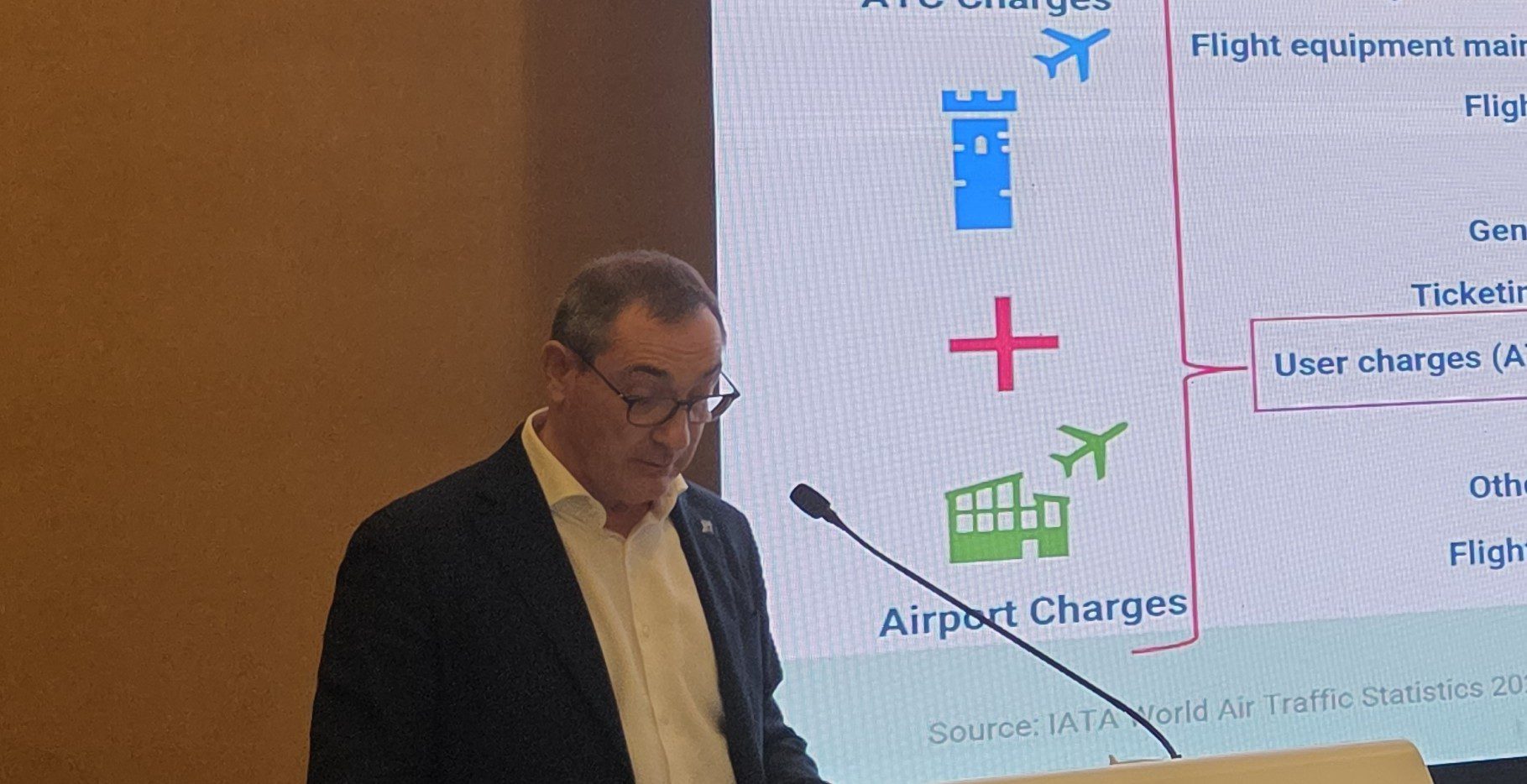
Airport charges remain a recurring point of friction in aviation economics. At WAGA 2026 in Lima, ACI-LAC Director General Rafael Echevarne argued that their actual weight in airline operating costs is relatively limited — while the revenues they generate remain tied to airport operations, infrastructure and long-term investment.
LIMA, PERU — The debate over the cost of air transport often turns to airport charges. Rafael Echevarne used his WAGA 2026 interventions to challenge the scale sometimes attributed to them, placing the issue within the wider economics of running both airlines and airports.
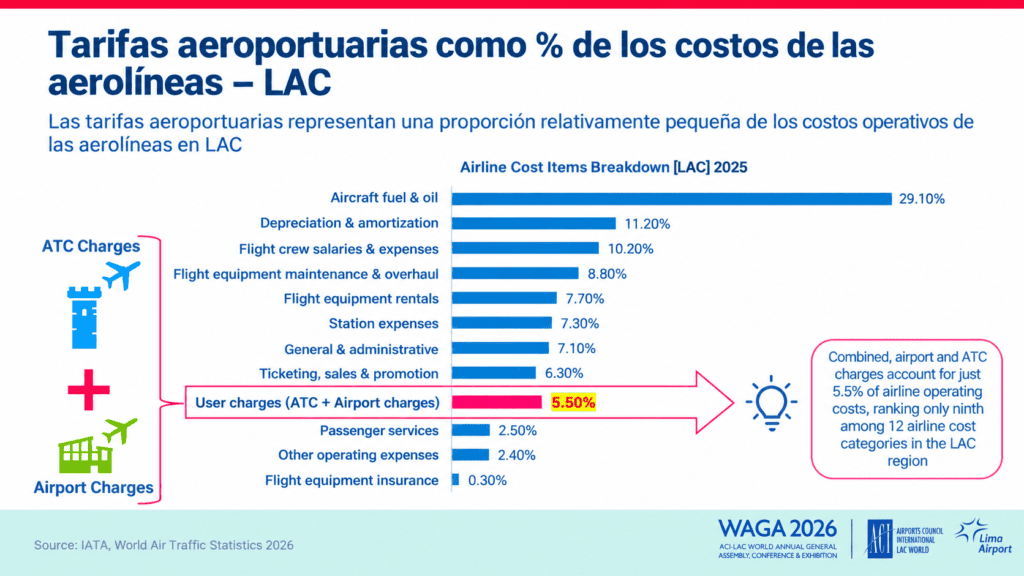
“Airport tariffs have an impact of less than 6% on the operating costs of airlines,” Echevarne said, describing them as one of the smaller components in the airline cost structure. He also argued that their relative weight falls further when other expenses, particularly fuel, rise.
The point was not simply that airport charges are limited in percentage terms. Echevarne’s broader argument was that the way those charges are established — and what they finance — needs to be considered before treating them as a straightforward obstacle to lower fares or greater connectivity.
A 4.3% figure behind the broader message
During an earlier media workshop in Lima, Echevarne went further into the numbers. Data included in his presentation put airport charges at 4.3% of airline operating costs, a more specific figure that sits within the “less than 6%” message he later presented during WAGA.
He also showed how the airport-related component of a ticket can vary significantly depending on the market and whether the journey is domestic or international.
For domestic tickets, the examples presented were 4% in Brazil, 8% in Colombia, 4% in Argentina and 8% in Chile. For international tickets, the corresponding examples were 1% in Brazil, 6% in Colombia, 7% in Argentina and 3% in Chile. Echevarne stressed that these were average examples rather than a single uniform charge across the region.
That distinction matters. There is no single airport-cost percentage that applies to every passenger journey in Latin America and the Caribbean. Market structure, type of operation and national charging frameworks all affect the final amount.
Airport charges are not freely set by airports
Echevarne also pushed back against the idea that airports can simply increase charges at will.
In much of Latin America, he explained, airport operators do not independently determine the tariffs they charge airlines and passengers. Economic regulators, ministries or equivalent authorities are commonly involved in establishing or approving them.
The framework outlined in his presentation included several principles: charges should not discriminate between airlines, they should be related to the costs associated with providing airport infrastructure and services, and the process should be transparent.
Consultation with airlines is also part of the process before tariffs are implemented, according to Echevarne.
This creates a fundamental difference between airport pricing and airline ticket pricing. Airlines operate commercially and can adjust fares according to demand, market conditions and revenue management. Airport charges, by contrast, tend to remain stable until a formal tariff review takes place.
Echevarne noted that in many markets such reviews may occur only every several years, while airfares can vary substantially from one day to another.
The other side of the equation is investment
The discussion becomes more complex once infrastructure enters the picture.
Airport tariffs are not only an operating-cost issue for airlines. For airports, they form part of the revenue base used to operate facilities and support investment. Echevarne linked the charging debate directly to the large infrastructure requirements facing airports across Latin America and the Caribbean.
This creates a policy trade-off. Lower charges may appear attractive from the perspective of immediate airline costs, but airports also need sufficient and predictable revenues to maintain existing facilities and finance new capacity.
That question becomes more important as the region prepares for further passenger growth and as airports face investment requirements in terminals, airside infrastructure, technology, resilience and sustainability.
The issue, therefore, is not simply whether airport charges should be higher or lower. It is whether charging frameworks can remain competitive while providing airports with sufficient financial capacity to invest.
From the cost of charges to the value of infrastructure
Echevarne’s intervention reframed the debate around airport economics.
Airport charges do affect airline costs, and in price-sensitive markets even relatively small variations can matter. But the data presented in Lima suggest they form only one part of a much broader cost structure.
At the same time, those charges sit within a regulated system designed to pay for infrastructure and services that airlines themselves depend on to operate.
For regulators, airports and carriers, the longer-term question is therefore less about isolating one percentage point than finding a balance between competitive operating costs, sustainable airport economics and the investment required to support future connectivity.
FAQ
How much do airport charges represent in airline operating costs?
According to Rafael Echevarne at WAGA 2026, airport charges account for less than 6% of airline operating costs. A separate cost breakdown presented in Lima showed combined airport and air traffic control charges at 5.5%.
Who determines airport charges in Latin America and the Caribbean?
In many markets, airport operators do not set charges independently. Economic regulators, ministries or other public authorities are involved in approving or determining tariff levels.
Are airport charges the same across the region?
No. Their impact varies by country, airport and type of journey. The share of airport-related costs can also differ between domestic and international tickets.
Why are airport charges important for airports?
They help cover the cost of operating airport infrastructure and contribute to the revenues needed to maintain facilities and support future investment.
Editor’s note: This article is Part 3 of 7 in LATITUDE15’s WAGA 2026 series examining the key issues highlighted by ACI-LAC Director General Dr. Rafael Echevarne in Lima.