Airports across Latin America and the Caribbean are undergoing a gradual transformation. Discussions around airport cities, cargo strategies and economic positioning suggest that the sector is moving beyond its traditional focus on infrastructure and operations.
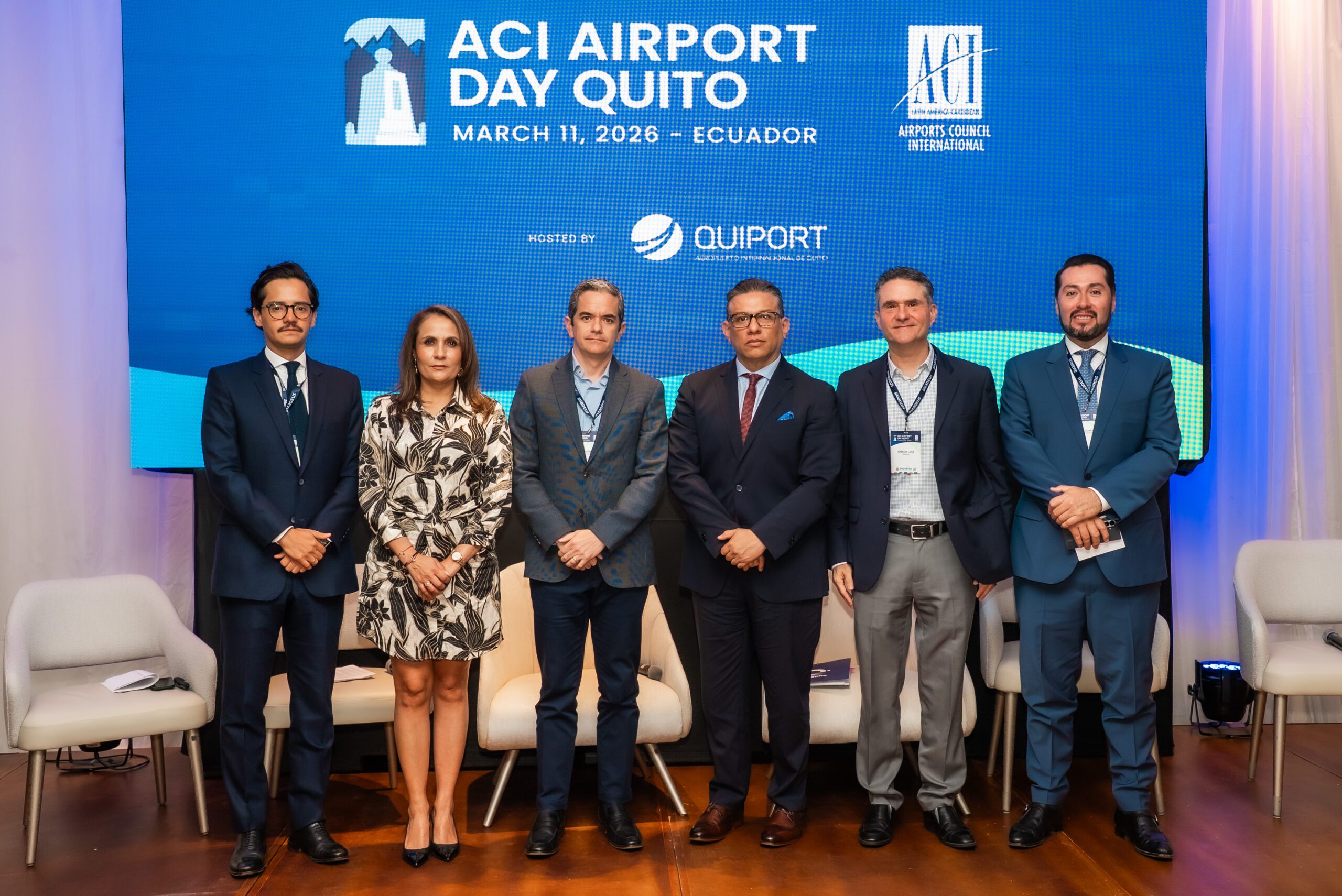
Yet, across the panels held during the ACI Airport Day Quito, another theme repeatedly surfaced—less visible, but equally structuring: airport coordination.
While investments, capacity and development models were widely discussed, several interventions pointed to a different type of challenge. Rather than being purely technical or financial, it appears to lie in how airport systems are organised and how the different actors interact.
Beyond infrastructure: a system challenge
For many years, airport development in the region has been closely associated with infrastructure expansion. Increasing capacity, modernising terminals and improving operational performance have been central priorities.
However, the discussions in Quito suggest that infrastructure alone may not be sufficient to support the next phase of development. As airports become more integrated into economic ecosystems—through cargo, real estate or industrial activity—their performance appears increasingly linked to the functioning of a broader system.
This shift suggests a move beyond infrastructure-led growth toward more system-oriented dynamics, where coordination across actors appears to play an increasingly central role.

A fragmented value chain
One of the recurring observations across the panels relates to the multiplicity of stakeholders involved in airport operations.
Airports interact with airlines, cargo operators, logistics providers, customs authorities and various public institutions. Each of these actors operates within its own framework, with specific processes, timelines and constraints.
The discussions suggest that this multiplicity can result in fragmentation. In some cases, inefficiencies may not stem from a lack of capacity, but from misalignment between actors across the value chain.
This fragmentation appears particularly relevant in cargo operations, where the movement of goods depends on the coordination of multiple entities beyond the airport itself.
Data and processes as coordination gaps
Beyond institutional fragmentation, several interventions pointed to operational challenges related to data and process integration.
The absence of fully interconnected systems was mentioned as a potential source of inefficiency. When information is not shared in real time, or when processes are not aligned, bottlenecks may emerge—even in environments where infrastructure is adequate.
Examples discussed during the panels include the planning of truck flows, the allocation of resources and the management of cargo handling processes. In these cases, improving performance appears to depend less on expanding capacity than on enhancing coordination mechanisms.
This suggests that digitalisation, while often framed as a technological issue, may also be understood as a coordination tool within airport ecosystems.

Institutional and governance constraints
Coordination challenges also seem to extend to institutional and governance structures.
The involvement of multiple public authorities, regulatory bodies and private operators can create complex decision-making environments. In such contexts, aligning priorities and implementing long-term strategies may become more difficult.
Discussions around concession models further highlight this dimension. In some cases, contractual frameworks or revenue-sharing mechanisms may influence how airport operators approach development projects, particularly those requiring long-term investment.
These elements suggest that governance structures play a significant role in shaping how airport systems evolve, beyond purely operational considerations.
Implications for Latin America and the Caribbean
Taken together, these observations point to a broader implication for the region.
While opportunities for airport development appear significant—driven by growing demand, evolving economic structures and increasing integration into global supply chains—the ability to capture these opportunities may depend on how effectively coordination challenges are addressed.
For Latin America and the Caribbean, this suggests that future development may not rely solely on infrastructure expansion or new investment models. It may also require greater alignment across institutions, processes and stakeholders.
At the same time, the diversity of contexts across the region indicates that these dynamics are unlikely to unfold uniformly.

Voices and perspectives from the sector
The perspectives shared during the event reflect these challenges from different operational standpoints.
Airlines highlighted the need to adapt continuously to external factors such as cost structures and demand variability, which can influence how capacity is deployed.
Cargo operators pointed to the importance of planning and resource allocation, particularly in environments where demand can fluctuate and coordination is critical.
Airport operators, for their part, emphasised the role of collaboration with both private and public stakeholders, suggesting that the performance of airport systems is closely linked to the ability to align actors beyond the airport perimeter.
These perspectives illustrate how coordination challenges are experienced across different segments of the value chain.
Reading the road ahead
The discussions in Quito suggest a set of interconnected dynamics, where infrastructure, operations and governance interact.
As airports continue to evolve toward more complex economic and logistical roles, coordination appears likely to become an increasingly relevant factor.
In this context, the development of airport systems may depend not only on investment or capacity, but also on the ability to organise and align the actors that shape them.
Rather than representing a single constraint, coordination appears to shape how airport ecosystems function—and how effectively they can evolve across the region.