
Airports are increasingly redefining their role in the global economy. No longer viewed solely as infrastructure designed to move aircraft, passengers and cargo, they are gradually evolving into platforms for logistics, industry and urban development.
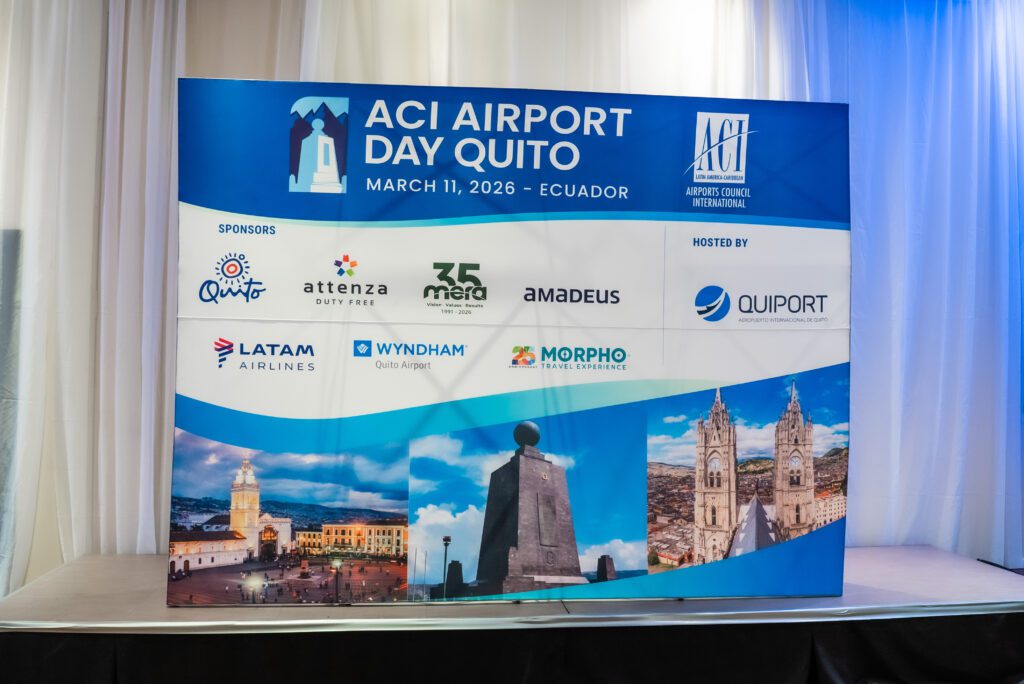
This transformation was at the center of discussions during the ACI Airport Day Quito, held on March 11, 2026 and organized by Airports Council International – Latin America and the Caribbean (ACI-LAC) with the support of Corporación Quiport. The event gathered airport operators, airline executives and industry experts to explore topics ranging from airport cities and cargo logistics to digital transformation across the aviation ecosystem.
Across multiple panels—from airport cities to air cargo and leadership strategy—one message emerged clearly: airports are evolving far beyond their traditional role as transport infrastructure.

Airports are no longer just infrastructure
One of the recurring themes of the event was the need to rethink how airports are perceived. Rather than viewing them solely as facilities that move aircraft, passengers and cargo, several speakers emphasized that airports increasingly act as engines of economic activity.
In many parts of the world, the concept of the “airport city” has been developing for years, integrating commercial, real estate and logistics activities into the airport environment. In Latin America, however, this shift is more recent. Over the past two decades, much of the region’s focus has been on modernizing airport infrastructure—ensuring that aircraft operations, passenger processing and cargo handling function efficiently.
Now that many airports have reached that stage of maturity, operators are beginning to look at the next step: developing economic ecosystems around the airport itself.
Examples presented during the panel illustrated how this transformation is already underway. Real estate developments linked to airports, new commercial areas and hospitality projects are becoming increasingly common. The message was clear: airports are gradually positioning themselves as development platforms for surrounding regions, not just transport nodes.
Industrial ecosystems are emerging around airports
Beyond retail and commercial developments, some airports are becoming anchors for industrial clusters.
One of the most striking examples discussed was the aerospace cluster developed around Querétaro International Airport in Mexico. The airport opened in 2004, and only months later the arrival of aerospace manufacturer Bombardier triggered the creation of an industrial park of 83 hectares within the airport area.
Over time, the region evolved into a major aerospace manufacturing hub. Today, companies in Querétaro produce structural aircraft components, landing gear systems, avionics and other advanced aerospace equipment. According to the panel discussion, the region has become one of the most attractive destinations globally for aerospace foreign direct investment.
The ecosystem extends beyond manufacturing. A specialized public university dedicated entirely to aerospace education was also created within the airport zone to support the growing industry. The result is a combination of industry, education and airport infrastructure working together in a single ecosystem.
For many airport operators in the region, this example illustrates how airports can serve as catalysts for broader economic development.

Cargo is becoming a strategic pillar
Another key insight from the discussions was the growing strategic importance of air cargo.
Although air freight represents only around 1% of global trade by volume, it accounts for approximately 30% of global trade by value.
This imbalance highlights the high-value nature of goods transported by air—ranging from pharmaceuticals to electronics and perishable products—and explains why cargo is becoming increasingly central to airport strategies.
Quito itself offers a clear illustration of this trend. Since 2013, the city’s Mariscal Sucre International Airport has handled 2.8 million tonnes of cargo, reaching a record 406,754 tonnes in 2025.
The cargo profile is also highly specialized: roughly 92% of exports correspond to flowers, making the airport a crucial gateway for Ecuador’s floriculture industry.
This concentration highlights how airports can become deeply embedded in regional economic sectors, linking local production to global markets.

E-commerce is reshaping airport logistics
The rapid growth of e-commerce is also transforming air cargo operations.
In Ecuador, panelists noted that e-commerce cargo accounted for roughly 15% of total cargo volumes in 2023, but had risen to 35% by 2025.
This shift brings new operational challenges. E-commerce logistics require faster processing times, more agile supply chains and greater coordination between actors across the logistics ecosystem.
Several speakers stressed the importance of collaboration between airlines, cargo terminals, logistics operators and public authorities. Digitalization was also highlighted as a key enabler. Integrating systems and sharing real-time data across the supply chain could help improve predictability, optimize resources and reduce bottlenecks in cargo operations.

Collaboration will define the airport of the future
Perhaps the most important lesson from Quito was that infrastructure alone is no longer enough.
Airports increasingly depend on cooperation with a wide range of stakeholders—including municipalities, national governments, logistics companies and airlines. Without that coordination, even the most advanced infrastructure cannot reach its full potential.
The case of Bogotá’s El Dorado airport illustrates this dynamic. The airport handles nearly 46 million passengers annually and around 850,000 tonnes of cargo, supporting 33,000 direct jobs and more than 60,000 jobs in the aviation sector across the city.
Such scale requires integrated planning between the airport and the surrounding urban environment. Local authorities have therefore begun incorporating the concept of “Bogotá Ciudad-Aeropuerto” into broader urban development plans.
For airport operators across Latin America, the message is clear: future competitiveness will depend not only on infrastructure investments, but also on governance, data integration and long-term coordination with public institutions.

A new role for airports
Taken together, the discussions in Quito suggest that the airport of tomorrow will look very different from the airport of yesterday.
Rather than simply processing aircraft movements, airports are becoming multifunctional platforms—combining logistics hubs, industrial clusters, real estate developments and innovation ecosystems.
For Latin America and the Caribbean, the transformation may still be in its early stages. But as the conversations in Quito demonstrated, the shift is already underway.