For years, maritime decarbonisation strategies were largely shaped around major global shipping corridors, large-scale port infrastructure and industrialised economies capable of mobilising significant capital for energy transition projects. Across the Caribbean, however, a different model is beginning to emerge — one built around smaller ports, modular systems and infrastructure adapted to the realities of Small Island Developing States (SIDS).
Recent discussions held during the “Progressing Maritime Decarbonisation in St. Kitts and Nevis” workshop organised under the IMO–EU Global MTCC Network (GMN) Phase II programme offered a clear illustration of that shift. Rather than focusing exclusively on long-term climate targets, the workshop highlighted how Caribbean islands are increasingly experimenting with practical, small-scale projects designed to bridge the gap between decarbonisation policy and operational deployment.
At the centre of these discussions stood an increasingly important idea for the region’s maritime sector: Caribbean ports may evolve not only as logistics gateways, but also as energy transition platforms.
Caribbean decarbonisation faces a different set of constraints
Unlike larger maritime economies, Caribbean SIDS operate within highly constrained infrastructure and financing environments. Most islands remain heavily dependent on imported fossil fuels, while electricity costs, grid limitations and exposure to climate-related disruptions continue to shape infrastructure planning decisions.
Those structural realities create a very different decarbonisation pathway compared with larger global port hubs.
In St. Kitts and Nevis, participants repeatedly identified financing constraints, technical capacity gaps and infrastructure readiness as some of the main barriers slowing maritime decarbonisation efforts.
The workshop also highlighted a broader regional concern: awareness around maritime decarbonisation is no longer the main challenge. The Caribbean’s next hurdle lies in implementation capacity — particularly the ability to develop projects that are technically feasible, financially viable and adapted to small-island operating environments.
That reality is increasingly pushing Caribbean governments, port authorities and regional organisations toward more incremental and demonstrative approaches.
Rather than waiting for large-scale infrastructure transformation, several islands are beginning to explore:
- renewable-powered port systems;
- electrification of equipment and fleets;
- distributed microgrids;
- energy-efficient operations;
- and smaller-scale pilot projects capable of demonstrating operational feasibility.
Ports are becoming strategic energy infrastructure
One of the workshop’s strongest underlying themes was the gradual convergence between maritime infrastructure and national energy transition strategies.
In many Caribbean islands, ports already function as critical economic lifelines supporting tourism, imports, fuel supply chains and inter-island connectivity. Increasingly, they are also being viewed as strategic locations for renewable energy integration and emissions reduction initiatives.
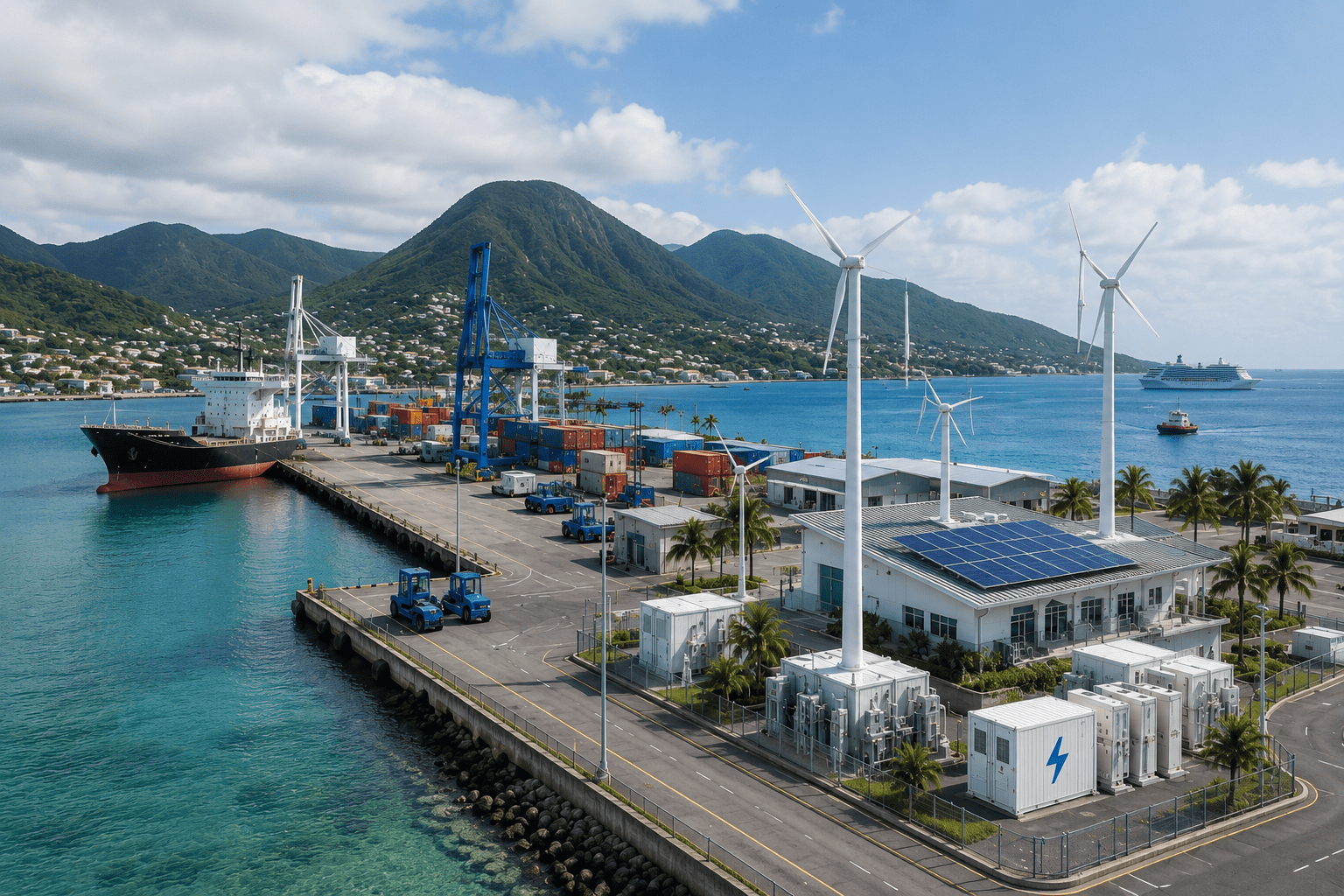
That evolution is particularly visible in St. Kitts and Nevis, where Basseterre Deep Water Port is being used as the site of a pilot renewable energy-powered microgrid project under the GMN Phase II programme.
The project aims to integrate wind-powered generation into port operations while supporting energy monitoring, operational optimisation and future emissions reductions.
Although relatively modest in scale, the initiative reflects a broader regional logic emerging across Caribbean SIDS: ports may increasingly become controlled environments where islands can test low-carbon technologies before wider deployment.
That approach is particularly attractive for smaller island states because ports already concentrate:
- critical infrastructure;
- electricity demand;
- logistics activity;
- operational equipment;
- and institutional coordination.
As a result, ports provide one of the few environments where decarbonisation measures can be implemented, monitored and scaled in relatively structured conditions.
Small-scale demonstration projects are gaining importance
A recurring message throughout the workshop was the growing importance of pilot projects and demonstration initiatives in the Caribbean maritime sector.
Unlike large global ports capable of deploying billion-dollar transition programmes, Caribbean islands often require smaller and more modular solutions capable of operating within constrained budgets and infrastructure systems.
The Basseterre initiative reflects that philosophy. The project combines renewable generation, monitoring systems and smart energy technologies while remaining sufficiently compact to fit within the realities of a small-island port environment.
Participants also explored additional concepts during breakout sessions, including:
- electrification of port fleets and equipment;
- hybrid renewable energy systems;
- wave energy generation;
- and broader renewable integration into maritime infrastructure.
These discussions suggest that Caribbean maritime decarbonisation may increasingly rely on distributed pilot ecosystems rather than singular mega-projects.
That model could ultimately prove more realistic for SIDS, where infrastructure resilience, scalability and operational flexibility often matter more than sheer project size.
Hurricane resilience is shaping technology choices
Climate exposure is also influencing the types of technologies being explored across the region.
The workshop highlighted the AeroFOLD wind turbine system proposed for the Basseterre pilot project, specifically designed with hurricane-prone environments in mind.
According to the report, the system incorporates:
- foldable structures;
- tilt-down mechanisms;
- lightweight modular components;
- and simplified foundation requirements.
That emphasis on resilience reflects one of the Caribbean’s core infrastructure realities: decarbonisation technologies cannot simply be imported from larger continental markets without adaptation.
For many island ports, the challenge is not only reducing emissions, but also ensuring that energy systems can withstand hurricanes, operate within limited space and integrate with fragile electrical grids.
As a result, Caribbean maritime decarbonisation is increasingly becoming a question of adaptation as much as emissions reduction.
Financing remains the region’s largest structural challenge
Despite growing momentum around pilot projects and regional cooperation, financing continues to represent one of the sector’s most significant constraints.
Workshop participants identified several recurring barriers:
- limited fiscal capacity;
- difficulties accessing international climate finance;
- insufficient technical expertise for project preparation;
- and the relatively small scale of Caribbean projects, which can reduce investor attractiveness.
Discussions therefore focused heavily on the need to develop “bankable” projects capable of aligning with climate finance mechanisms and development funding requirements.
Several financing pathways were discussed during the sessions, including:
- blended finance models;
- public–private partnerships;
- Green Climate Fund mechanisms;
- Caribbean Development Bank support;
- and Inter-American Development Bank financing structures.
For Caribbean SIDS, however, access to financing increasingly depends not only on climate ambition, but also on the ability to demonstrate technical credibility, operational readiness and long-term scalability.
Caribbean ports may become the region’s decarbonisation laboratories
The workshop ultimately reflected a broader transition underway across the Caribbean maritime sector.
Rather than attempting to replicate the decarbonisation models of major international hubs, Caribbean SIDS appear to be developing a more decentralised approach built around:
- modular infrastructure;
- pilot-scale deployment;
- resilient technologies;
- and targeted renewable integration within strategic port environments.
That strategy may prove particularly relevant for island economies where infrastructure constraints leave little room for large-scale experimentation.
At ports such as Basseterre, maritime decarbonisation is beginning to evolve from a regional policy discussion into a series of operational test cases capable of shaping how Caribbean SIDS approach the next phase of maritime energy transition.