
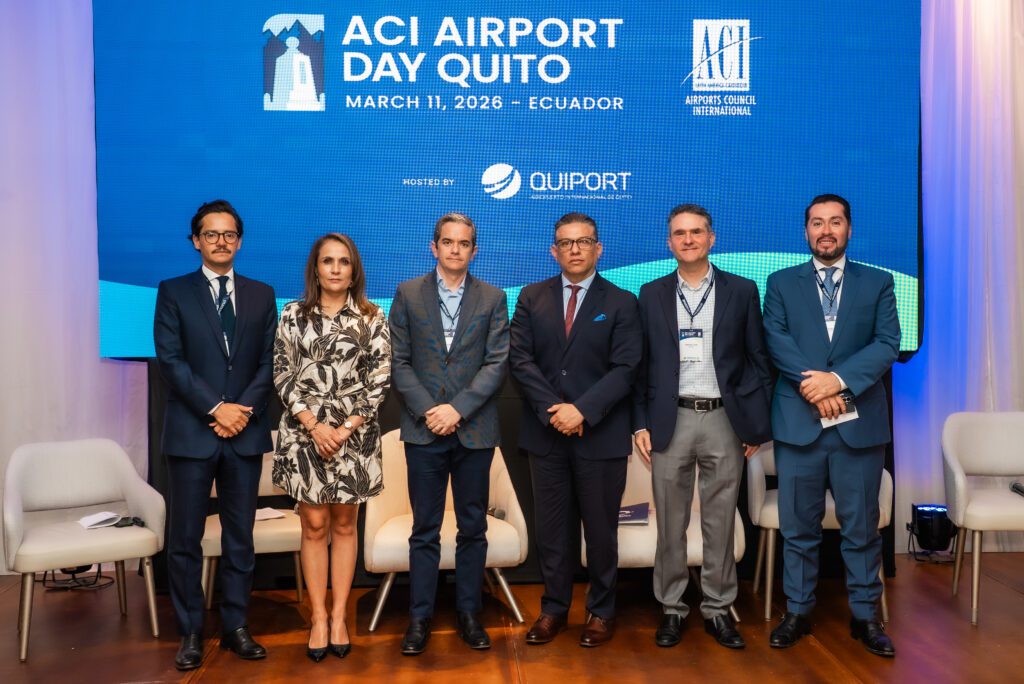
Airport cities have become a recurring reference in discussions on the evolution of airport business models. Initially developed in regions where infrastructure maturity and land availability enabled long-term planning, the concept is increasingly being explored in Latin America and the Caribbean. Discussions held during the ACI Airport Day Quito suggest that while the model is gaining traction in the region, its implementation in the region appears to vary depending on local and institutional conditions.
Across the panels dedicated to airport development and leadership perspectives, speakers pointed to a gradual shift in how airports are positioned. Rather than being seen solely as transport infrastructure, they are increasingly framed as platforms capable of supporting broader economic activity.
From infrastructure to economic platforms
Several interventions highlighted a change in perspective: airports are no longer considered only as nodes facilitating the movement of passengers and cargo, but as potential drivers of economic development.
This shift appears to be linked to the level of maturity reached by many airport systems in the region. After decades focused on expanding capacity, modernising terminals and improving operational performance, some operators are now exploring ways to extend their role beyond core aeronautical functions.
In this context, non-aeronautical activities—ranging from real estate developments to logistics and commercial services—are increasingly being considered as part of airport strategies. These elements suggest a broader repositioning of airports within regional economies, although the extent of this transition varies across locations.

Different models are emerging
The discussions in Quito indicate that there is no single model for airport cities in Latin America. Instead, different approaches appear to be emerging, depending on local conditions and strategic priorities.
Examples shared during the panels illustrate this diversity. In some cases, airport-related developments focus on commercial and real estate projects, integrating retail, hospitality and office spaces into the airport environment. In others, the emphasis is placed on industrial activity.
The case of Querétaro reflects a more industrial-oriented model, with the development of an aerospace cluster covering around 83 hectares within the airport area, supported by manufacturing companies and specialised training institutions. This configuration suggests a strong alignment between airport infrastructure and regional production systems.
Other examples point toward mixed-use developments. “In Brazil, projects associated with airport operators have explored large-scale real estate developments—reaching up to around 1 million square metres in the case presented—combined with logistics and commercial functions. Meanwhile, long-term planning strategies such as those discussed for Lima involve significant land expansion, with airport areas increasing from around 270 to 940 hectares, allowing for the integration of non-aeronautical activities over time.
This variety of configurations indicates that airport cities in the region are not following a uniform trajectory, but are adapting to specific economic and spatial contexts.

What makes airport cities possible
While models may differ, several factors were consistently identified as influencing the feasibility of airport city developments.
Location appears to be a primary consideration. Proximity to urban centres, access to transport networks and integration with surrounding territories were highlighted as key elements. Without adequate connectivity—both airside and landside—the potential for developing complementary activities may be limited.
Land availability is another important factor. Airport cities often require significant space for development, which may not be accessible in all locations. This constraint can shape both the scale and the type of projects that can be implemented.
Planning frameworks and institutional coordination also seem to play a critical role. The discussions suggest that alignment between airport operators, local authorities and national governments is necessary to enable long-term development. In the absence of such coordination, projects may face delays or structural limitations.
Structural constraints remain
Alongside these enabling factors, several constraints were highlighted during the panels.
One of the recurring themes relates to concession frameworks. In some cases, the duration of concessions or the structure of revenue-sharing agreements may limit the ability of airport operators to engage in long-term investments. Where a significant portion of revenues is transferred to the state, the capacity to reinvest in non-aeronautical developments can be affected.
These institutional arrangements appear to influence strategic decision-making. Airport operators may prioritise shorter-term, lower-risk projects rather than larger developments that require extended investment horizons.
Governance complexity was also mentioned as a potential limitation. The involvement of multiple stakeholders—public authorities, private operators and regulatory bodies—can create fragmentation in decision-making processes, affecting the implementation of integrated development strategies.
These constraints suggest that, beyond strategic intent, the development of airport cities remains closely tied to institutional and regulatory frameworks.

Implications for Latin America and the Caribbean
Taken together, these discussions suggest that airport cities in Latin America are evolving within a specific set of conditions.
On one hand, the region appears to offer significant opportunities. The presence of growing urban centres, expanding air connectivity and evolving economic structures may support the development of airport-related ecosystems.
On the other hand, structural constraints—particularly those related to governance and concession models—may influence the pace and scope of these developments. For Latin America and the Caribbean, this suggests a pathway that may differ from more mature markets, where institutional frameworks and financing structures are often more stable.
Rather than converging toward a single model, airport cities in the region seem likely to reflect a diversity of approaches. Their evolution may depend on how effectively local conditions, institutional frameworks and market dynamics can be aligned.
Voices and perspectives from the sector
Industry perspectives shared during the event reflect this balance between opportunity and constraint.
Airport operators pointed to the importance of identifying development strategies that are compatible with their regulatory and financial frameworks. In some cases, this involves focusing on projects that can be implemented within existing concession structures.
Examples from industrial developments, such as those observed in Querétaro, suggest that strong alignment between airport infrastructure and regional economic sectors can support more integrated models.
At the same time, experiences shared by other operators indicate that the development of airport cities often requires coordination beyond the airport perimeter, involving urban planning, transport infrastructure and public policy.
These perspectives highlight the multiplicity of pathways through which airport-related development may take place.
Reading the road ahead
The discussions in Quito suggest that airport cities are gradually becoming part of the strategic conversation in Latin America and the Caribbean.
However, their development does not appear to follow a predefined model. Instead, it seems to depend on a combination of local factors, institutional frameworks and strategic choices made by operators and public authorities.
As airports continue to evolve, airport cities may represent one possible direction among others. Their relevance and impact are likely to vary across the region, reflecting the diversity of contexts in which they emerge.
In this sense, airport cities do not appear to follow a single model, but rather reflect a range of approaches shaped by local conditions.