As international passenger traffic continues to rebound, airports and border agencies face a common challenge: how can they accommodate growing traveller volumes without compromising security or investing in ever-expanding border infrastructure?
This question was at the centre of an ACI-LAC webinar held on 17 June, presented by Alex Gerdts, Director, Airports & Borders for Latin America and the Caribbean at Amadeus. Rather than portraying biometrics as a standalone solution, Gerdts outlined how border management is evolving towards an integrated ecosystem where passenger data, digital identity and operational intelligence work together to make border crossings faster, safer and more efficient.
For airport operators across Latin America and the Caribbean, the discussion highlighted a broader industry reality: the future of border management will depend less on individual technologies than on how effectively governments, airports and airlines connect information before passengers even arrive at immigration.

Border management is becoming a capacity challenge
Border control has traditionally been viewed as a security function. Today, it is equally becoming an operational capacity challenge.
Airport operators and border authorities are simultaneously facing:
- Rising international passenger volumes;
- Persistent staffing shortages;
- More complex security threats;
- Growing passenger expectations for seamless travel.
These pressures are forcing governments to rethink traditional inspection models. Simply adding more immigration counters or deploying additional officers is becoming increasingly difficult, both financially and operationally.
Instead, the focus is shifting towards smarter border management, where technology allows officers to concentrate on higher-value tasks while routine identity verification becomes faster and more efficient.
Passenger data is becoming the first line of border management
One of the webinar’s strongest messages was that modern border management begins well before a traveller reaches an immigration desk.
Increasingly, governments rely on a combination of:
- Advance Passenger Information (API);
- Passenger Name Record (PNR);
- Electronic Travel Authorisation (ETA);
- Passenger Data Gateway platforms.
Together, these systems allow authorities to assess passenger risk before departure rather than only upon arrival.
Instead of relying solely on passport information, authorities can analyse travel history, itinerary patterns, booking information and other contextual data to identify potential risks while accelerating clearance for low-risk travellers.
As Alex Gerdts explained throughout the session, border management is progressively moving from reactive inspection towards predictive assessment—a shift that improves both security and operational efficiency.
Biometrics are changing the process—not replacing people
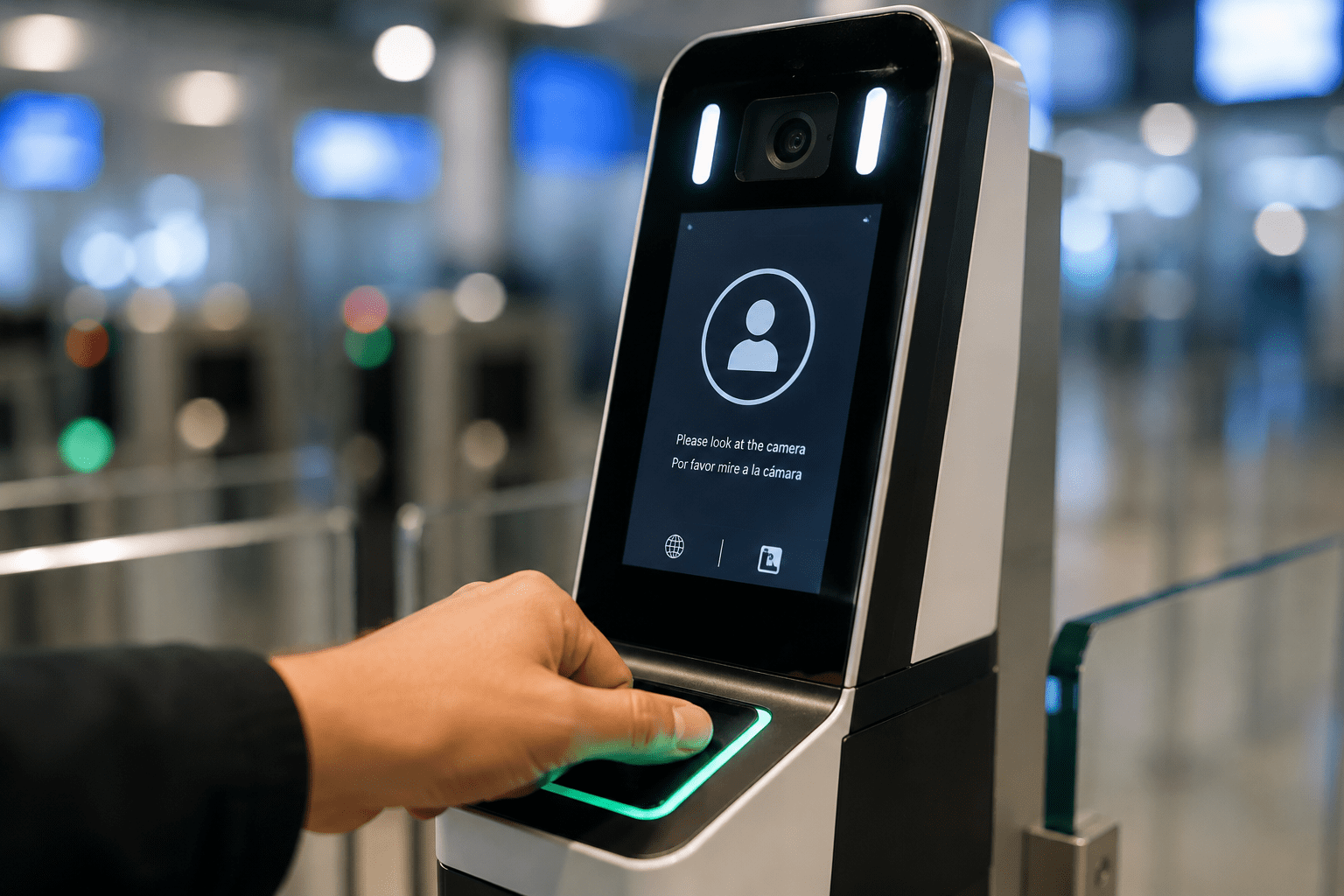
Facial recognition often dominates public discussions around modern border technology. Yet one of the webinar’s central messages was that biometrics should not be viewed as a replacement for immigration officers.
Instead, biometric verification simply confirms a traveller’s identity. Border officers continue to make every admission decision.
As Gerdts noted during the presentation: “Biometrics are about scaling trust, not replacing it.”
The webinar also addressed several common misconceptions surrounding biometric technologies. Contrary to popular belief:
- biometric systems do not automatically retain facial images indefinitely;
- many solutions rely on encrypted mathematical templates rather than photographs;
- national authorities remain responsible for data retention policies and governance.
In other words, biometrics strengthen identity verification while keeping human judgement at the centre of border control.
Operational performance is becoming part of the security equation
For airports, the value of digital identity extends far beyond border security.
More efficient passenger processing translates directly into measurable operational benefits, including:
- shorter queues during peak periods;
- improved passenger throughput;
- better allocation of immigration resources;
- fewer missed flight connections;
- enhanced passenger satisfaction.
These improvements also strengthen airport competitiveness.
Rather than investing exclusively in physical infrastructure, airports can increase processing capacity by making existing border operations more efficient.
The discussion therefore reinforced an important industry trend: operational performance is becoming just as critical as security itself.
Digital identity is shaping the next generation of border management
Looking ahead, the webinar outlined several initiatives that are expected to reshape international travel over the coming years.
Among the most significant developments are:
- ICAO Digital Travel Credentials (DTC);
- Mobile Identity Wallets;
- Interoperable digital identities;
- Regional API/PNR cooperation;
- Closer integration between airports, seaports and other transport modes.
These initiatives all point towards the same objective: allowing verified passenger identities to move securely across different stages of the journey while reducing unnecessary document checks and improving operational coordination.
Rather than functioning as isolated technologies, they form part of a connected digital ecosystem designed to support both security and passenger mobility.
As passenger volumes continue to grow across Latin America and the Caribbean, the industry’s next challenge will not simply be deploying biometric cameras. It will be building border systems capable of combining trusted identity, high-quality passenger data and operational intelligence into a single, seamless process.
That evolution is already underway—and for many airports, it may prove to be one of the defining drivers of competitiveness in the decade ahead.