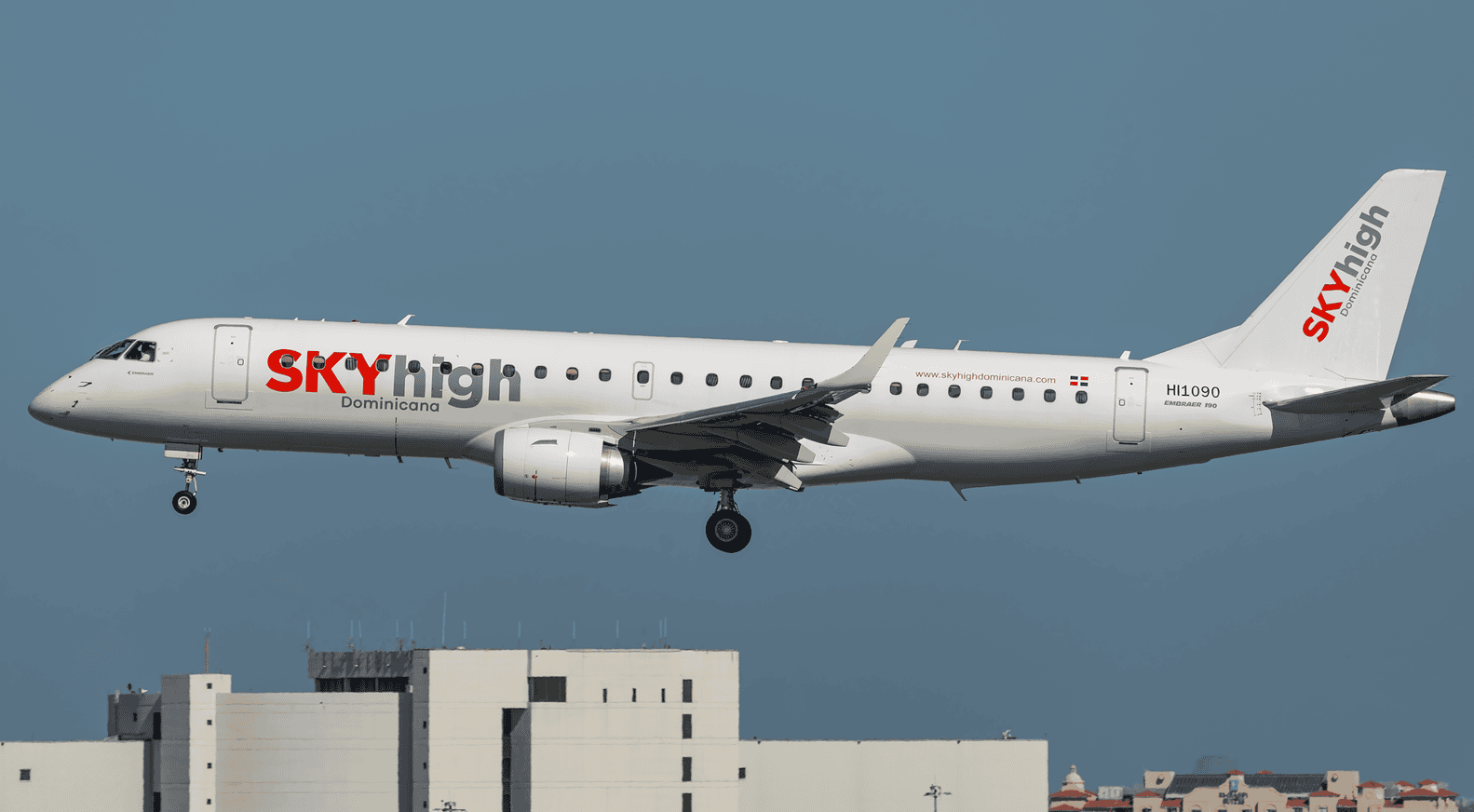
Sky High Aviation Services has marked five years of nonstop operations between Santo Domingo and Martinique, consolidating a regional air link that has progressively moved from a 50-seat regional jet to higher-capacity aircraft.
Launched on July 5, 2021, the service currently operates three times a week between Santo Domingo’s Las Américas International Airport and Martinique Aimé Césaire International Airport, according to airport operator SAMAC. Sky High remains the operating carrier on the nonstop route, connecting Martinique directly with one of the Caribbean’s largest aviation markets.
Five years of sustained regional service
When Sky High entered the Martinique market in July 2021, it initially offered two weekly services using a 50-seat Embraer ERJ 145. The airline has since increased frequencies and maintained its presence despite the operational challenges that often affect smaller intra-Caribbean routes.
The current schedule represents more than a bilateral connection between Martinique and the Dominican Republic. It provides residents, tourists and business travellers with a direct alternative to itineraries requiring connections through airports outside the immediate Caribbean region.
For SAMAC, the five-year milestone supports its wider strategy of strengthening Martinique’s regional accessibility. The airport operator views the continuity of the service as a contribution to tourism, economic activity and cultural exchanges across the Greater Caribbean.
From 50 seats to larger aircraft
The clearest indication of the route’s development has been the progressive increase in aircraft capacity.
Sky High launched the service with the Embraer ERJ 145 before introducing the larger Embraer 190 on the route in August 2022. Configured with 97 seats, including nine in business class and 88 in economy, the E190 nearly doubled the number of passengers that could be carried compared with the original aircraft.
According to SAMAC, the airline has more recently deployed a Boeing 737 with capacity for 143 passengers in the Martinique market. Published flight schedules have shown both Embraer 190 and Boeing 737-700 operations on the route, indicating that aircraft deployment may vary by service or operating period.
The introduction of larger aircraft does not, by itself, provide evidence of the route’s profitability, as no passenger totals or load-factor data were disclosed. It nevertheless points to a substantial increase in the capacity that Sky High is prepared to offer between the two islands.
Santo Domingo broadens Martinique’s regional access
The service also gives Martinique access to Sky High’s network from Las Américas International Airport.
The airline’s published schedule includes services from Santo Domingo to destinations such as Miami, Havana, Bonaire, Georgetown, Antigua, Anguilla, Saint Kitts and Guadeloupe. Available connections depend on operating days and timetable coordination, but the network gives Santo Domingo a growing role as a gateway between Martinique and other Caribbean and American markets.
This network dimension is particularly relevant for an island market where direct regional air services remain limited. Maintaining links through a Caribbean-based hub can support business travel, tourism and mobility within the region without systematically routing passengers through European or North American gateways.
A stronger commercial foothold in Martinique
Sky High has reinforced its local presence by opening a commercial agency inside Martinique Aimé Césaire International Airport. The initiative extends the airline’s involvement beyond flight operations and provides it with a permanent customer-facing presence in the market.
SAMAC President Nathalie Sébastien said the airline’s continued commitment contributes to stronger economic, tourism and cultural exchanges within the Greater Caribbean. For the airport operator, the anniversary also supports its ambition to position Martinique Aimé Césaire as a more prominent regional gateway.
Five years after its launch, the Santo Domingo route illustrates how sustained operations, gradual capacity growth and locally based commercial services can strengthen intra-Caribbean connectivity, even in relatively small island markets.