
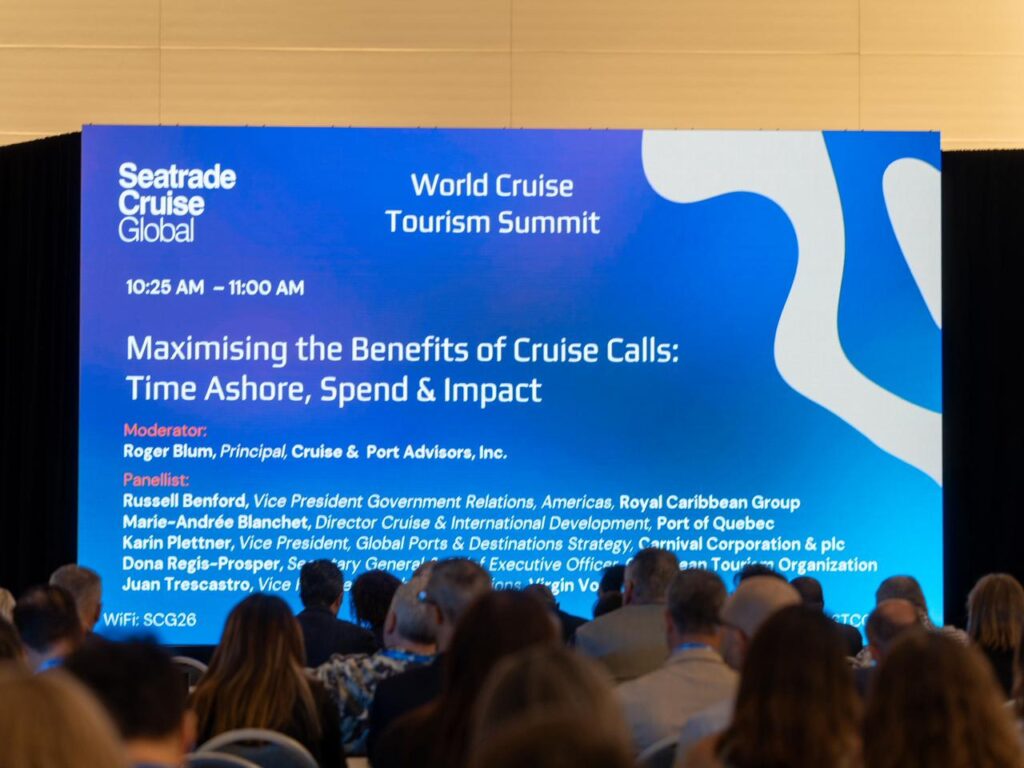
At Seatrade Cruise Global, discussions around cruise growth and passenger volumes often dominate the agenda. Yet during the session “Maximising the Benefits of Cruise Calls: Time Ashore, Spend & Impact,” held on April 13 at the Sunset Vista Salon, the conversation shifted toward a more nuanced question: how is value actually created during a port call?
Bringing together representatives from cruise lines, ports and tourism organizations, the panel explored how time spent ashore translates into economic impact, visitor engagement and long-term destination visibility. The exchanges suggest that maximizing the benefits of cruise calls increasingly depends not only on attracting ships, but on understanding and influencing what happens once passengers — and crew — step ashore.
Rethinking value creation beyond passenger numbers
A central message emerging from the discussion is that the value of a cruise call cannot be measured solely through passenger volumes. While traffic remains important, the panel repeatedly pointed to the need to better understand behaviors, choices and experiences onshore.
Russell Benford, Vice President Government Relations, Americas at Royal Caribbean Group, emphasized the importance of direct passenger feedback, noting that “the greatest source of information is actually the cruise guests.”
This perspective suggests that destinations seeking to increase economic impact must move beyond aggregate data and develop more granular insights into how visitors interact with local environments. Simple tools — such as on-site surveys or real-time feedback collection — were described as effective ways to capture these insights and inform decision-making.
Crew spending emerges as an underleveraged driver
Beyond passenger activity, the discussion highlighted the often-overlooked role of crew members in local economies.
Karin Plettner, Vice President, Global Ports & Destinations Strategy at Carnival Corporation, pointed to how crew behavior can directly influence passenger choices, sharing an example where a location initially popular among crew members later became a preferred spot for guests through onboard recommendations.
Panelists also noted that crew spending patterns differ significantly from those of passengers, with expenditures often directed toward everyday services such as food and retail.
Dona Regis-Prosper, Secretary General and CEO of Caribbean Tourism Organization, highlighted that destinations which actively cater to crew — through transport, services or dedicated amenities — can strengthen both economic impact and visitor experience.
These observations suggest that destinations may benefit from adopting a more deliberate strategy toward crew engagement, recognizing their dual role as both consumers and informal ambassadors.
From visitors to influencers: amplifying destination impact
Another key theme discussed during the panel relates to the growing influence of passengers as digital amplifiers of destinations.
As highlighted by Roger Blum, Principal at Cruise & Port Advisors and session moderator, each cruise call represents not only a flow of visitors but also a network of potential visibility, noting that “everybody on that ship is an influencer.”
With travelers increasingly sharing their experiences online, even a single ship call can generate significant digital exposure. This extends the impact of a cruise visit beyond immediate spending, contributing to destination awareness and future demand.
The discussion also pointed to the growing role of artificial intelligence in travel planning. Russell Benford noted that destinations will increasingly need to understand how digital tools aggregate and recommend experiences, as travelers rely more on AI-driven itineraries.
Local ecosystems at the center of value creation
Underlying these discussions is a broader shift toward recognizing the role of local ecosystems in delivering meaningful cruise experiences.
Marie-Andrée Blanchet, Director Cruise and International Development at the Port of Quebec, highlighted how ports can act as facilitators within their communities, helping local stakeholders connect with cruise flows and enhance the overall visitor experience.
Panelists suggested that improving collaboration between ports, local businesses and communities can help extend time ashore and diversify activities available to visitors.
Implications for Latin America and the Caribbean
For Latin America and the Caribbean, these discussions offer relevant insights into how cruise tourism could evolve at destination level.
The region, already central to global cruise itineraries, stands to benefit from sustained passenger growth. However, the panel suggests that future competitiveness may increasingly depend on how effectively destinations manage and enhance onshore experiences.
Strategies such as collecting and leveraging visitor data, engaging with crew as a distinct market segment, and strengthening collaboration with local stakeholders could play a key role in maximizing economic returns. At the same time, the growing importance of digital visibility and social sharing indicates that destinations may need to rethink how they position themselves within both physical and virtual travel ecosystems.

Reading the road ahead
The discussions from this session suggest that maximizing the benefits of cruise calls requires a broader understanding of value creation.
While time ashore remains a critical factor, it is the combination of visitor behavior, local engagement and digital amplification that ultimately shapes the overall impact of a cruise visit. As the industry continues to evolve, destinations that are able to connect these elements — from data and experience design to community involvement — may be better positioned to capture both immediate and long-term benefits from cruise tourism.
Photo credit : Caribbean Tourism Organization, Lemoneight