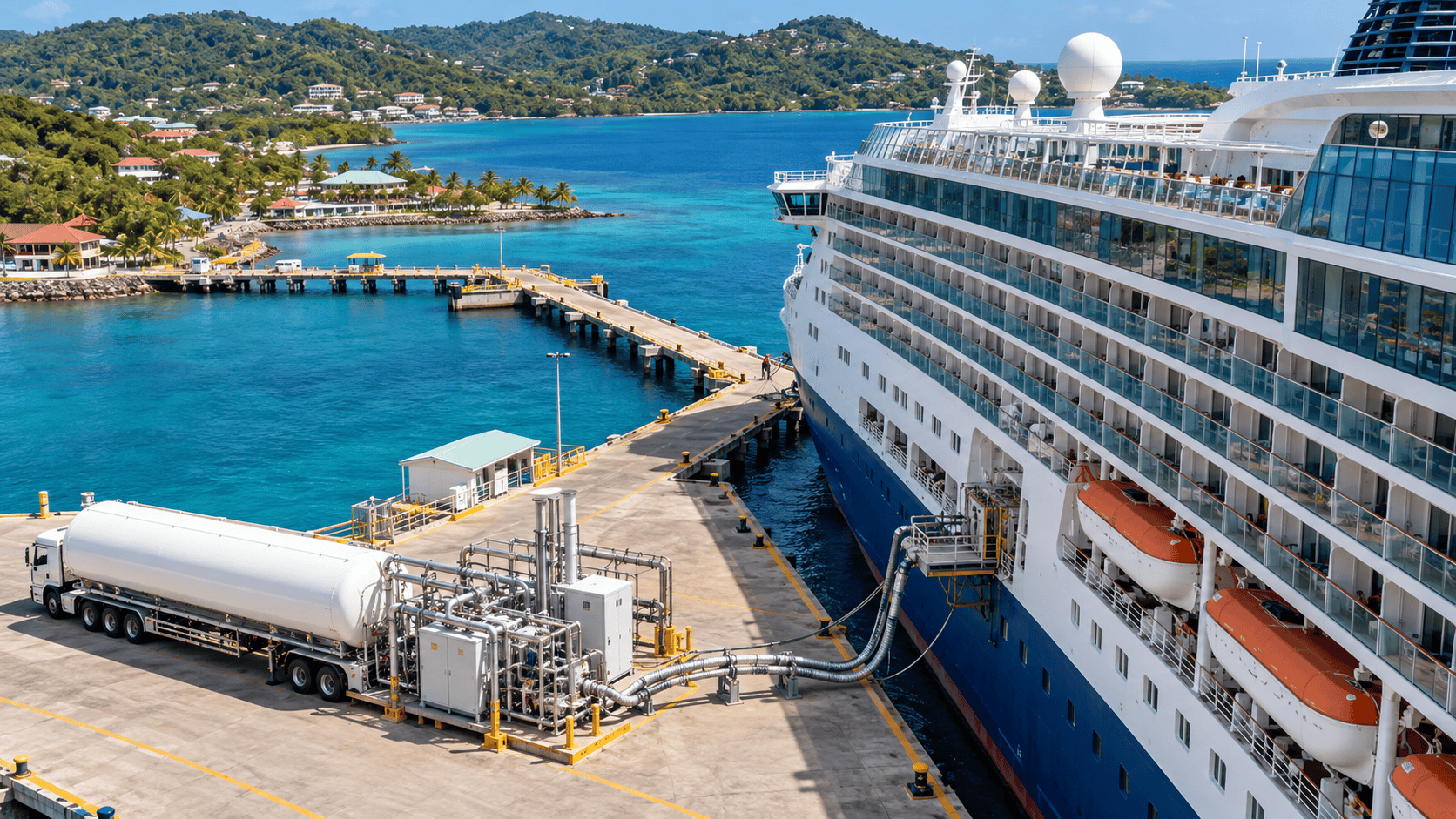
Roatán, Honduras, hosted what Carnival Corporation described as the first cruise LNG bunkering operation in Latin America and the Western Caribbean in June 2026, using a mobile supply solution to refuel Carnival Jubilee. The operation comes as more cruise ships are being designed for alternative fuels and shore power, shifting part of the industry’s decarbonization challenge from ships to ports, fuel suppliers and energy infrastructure.
Cruise companies are investing in ships capable of using different fuels as the maritime sector works toward lower emissions. The infrastructure needed to supply those fuels, however, is developing at a different pace. Roatán offers a first regional example of how ports may respond without waiting for a single dominant fuel or infrastructure model to emerge.
Roatán brings LNG bunkering into the Western Caribbean
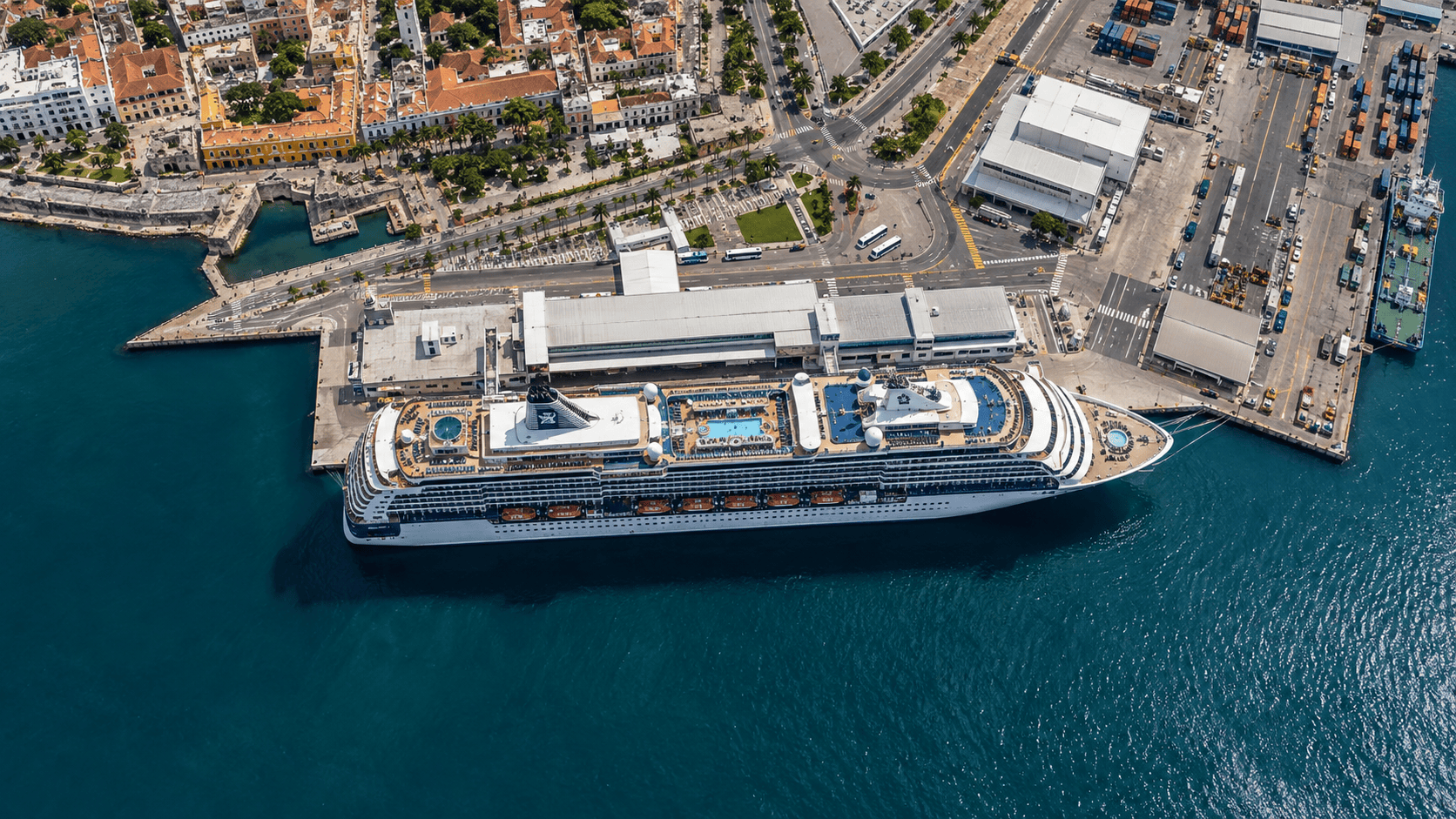
On June 1, 2026, Carnival Jubilee received liquefied natural gas at Isla Tropicale in Roatán, Honduras. Carnival Corporation described the operation as the cruise industry’s first LNG bunkering in Latin America and the Western Caribbean.
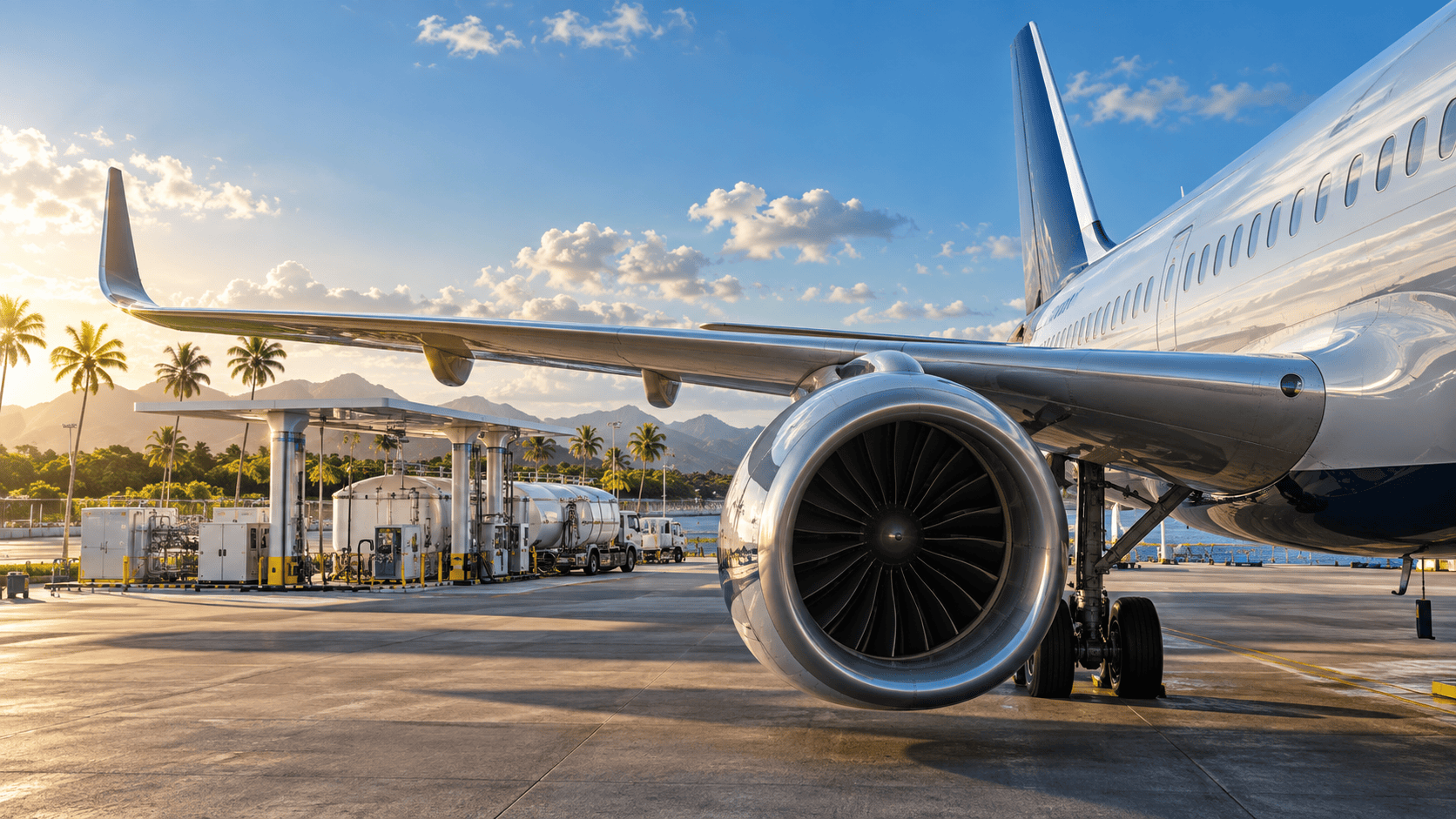
The Roatán operation used a mobile LNG fueling solution, rather than relying on a large permanent bunkering terminal. Carnival Corporation said the location allows LNG-capable ships operating Western Caribbean itineraries to access fuel without significant deviations from their routes.
Michael McNamara, Vice President of Strategic Sourcing – Fuel at Carnival Corporation, positioned the Roatán operation as part of the company’s broader expansion of its LNG bunkering network. Carnival Corporation reported 11 LNG-capable ships in operation in June 2026, with additional vessels planned through 2033.
The use of mobile infrastructure is particularly relevant for Caribbean ports facing uncertainty over future marine fuels. Roatán demonstrates that a port can introduce a new fueling capability through a flexible logistics model, although the available information does not establish whether mobile bunkering is more economical than permanent infrastructure.
Port Everglades in Fort Lauderdale, Florida, provides another 2026 example. The port completed its first shore-to-ship LNG bunkering operation on March 26, supplying Ilma of The Ritz-Carlton Yacht Collection. The two operations show new LNG supply points emerging around cruise routes serving the Caribbean.
Cruise ships are becoming more fuel-flexible
The development of new port infrastructure reflects changes already taking place aboard cruise ships.
In the second-quarter 2026 edition of FCCA’s Travel & Cruise Magazine, journalist Fran Golden examines the sector’s transition toward fuel-flexible propulsion in the article Fueling the Future of Cruise. The article identifies LNG, methanol, biofuels, batteries, hydrogen and carbon-capture technologies among the pathways being tested or prepared by cruise operators.
Bud Darr, President and CEO of Cruise Lines International Association, identifies fuel availability as one of the principal constraints on that transition.
“Fuel supply remains by far the controlling factor,” Darr tells Travel & Cruise Magazine.
The FCCA article also points to a shortage of midstream distribution infrastructure. Producing a lower-emission marine fuel is only one part of the supply chain; the fuel must also be transported, stored and delivered at ports located along viable shipping routes.
New CLIA data released on September 16, 2026, show how quickly the fleet itself is changing. Thirty CLIA-member cruise ships now operate with multi-fuel engines, compared with one in 2018. Based on the August 2026 orderbook, CLIA expects 56 multi-fuel-capable ships to be in service by the end of 2030 and 69 by 2039.
The figures illustrate why fuel infrastructure is becoming a strategic port issue. A ship capable of using several fuels gains flexibility only when the corresponding energy source is available at the right location, at sufficient scale and under commercially viable conditions.
Nassau and Panama pursue different infrastructure models
Nassau, the Bahamas, is pursuing a significantly different model from Roatán.
The Arawak Cay LNG Project in New Providence is designed to provide 70 MW of LNG-fueled electricity and deliver shore power to ships at Nassau Cruise Port. The project includes LNG reception, storage and regasification infrastructure alongside electricity generation and transmission equipment.
Island Power Producers continued to report construction progress at Arawak Cay in August 2026. The project therefore represents infrastructure under development rather than an established cruise shore-power service already available across Nassau Cruise Port.
The Nassau project demonstrates the complexity behind shore power. Supplying electricity to a large cruise ship at berth can require fuel infrastructure, electricity generation, transmission capacity and ship-to-shore connection equipment working as one system.
Panama offers another approach through the Costa Norte LNG Terminal in Colón. The AES-operated facility includes a 180,000-cubic-metre LNG storage tank, a jetty capable of handling vessels ranging from small-scale LNG carriers to large ships, and truck-loading facilities.
Costa Norte has also been used to develop smaller-scale LNG distribution beyond Panama. AES previously demonstrated a multimodal supply chain using ISO containers to transport LNG from Panama to Colombia, illustrating how a large terminal can support markets beyond its immediate location.
The available evidence does not establish that large numbers of cruise ships are already bunkering LNG at Costa Norte in 2026. Panama’s importance to the discussion lies instead in the infrastructure and logistics capacity that can support a wider regional energy network.
Shore power reveals the infrastructure gap
Shore power provides perhaps the clearest indication that ship technology is advancing faster than port infrastructure.
Cruise Lines International Association reported in September 2026 that 193 cruise ships are already capable of connecting to onshore power. Those vessels represent 65% of reporting ships and 72.5% of reporting passenger capacity.
Only 40 cruise ports worldwide, representing fewer than 3% of cruise ports, currently offer onshore power at at least one cruise berth, according to CLIA.
Onshore power allows compatible cruise ships to switch off their engines while alongside and draw electricity from the local grid. The emissions benefit depends on the electricity mix supplying the port, meaning that installing the physical connection is only part of the transition.
The gap between 193 compatible ships and 40 equipped ports illustrates the broader infrastructure challenge facing maritime decarbonization. Cruise companies can install shore-power connections or fuel-flexible engines aboard their vessels, but ports, energy companies and governments must develop the systems that make those technologies usable.
LNG also requires careful positioning within that transition. Liquefied natural gas is not a zero-carbon fuel. LNG remains a fossil fuel, although cruise operators use it as a lower-emission pathway compared with conventional marine fuels and as a potential bridge toward renewable or synthetic alternatives that may use similar infrastructure in the future.
The long-term question for Caribbean ports is therefore not simply whether to invest in LNG, methanol or shore power. The more difficult question is how to develop infrastructure that remains useful while the maritime energy mix continues to evolve.
Roatán’s mobile bunkering model, Nassau’s shore-power project and Panama’s LNG logistics infrastructure represent three different responses to that uncertainty. Together, the three cases show that cruise decarbonization is increasingly becoming an infrastructure challenge on land as much as a technology challenge at sea.
Sources: FCCA – Travel & Cruise Magazine, Q2 2026; CLIA – Environmental Technologies and Practices Report 2026; Carnival Corporation – Roatán LNG Bunkering; Bahamas DEPP – Arawak Cay LNG Project EIA; Autoridad Marítima de Panamá – AES Colón LNG Terminal; AES – LNG and Bunkering Infrastructure
What happened in Roatán in June 2026?
Carnival Corporation used a mobile LNG supply solution to refuel Carnival Jubilee at Isla Tropicale in Roatán, Honduras, on June 1, 2026. Carnival described the operation as the cruise industry’s first LNG bunkering in Latin America and the Western Caribbean.
Is LNG a zero-carbon fuel for cruise ships?
No. LNG remains a fossil fuel and does not eliminate greenhouse-gas emissions. Cruise companies currently use LNG as one lower-emission pathway while preparing for renewable and near-zero-emission fuels.
What is shore power for cruise ships?
Shore power allows a compatible cruise ship to connect to electricity supplied from land while berthed, reducing or eliminating the need to run its auxiliary engines in port.
Are Caribbean ports ready for alternative-fuel cruise ships?
Readiness varies by port and technology. Roatán has demonstrated mobile LNG bunkering, Nassau is developing cruise shore-power infrastructure, and Panama has large-scale LNG storage and distribution capabilities, while many other ports have yet to document comparable systems.