Curaçao has brought the Queen Emma Bridge in Willemstad into a new operating phase after replacing its fuel-powered propulsion with an electric drive and renewing key electrical, mechanical and structural systems. The project matters beyond emissions: the floating bridge must simultaneously connect Punda and Otrobanda, open for vessels using St. Anna Bay and preserve one of Willemstad’s most recognizable historic structures.
A bridge that is part of the port
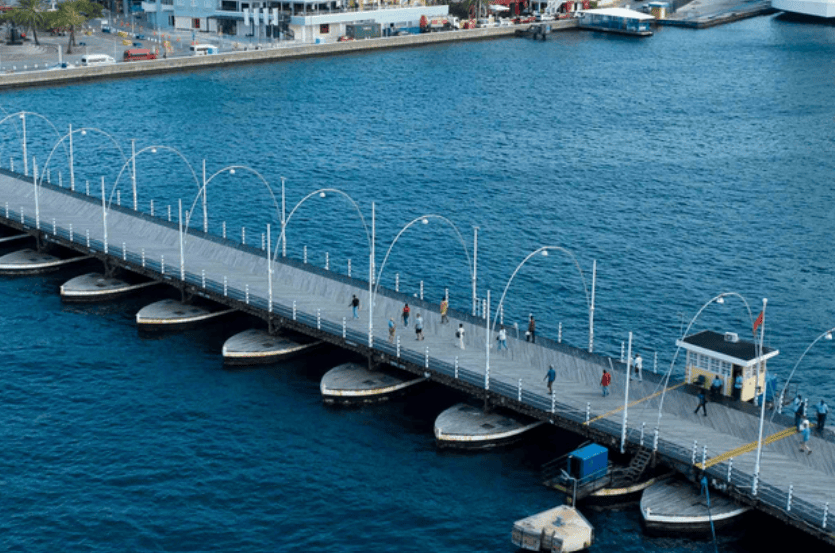
The Queen Emma Bridge in Willemstad, Curaçao, opened in 1888 across St. Anna Bay and created a direct pedestrian connection between the historic districts of Punda and Otrobanda. The floating structure rests on pontoons and swings laterally to allow vessels to enter and leave the Port of Willemstad.
The Queen Emma Bridge therefore performs more than an urban mobility function. The bridge’s ability to move forms part of the operating interface between Willemstad and its harbour: pedestrians need a reliable crossing between Punda and Otrobanda, while maritime traffic needs the same structure to clear the navigation channel when ships pass through St. Anna Bay.
Curaçao Ports Authority (CPA) has maintained that balance through several previous interventions. Approximately 95% of the Queen Emma Bridge was replaced during a major renovation in 2006, while the upper layer of the wooden deck was renewed in 2015.
From fuel-powered propulsion to electric drive
The 2026 modernization changes one of the Queen Emma Bridge’s most important operating systems. Curaçao Ports Authority replaced the existing fuel-powered propulsion with an electric drive system, eliminating the need for gasoil during normal propulsion operations. CPA says the change removes exhaust emissions and smoke from the propulsion engines and reduces environmental risks associated with fuel and oil spills.
By late September 2026, the Queen Emma Bridge had entered a new phase following completion of the major modernization works. Around four kilometres of new electrical cabling were installed, while the previous propulsion equipment — in service since 1987 — was replaced after almost four decades of operation.
The new electrical infrastructure does more than power the bridge’s propulsion. The renewed system also supplies security cameras, safety barriers and lighting, with streetlights, navigation lights and other lighting equipment upgraded using LED technology.
More than an engine replacement
The Queen Emma Bridge Electrification Project was designed as a broader technical overhaul rather than a standalone propulsion conversion. Curaçao Ports Authority combined the new electric drive with a new motor pontoon, new control cabin, renewed electrical cabling and switchgear, structural work and maintenance of mechanical components on both sides of St. Anna Bay.
Aqualectra also installed a new transformer at Otrobanda and the associated power cables needed to connect the Queen Emma Bridge to its new electrical system. Final testing and commissioning formed part of the programme before the bridge could return to normal operation.
Holland Shipyards Group led the renovation and electrification under a contract awarded by Curaçao Ports Authority in January 2026. Royal Van der Leun was responsible for major parts of the electrical scope, including the electrical installation of the new motor pontoon, shore-side distribution equipment, bridge cabling, CCTV and parts of the lighting system.
Giving the old motor pontoon a second role
The Queen Emma Bridge consists of 16 pontoons, including two fixed pontoons. Curaçao Ports Authority removed the existing motor pontoon during the project and sent it to a workshop for reconditioning rather than discarding it.
Once refurbished, the former motor pontoon is intended to replace one of the Queen Emma Bridge’s two fixed pontoons, while a newly built motor pontoon equipped with the electric drive takes over the propulsion function.
The reuse is a relatively small element within the overall programme, but it illustrates how a modernization project can extend the service life of existing maritime infrastructure while introducing entirely new operating technology.
Keeping Punda and Otrobanda connected
The main works on the Queen Emma Bridge were scheduled between 2 August and 25 September 2026, requiring the floating crossing to be taken out of service for an extended period. Curaçao Ports Authority used the closure to combine electrification with structural, mechanical and maintenance work that would otherwise have required multiple interventions.
Pedestrian connectivity remained a separate operational requirement during the works. Ferry services between Punda and Otrobanda in Willemstad were expanded to operate 24 hours a day, seven days a week, ensuring continued movement across St. Anna Bay while the bridge was unavailable.
The temporary ferry arrangement shows why the Queen Emma Bridge is not simply an engineering asset. Taking the structure out of service immediately affects everyday urban movement between two central districts of Willemstad.
Modernizing the machinery without changing the landmark
Curaçao Ports Authority has repeatedly emphasized that the Queen Emma Bridge’s recognizable appearance and historic identity should remain intact despite the technical transformation underneath it. The floating pedestrian connection continues to link Punda and Otrobanda while retaining the form that has defined Willemstad’s waterfront for generations.
The result offers a useful port-city lesson beyond Curaçao. Decarbonization in ports is often associated with shore power, cargo-handling equipment, alternative fuels or electric harbour craft. The Queen Emma Bridge shows another layer of the transition: the infrastructure connecting a port to its city can also be modernized without replacing the urban and maritime functions that made it valuable in the first place.
For Willemstad, the challenge was not simply to electrify a bridge. Curaçao had to modernize a structure that serves pedestrians, vessel traffic and the historic waterfront at the same time.
The Queen Emma Bridge may now move differently, but its fundamental role remains unchanged: keeping Willemstad connected while making way for the ships that keep its harbour moving.
Sources: Curaçao Ports Authority
FAQ
When was the Queen Emma Bridge built?
The Queen Emma Bridge opened in 1888 across St. Anna Bay in Willemstad, Curaçao.
What changed during the 2026 project?
Curaçao Ports Authority replaced the fuel-powered propulsion with an electric drive and renewed electrical, mechanical, structural, control and safety systems.
Why does the Queen Emma Bridge move?
The floating bridge swings open so vessels can enter and leave the Port of Willemstad through St. Anna Bay.
How were pedestrians connected during the closure?
Ferries between Punda and Otrobanda operated 24 hours a day, seven days a week while the Queen Emma Bridge was out of service.