
The CARICOM Multilateral Air Services Agreement has been signed by twelve Caribbean states but contains no superseding clause over earlier bilateral agreements. More than twenty civil aviation authorities coexist in the region with differentiated requirements on landing permits. The NACO/ACI-LAC study released in March 2026 documents the paradox of a liberalisation that is effective only on paper. A decoding.
The policy and regulatory framework for aviation varies across Caribbean countries, with key regulatory areas such as pilot licensing, aircraft certification, air operator certification, and safety and security oversight placed under the jurisdiction of national civil aviation authorities. This is how the study The State of Air Connectivity in the Caribbean, commissioned by ACI-LAC to NACO and published in March 2026, opens its section on regulatory fragmentation. Behind this diplomatic phrasing lies a precise finding: despite several regional initiatives in favour of harmonisation, real and effective alignment across Caribbean countries remains a challenge.
MASA: a multilateral Open Skies with incomplete clauses
The study documents precisely the central multilateral instrument in the region: the CARICOM Multilateral Air Services Agreement (MASA). The report acknowledges that MASA usefully expands the scope of market access rights available to CARICOM-designated airlines to seventh freedom and cabotage, including a series of operational flexibility provisions similar to those proposed by the LACAC Open Skies Agreement and the U.S. Model Open Skies Agreement Text.
Signatory parties to MASA include a number — but not all — of Caribbean states: Antigua and Barbuda, Barbados, Dominica, Grenada, Guyana, Haiti, Jamaica, Saint Kitts and Nevis, Saint Lucia, Saint Vincent and the Grenadines, Suriname, and Trinidad and Tobago. But it is precisely what the text does not contain that matters. NACO states clearly that, in addition to uneven ratification of MASA, no superseding clause was inserted in the text of the agreement. This means that restrictive provisions in existing bilateral air services agreements between CARICOM Member States continue to apply.
Over twenty authorities, just as many procedures
Beyond MASA, the study documents the plurality of national civil aviation authorities and their procedural divergences. While the regional Eastern Caribbean Civil Aviation Authority (ECCAA) promotes a collective and uniform approach among its members, other islands have opted for a country-based approach to the policy and regulatory aspects relevant to fostering air connectivity.
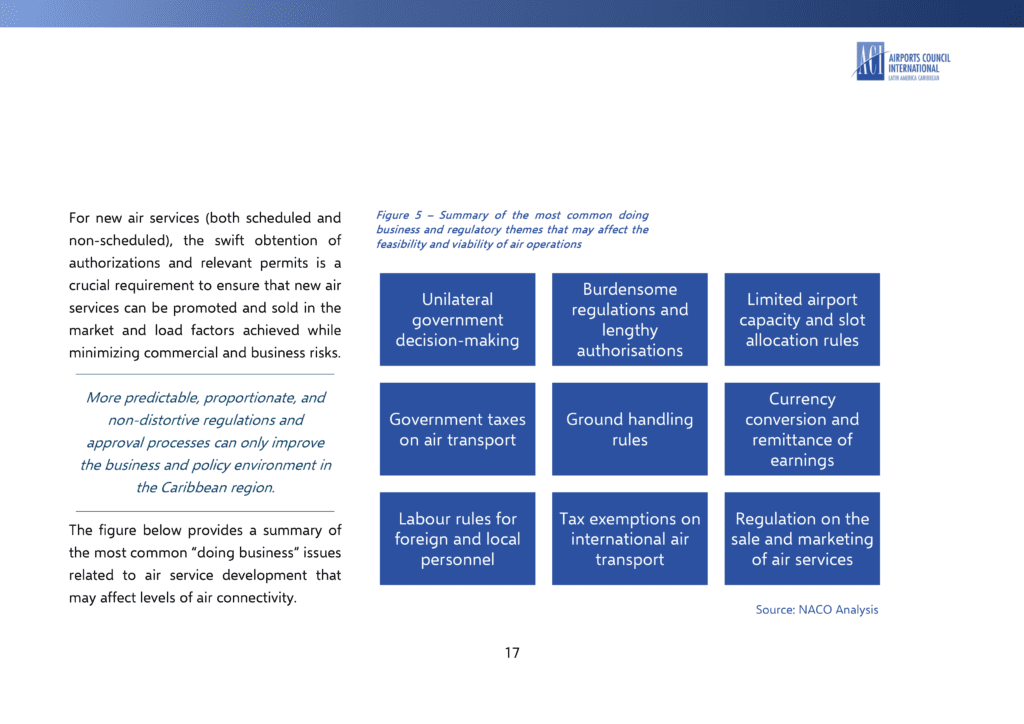
Concretely, the report observes that Caribbean countries have different requirements for landing permits, with significant differences in required application times and documentation. Some countries require special application procedures, adding to airlines’ administrative burden. The imposition of unreasonably lengthy authorisation processes for new air services, including one-time charter operations, was flagged by several airport executives interviewed for the study. The report notes that such processes can result in the cancellation of planned flights, due to airlines’ inability to market and sell new services on time.
Differentiated charges as the exception, not the rule
Within this fragmentation, the report identifies a few notable initiatives. The Dutch Caribbean Cooperation of Airports (DCCA) introduced in 2024 a reduced Passenger Facility Charge of USD 15 for passengers arriving from other Dutch Caribbean islands — significantly lower than the USD 41 charged to other international travellers. Dominica applies a passenger service charge roughly 35% lower for CARICOM nationals compared with non-CARICOM foreign visitors.
But these moves remain isolated. Region-wide, taxes and charges range from USD 20 to USD 90 per passenger depending on the country. Several Caribbean states — Barbados, Saint Lucia, Antigua and Barbuda, Curaçao, Sint Maarten, Trinidad and Tobago, Puerto Rico, Dominica — impose no air travel taxes, while others stack several: aviation tax, tourism tax, sanitary tax, immigration fee, solidarity tax. The report notes that there is no consistency across the region in the way governments approach aviation taxation.
Harmonisation or convergence: a paradigm shift
Faced with this picture, the study formulates an important paradigm shift. One of the region’s policy agenda items has been the aspirational goal of regulatory harmonisation — albeit with a certain level of vagueness on what it actually entails for governments. In practice, NACO writes, proposals in favour of regulatory harmonisation promote higher levels of regulatory uniformity, similar to that of the European Union, in a naturally fragmented region such as the Caribbean.
Against this ambition, the report sets out a distinct concept: regulatory convergence. Where harmonisation aims for maximum uniformity, convergence points to a multilateral or bilateral process whereby regulatory requirements across countries become more similar or aligned on common principles, frameworks, rules and standards. In the Caribbean context, NACO writes, regulatory convergence is a more suitable and realistic approach to align multiple regulatory regimes and promote intra-regional connectivity in the short term — both practically and politically.
The European lesson: twenty years for a partial convergence
To calibrate that ambition, the study draws on the reference experience. It has taken the European Commission more than twenty years to progress regulatory convergence with non-EU partners, and even today the aspiration of a single and cohesive aviation market seems unfinished. The report draws a clear cautionary signal: Caribbean stakeholders should be cautiously optimistic about multilateral solutions that may take years or even decades to materialise.
The closing article of this series will bring together the five concrete levers NACO recommends to break this logic: targeted bilateral approach, pragmatic regulatory convergence, regional connectivity incentive schemes, holistic travel journey vision, and effective rather than paper liberalisation.
Source : NACO (Netherlands Airport Consultants), The State of Air Connectivity in the Caribbean: A Renewed Vision for Progress, independent study commissioned by ACI-LAC, March 2026, 128 pages. Data sources: sections 2.3, 4.7 and 5.2.2.