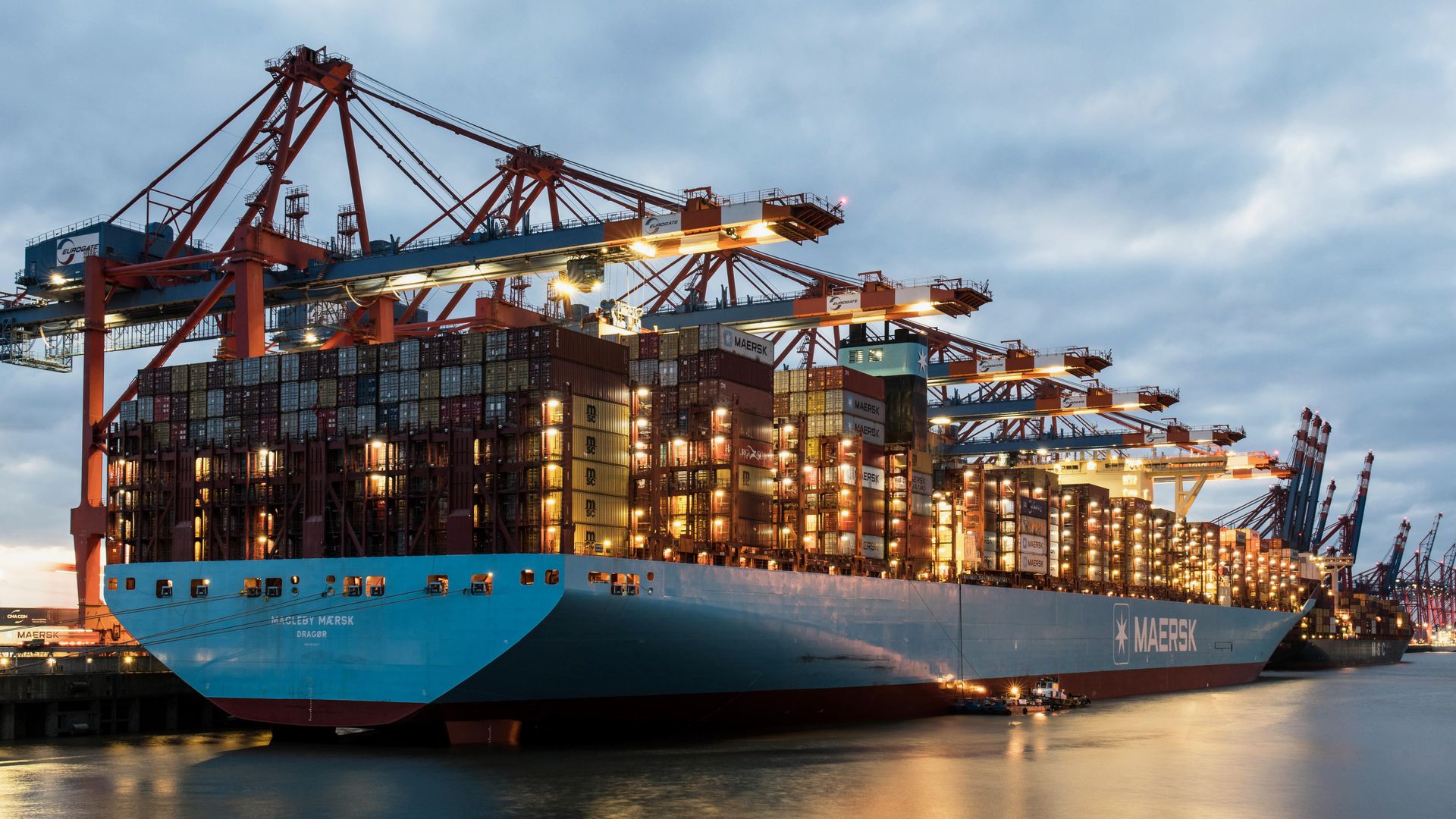
Maersk has announced a US$500 peak season surcharge on dry container shipments from Brazil, Paraguay, Uruguay and Argentina to the Caribbean and U.S. Gulf Coast, effective October 8, 2026. The shipping company will also apply a US$1,000 surcharge on shipments from the same origins to the west coast of South America.
In a tariff announcement published on September 8, 2026, Maersk introduced and revised its Peak Season Surcharge (PSS) for selected South American trade corridors. The measure covers all dry container sizes and is calculated per container rather than per twenty-foot equivalent unit (TEU). Its application depends on the pricing conditions associated with each booking.
Two Surcharge Levels for South American Cargo
Maersk’s new tariff schedule establishes two distinct surcharge levels for shipments originating in Brazil, Paraguay, Uruguay and Argentina. Dry containers bound for the Caribbean and U.S. Gulf Coast will be subject to a US$500 charge, while shipments to the west coast of South America will carry a US$1,000 surcharge.
The September 8 announcement applies specifically to dry containers. Maersk does not identify refrigerated containers or non-containerised cargo as part of the measure. The company also does not provide a detailed list of individual ports covered by the new rates.
Maersk describes the measure as an introduction and revision of its existing Peak Season Surcharge framework. The announcement provides the new tariff levels but does not specify the previous charges for each corridor, making it impossible to determine the exact net increase for individual shipments.
October 8 Implementation Depends on Booking Conditions
Maersk has set October 8, 2026, as the effective Price Calculation Date (PCD) for the revised surcharges. The applicable date varies according to the booking category.
For standard non-Spot bookings outside the jurisdiction of the U.S. Federal Maritime Commission (FMC), Maersk uses the scheduled departure date of the first sea leg at the time of booking confirmation. For non-Spot bookings subject to FMC rules, the relevant date is the final container gate-in date. Spot bookings use the booking confirmation date.
Maersk also specifies that the announced amounts remain subject to other applicable charges, including local and contingency surcharges. The US$500 and US$1,000 figures therefore represent individual tariff components rather than complete ocean freight prices.
The September 8 announcement does not specify an expiry date for the revised surcharge levels.
Hapag-Lloyd Also Announces October Rate Adjustments
Hapag-Lloyd has separately announced a General Rate Increase (GRI) effective October 1, 2026, on several trade corridors originating on the east coast of South America.
The German shipping company will introduce a US$500 increase per dry container on its GS1 service connecting South America’s east coast with North America, Central America and the Caribbean. Hapag-Lloyd has also announced a US$1,000 increase per dry container on its CON service to South America’s west coast and a US$300 adjustment on its SEC service to North America’s east coast.
Maersk’s Peak Season Surcharge and Hapag-Lloyd’s General Rate Increase are separate commercial measures, with different implementation dates and tariff structures. Both announcements concern freight pricing on South American routes, but neither establishes a uniform increase across all shipping companies.
For shippers and freight forwarders operating between South America and the Caribbean, the announced adjustments make booking dates, container categories and contractual conditions important factors in determining the applicable transport charges.
How much is Maersk’s new Caribbean surcharge?
Maersk has announced a US$500 peak season surcharge per dry container from Brazil, Paraguay, Uruguay and Argentina to the Caribbean and U.S. Gulf Coast.
When does Maersk’s surcharge take effect?
The effective date is October 8, 2026, subject to the Price Calculation Date applicable to each booking.
Which South American countries are affected?
Maersk identifies four countries of origin: Brazil, Paraguay, Uruguay and Argentina.
Does the surcharge apply to refrigerated containers?
Maersk’s September 8 announcement covers dry containers. Refrigerated containers are not explicitly included in the announced measure.